
What Is Client Acquisition?
Client acquisition is the process a business uses to attract, qualify and win new clients. It covers every step from the first time a stranger hears about you to the day they sign and work begins. It blends marketing, sales and follow-up, and it is usually measured by how many clients you win and what each one costs.
People often use “client acquisition” and “customer acquisition” to mean the same thing. The word “client” usually signals a higher-touch sale, where you deliver a service shaped around one account’s needs. A customer, by contrast, often buys in one-off or occasional transactions without personal attention.
Client acquisition is also bigger than lead generation. Lead generation captures interest. Client acquisition turns that interest into signed work.

Client Acquisition in a Sentence
Our client acquisition plan was to post once on LinkedIn and wait, which is a great strategy if your goal is a very quiet inbox.
Key Takeaways
- Client acquisition covers the full path from first contact to a signed client. It is not one campaign or one sales call.
- Lead generation is one part of it. Acquisition only ends when someone becomes a paying client.
- The core number to track is customer acquisition cost (CAC). What you spend on sales and marketing divided by the new clients you win.
- Winning the right clients matters more than winning any client. A poor-fit client costs you time, margin and focus.
How Client Acquisition Works
Most acquisition systems follow the same five steps.
- Define the client you want. Write down the industries, problems, budget and project size that fit your business. Write down who you will turn down, too.
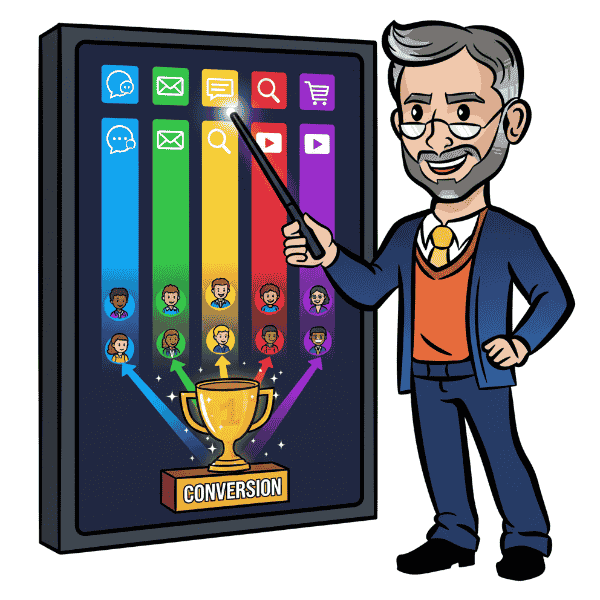
- Attract attention. Use content, ads, partnerships, outreach and word of mouth. Most firms mix several channels, which is called multi channel lead generation. Direct outreach to target accounts falls under sales prospecting. Happy clients can feed this step through client referral programs.
- Qualify the lead. Check need, budget, timing and fit before you spend hours on a proposal.
- Win the work. Run the discovery call, send a clear proposal, handle objections and agree on scope.
- Start well. Onboarding is the last step of acquisition. After that, retention takes over, whether through good service or a customer loyalty program.
Most guides stop at volume. They count leads and ignore fit. The better question is not how many clients you can win, but how many good ones you can serve well. Capacity matters too. If you win more work than your team can deliver, quality drops and the new client leaves.
To measure the whole system, use this formula:
CAC = total sales and marketing spend ÷ number of new clients won
Pick a fixed period, such as a month or a quarter. Count everything you spend to win clients, including ads, sales and marketing time and software. Then break the number down by channel to see which sources earn their keep.
Client Acquisition Example
Imagine Brightside Bookkeeping, a made-up firm that serves small dental practices. In one month it spends $4,000 on sales and marketing: $1,500 on ads, $2,000 on a part-time sales rep and $500 on software.
That effort produces 100 leads. Of those, 20 are qualified, 8 get a proposal and 4 sign.
CAC = $4,000 ÷ 4 = $1,000 per client.
Now suppose each new client pays $500 a month and stays for a year. That is $6,000 in revenue per client against a $1,000 cost to win them, so the math works. If clients left after one month, the same CAC would be a problem.
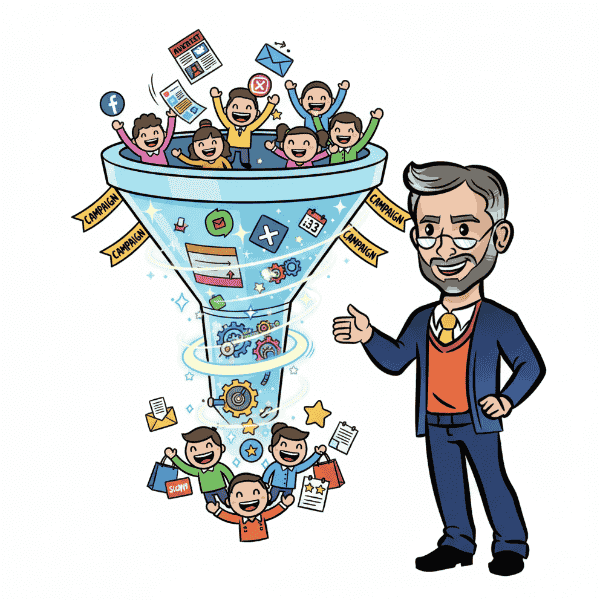
The funnel also shows where to improve. The biggest drop is between leads and qualified leads, so better targeting would help most. Before spending more on ads, Brightside should also check that its team can take on more than four new clients a month.
These are made-up round numbers. They only illustrate how the concept works and are not real results or industry benchmarks.
Common Client Acquisition Mistakes
- Chasing every lead. Not every client is good for your business. Some need things outside your expertise or cost more to serve than they pay. Avoid it by writing a clear suitable-client definition and qualifying every lead against it before you send a proposal.
- Relying on one channel. If all your clients come from one referral partner or one ad platform, a single change can empty your pipeline. Avoid it by tracking where each client came from and testing a second channel.
- Ignoring retention. Harvard Business Review notes that, depending on the study and industry, winning a new customer can cost anywhere from five to 25 times more than keeping an existing one. Avoid it by planning onboarding and regular check-ins before the contract is signed.
- Not tracking CAC. Spending without knowing your cost per client makes it impossible to tell what works. Avoid it by calculating CAC every month and by channel.
Next Step
Want help putting this into practice in your funnel? Book your free strategy session with Sales Funnel Professor!
Client Acquisition FAQs
What Is the Difference between Client Acquisition and Lead Generation?
Lead generation captures initial interest, such as a form fill or an inquiry. Client acquisition is the whole process that follows, from qualifying that interest to winning the work and starting delivery. Lead generation is one component. A business can generate plenty of leads and still acquire very few clients if qualification and sales are weak.
Is Client Acquisition the Same as Customer Acquisition?
Often, yes. Many companies use the terms interchangeably. The difference is mostly in the sale. Client acquisition usually describes services, longer relationships and a more personal sales process. Customer acquisition often describes products and shorter, repeat transactions. The steps and the cost formula are the same either way.
How Do You Calculate Client Acquisition Cost?
Divide your total sales and marketing spend for a period by the number of new clients you won in that period. Include ads, software, and the time your team spends on sales and marketing. If you spend $4,000 and win 4 clients, your CAC is $1,000. Track it monthly and by channel.
What Are the Main Client Acquisition Channels?
The most common channels are referrals, content and search engine optimization, paid ads, email and direct outreach, social media and partnerships. Which ones work best depends on who your clients are and how they buy. Start with the one or two closest to your ideal client, measure the cost per client, then add more.
Related Terms
- Lead generation — The top-of-funnel step that captures interest, which client acquisition then turns into signed work.
- Multi-channel lead generation — Using several channels at once to attract prospects, which spreads the risk of relying on one source.
- Sales prospecting — The active search for and outreach to potential clients, which feeds the early stages of acquisition.
- Client referral programs — A way to win new clients through the people you already serve.
- Customer loyalty program — What often comes next, keeping the clients you worked hard to acquire.
Sources
- Customer Acquisition Cost (CAC): How to Calculate and Reduce It — TechTarget
- Client Acquisition — Surface Marketing Foundations Glossary
- Client vs. Customer — Shopify
- What Is Client Acquisition? — Admetrics
- Client Acquisition vs. Client Retention — Built In
- The Value of Keeping the Right Customers — Harvard Business Review
- Firing the Right Customers Is Good Business — MIT Sloan Management Review