
Table of Contents
What Is a Real Estate Sales Funnel? (And Why It Matters in 2026)
The Core Stages of a Real Estate Sales Funnel
Stage 1: Awareness – How Serious Agents Get Found by the Right Prospects
Stage 2: Interest – Turning Traffic Into Trackable Leads
Stage 3: Consideration – Nurturing Leads Over 3–6 Months
Stage 4: Intent – Capturing “I’m Ready” Signals Fast
Stage 5: Evaluation – Winning the “Agent vs. Agent” Decision
Stage 6: Purchase – Managing the Transaction Without Dropping the Ball
Stage 7: Loyalty & Referrals – Building a Compounding Client Base
Specialized Real Estate Sales Funnels by Client Type
Digital-First Real Estate Sales Funnel Architecture
Key Metrics & KPIs for a High-Performing Real Estate Sales Funnel
Tech Stack & Automation for Real Estate Agents
Designing Your Real Estate Sales Funnel Strategy (Step-by-Step)
Common Funnel Mistakes Real Estate Agents Make (And How to Fix Them)
How Sales Funnel Professor Helps Real Estate Agents Build Revenue-Ready Funnels
A sales funnel for real estate agents is a structured, measurable system that guides prospects from first discovering your services through closing and into long-term loyalty as referral sources. If you’re a solo agent or team leader reading this, you likely already have pieces of a funnel scattered across your business: an IDX website, a CRM you half-use, open houses that generate sporadic leads, maybe some social media content. What you probably don’t have is a cohesive system that tracks conversion at every stage.
The standard industry conversion rate for real estate leads ranges from 0.4% to 1.2%, meaning for every 100 leads, only 1-2 typically convert to transactions. Top-performing agents push these numbers into the 2-3%+ range through deliberate funnel management. The difference isn’t luck—it’s architecture.
Sales Funnel Professor is a revenue-focused consultancy that designs and optimizes these funnels for agents, brokerages, and real estate teams. This article will give you the framework we use with clients.
What this article covers:
For agents who want a system that actually converts rather than a collection of disconnected tools, engaging a funnel building service ensures every page, form, and automation works together from day one.
Because real estate funnels must juggle long sales cycles, multiple client types, and hyper-local messaging, working with a funnel strategist who understands those dynamics can shave months off the learning curve.
Agents who would rather spend their hours with clients than wrestling with landing pages and automation workflows increasingly turn to done-for-you funnel services that handle the technical heavy lifting.
- The 7 core stages of a real estate sales funnel
- Specialized funnels by client type (first-time buyers, investors, luxury, sellers)
- Key metrics and KPIs for each stage
- Tech stack and automation recommendations
- Step-by-step implementation guidance
- Common funnel mistakes and how to fix them
What Is a Real Estate Sales Funnel? (And Why It Matters in 2026)
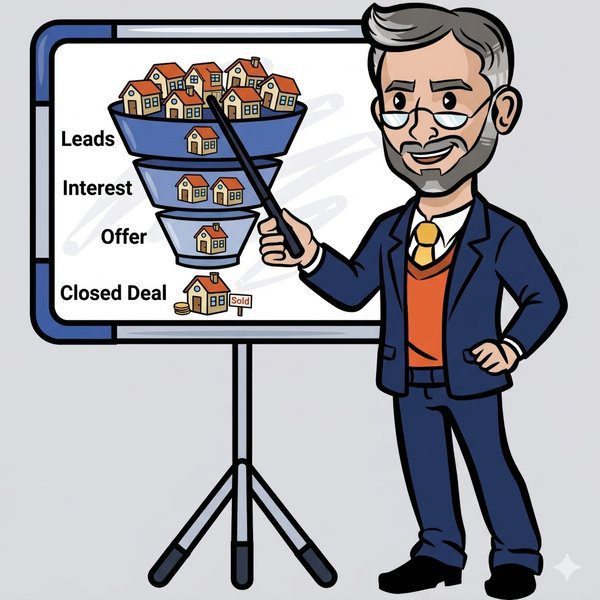
A real estate sales funnel is a mapped, trackable path that moves a stranger through awareness, interest, consideration, intent, evaluation, purchase, and ultimately into loyalty as a repeat client or referrer. It transforms chaotic lead generation into a predictable system for agents.
Most agents operate what we call a “hope-based” process: random leads flow in from various sources, sporadic follow up happens when someone remembers, and deals close more by accident than design. A deliberately designed funnel defines each funnel stage, assigns specific offers and touchpoints, and measures conversion at every step.
The real estate business has unique dynamics that make funnels essential:
| Long sales cycles | The buying or selling process often takes 3-9 months from first contact to close |
| Infrequent, high-value transactions | Clients buy or sell every 7-10 years on average |
| Trust-dependent decisions | High-value property decisions often take months, making consistent nurturing critical |
Effective sales funnels typically include stages such as awareness, interest, consideration, intent, decision, and conversion. Realistic benchmarks for 2026 include response time under 5 minutes, email open rates around 20%, and appointment-set rates of 15-30% from qualified leads. These aren’t aspirational—they’re achievable with proper systems.
The Core Stages of a Real Estate Sales Funnel
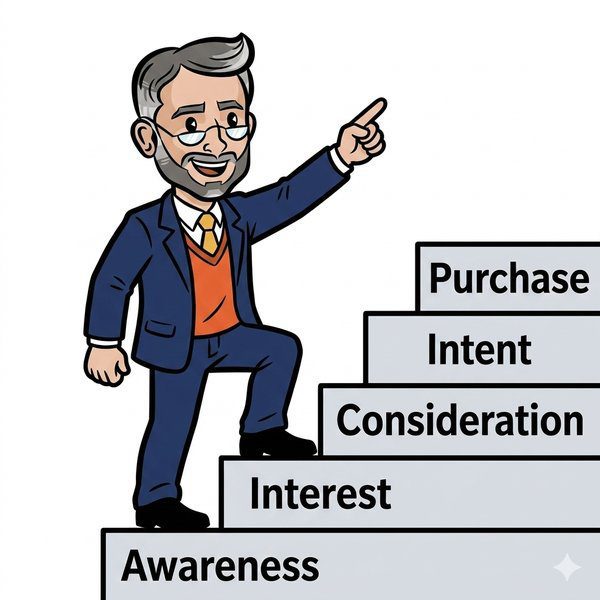
The real estate sales funnel consists of several stages, including Awareness, Interest, Consideration, Intent, and Purchase, each designed to guide potential buyers through their journey from initial awareness to final purchase. We add Evaluation and Loyalty to create a complete 7-stage model:
| Awareness | Prospect discovers you exist |
| Interest | Prospect raises their hand (opts in, calls, messages) |
| Consideration | Prospect evaluates whether to work with an agent |
| Intent | Prospect signals readiness to transact |
| Evaluation | Prospect compares you against other agents |
| Purchase | Active transaction from contract to close |
| Loyalty | Past clients become repeat customers and referral sources |
Small lifts at each stage compound dramatically. A 10% improvement in opt-in rates, combined with 10% better show-to-appointment conversion, combined with 10% higher close rates doesn’t equal 30% more deals—it compounds to 40-50% more closed transactions annually.
An effective sales funnel for real estate agents must be measurable at each of these stages, not just at the closing table. The sections below break down each stage with specific tactics, metrics, and examples.
Stage 1: Awareness – How Serious Agents Get Found by the Right Prospects
During the Awareness stage, potential clients first discover a real estate agent’s services, making it crucial for agents to position themselves strategically to attract attention. Research shows that 71% of buyers work with the first agent they contact, and this number jumps to 81% for sellers. The “first agent wins” principle means systematic awareness-building directly impacts your bottom line.
Awareness in 2026 blends digital and offline channels. Generating leads can be achieved through methods like Facebook ads, open houses, and local social media presence. Here are the tactics that work:
Digital awareness tactics:
- Hyper-local SEO content targeting specific searches (e.g., “Atlanta BeltLine condos under $600k 2026”)
- Google Business Profile optimized with 30+ reviews and monthly posts
- Short-form video tours of neighborhoods—not just specific properties
- Google ads targeting high-intent keywords in your local market
Offline awareness tactics:
- Co-branded workshops with mortgage brokers (e.g., “First-Time Buyer Workshop – June 2026”)
- Strategic signage with QR codes at listings and open houses
- Postcards with recent sold data to targeted neighborhoods
Pick 2-3 channels and commit to consistent output. Agents posting content 3x weekly see 40% higher lead flow than those with sporadic activity. A simple weekly calendar—Monday for local SEO content, Wednesday for video, Friday for community engagement—outperforms scattered efforts across 10 platforms.
Stage 2: Interest – Turning Traffic Into Trackable Leads
The interest stage is when anonymous website visitors raise their hand: they fill a form, message on Instagram, call from a yard sign, or click your listing and opt in. This is where lead capture happens.
Websites with simple contact forms convert 2.2% of visitors to leads on average, while specialized landing pages can achieve 4-5% conversion rates. The difference? A dedicated landing page with a single, specific offer dramatically outperforms a generic homepage.
Lead magnets that generate high quality leads in 2026:
- “2026 [City] First-Time Buyer Playbook” PDF with loan options, down payment requirements, and timeline
- Instant home valuation landing page for sellers
- “Private list of off-market multifamily deals in [City]” for real estate investors
- Neighborhood-specific reports with school scores, recent sales, and price trends
Lead capture best practices:
- Every awareness asset should point to a dedicated landing page, not your homepage
- Forms should capture name, email, phone, and client preferences
- QR codes at open houses boost field captures by 25%
- Use UTM parameters to track which sources produce leads
Target 8-25% opt-in rates on dedicated landing pages and 2-5% for general website forms. Track these in your CRM by source to identify which channels produce more leads worth pursuing.
Stage 3: Consideration – Nurturing Leads Over 3–6 Months
In the Consideration stage, prospects evaluate whether a real estate agent is the right fit for their needs, requiring agents to nurture relationships and demonstrate their value through consistent communication. Most leads need 6-12 touches before they’re ready to transact, and many agents give up after 1-2.
Automated email sequences can share market updates, buying/selling tips, and client success stories to nurture relationships. Email marketing plays a crucial role in client retention, with real estate emails achieving a 19.17% open rate compared to the all-industry median of 21.33%.
A structured 90-day nurture sequence:
| Weeks 1-4 | Welcome email, financing basics, 2026 market overview |
| Weeks 5-8 | Weekly market updates, price change alerts on saved searches |
| Weeks 9-12 | Educational content (inspection checklist, offer comparison guide, closing cost breakdown) |
Automation + human touches:
- Use your CRM to trigger behavior-based follow up: when a lead favorites a listing, schedule a call task
- Send personalized emails with Loom videos walking through a property report
- Scheduled check-in calls at 30, 60, and 90 days
Automated email and text follow-ups can increase engagement with leads, ensuring timely communication and nurturing relationships throughout the different stages. Target 30-40% open rates on highly segmented nurture emails and 10-20% reply rates on personalized check-in messages.
Stage 4: Intent – Capturing “I’m Ready” Signals Fast
The Intent stage is marked by clear signals from prospects indicating they are ready to take action, such as requesting meetings or asking detailed questions about properties. Intent behaviors include: requesting a showing, booking a listing appointment, calling after receiving a comparative market analysis, or submitting a mortgage pre-approval.
Contacting leads within 5 minutes increases conversion likelihood by 21 times compared to waiting 30 minutes. Speed-to-lead is the single most controllable factor at this stage.
How to architect fast response:
- Calendar links (Calendly-style) embedded in emails, website, and text messages for instant booking
- CRM notifications and mobile push alerts for high-intent form submissions
- Pre-built scripts and checklists for first calls so you qualify efficiently
- Set reminders in your CRM for immediate follow up on hot actions
Qualifying questions answered in first contact:
- Budget and price range confirmation
- Timeline for purchase or sale
- Financing status (pre-approved, cash, needs lender referral)
- Decision-makers identified
Target metrics: contact rate >70% on new leads, appointment-set rate >50% once contact is made.
Stage 5: Evaluation – Winning the “Agent vs. Agent” Decision
At this stage, potential clients are comparing you against 2-3 other real estate professionals. They’ve decided to transact—now they’re deciding with whom. Many agents lose here because they talk about themselves instead of solving the client’s specific problem.
Conversion assets that increase win rate:
- A one-page “Client Roadmap” that visually explains your sales process from consultation to closing
- Case studies: “How we sold 123 Maple St in 7 days at 103% of list in March 2026”
- Net sheet template for sellers showing proceeds after fees and taxes
- “Total monthly cost” breakdown for potential buyers including taxes, insurance, and HOA
Digital experience improvements:
- Fast-loading mobile site (under 3 seconds)
- Clean online calendar for easy booking
- Simple document management for sharing contracts and disclosures
- Short explainer videos answering common questions answered during evaluation
Social proof matters: screenshots of texts from past clients, Google review snippets mentioning specific neighborhoods and dates. Generic testimonials don’t convert leads—specific ones do.
Stage 6: Purchase – Managing the Transaction Without Dropping the Ball
The Purchase stage is where prospects officially become clients, and how agents manage this stage can significantly impact whether the relationship continues beyond the transaction. This isn’t just closing—it’s the entire selling process where trust is either cemented or destroyed.
Systematize the transaction:
- Standardized onboarding email after agreement signed with key dates and expectations
- Shared closing checklist for buyers/sellers: inspections, appraisal, financing milestones
- Weekly or twice-weekly proactive status updates via email or SMS
Research indicates 40-50% of client anxiety comes from lack of updates. Proactive communication reduces last-minute fallout and increases referral likelihood. Use transaction management tools or CRM pipelines to track every step and automate reminders for contingency deadlines.
Collect testimonials at or immediately after closing when goodwill is highest. Request specific, location-based details in the review—these help your local SEO and resonate with future ideal clients.
Stage 7: Loyalty & Referrals – Building a Compounding Client Base
The loyalty stage in the sales funnel represents the most valuable part, where one-time clients become repeat clients and active referral sources, significantly reducing client acquisition costs over time. For top agents, repeat and referral business accounts for 50%+ of production after 3-5 years in a market.
Nurturing clients after closing leads to referrals and ongoing relationships. Post-closing communication includes personalized, automated check-ins and market updates to maintain client relationships.
A structured loyalty system:
- Quarterly email newsletter with hyper-local data (Q1 2026 price changes by zip code)
- Annual home valuation check-in for owners
- Birthday and “homeversary” touches (cards, small gifts, personalized emails)
- Client appreciation events 1-2x per year with RSVP tracked via landing pages
Personal connections, such as check-in calls and client appreciation events, generate the highest referral rates, emphasizing the importance of making clients feel valued beyond the transaction.
12-month client loyalty calendar example:
- January: Market recap newsletter
- March: Homeversary cards for Q1 closings
- June: Client appreciation event
- September: Annual valuation check-ins
- December: Holiday touchpoint
Track a “referral ask” KPI: how many past clients per month you directly and respectfully ask for referrals. Stay connected through content marketing that provides valuable content without being salesy.
Specialized Real Estate Sales Funnels by Client Type
Top producers run multiple funnels in parallel, each tailored to a specific target market rather than a “one-size-fits-all” approach. Each funnel uses the same macro stages but different messaging, offers, and channel emphasis.
First-Time Homebuyer Sales Funnel
This funnel prioritizes education and psychological safety. First time buyers need reassurance more than aggressive closing tactics.
Key components:
- Monthly “First Home in [City]” webinar with 2026 loan options (FHA limits around $500k, current rates 6-7%)
- “Rent vs. Buy in [Neighborhood] 2026” calculator and free guide
- Nurture sequences explaining down payments (3-20%), credit requirements, inspections, and closing costs
- Checklists and timelines (“90-day path from pre-approval to keys”)
First time homebuyers respond to simple graphics, minimal jargon, and a reassuring tone. Co-branded content with lenders builds trust.
Seller / Listing-Focused Sales Funnel
This funnel drives your real estate business through listings, creating leverage rather than chasing buyers.
Awareness tactics:
- Targeted mailers: “5 homes sold in your subdivision in Q1 2026; average price up 7.4%”
- Search engine optimization for “sell my house in [Neighborhood]”
Interest-stage offers:
- Instant online home valuation tool
- “2026 [City] Home Seller Playbook: Netting the Most After Fees and Taxes”
The primary conversion event is a Listing Strategy Session, scheduled through a dedicated landing page. Messaging focuses on net proceeds, timeline clarity, and simplicity.
Real Estate Investor Sales Funnel
This funnel is data-driven and recurring. Investors buy multiple properties over years, making them high-LTV clients.
Components:
- Content targeting specific returns: “Duplex cash flow in East Atlanta 2026—real numbers,” “5-8% cap rate properties”
- Weekly “deal list” email with vetted properties, estimated rents, cap rates, value-add notes
- Webinars on 1031 exchanges, short-term rentals, or BRRRR strategies
- Investor strategy call calendar embedded on website
Track repeat purchase rate per investor and email click-through on deal alerts. Use spreadsheet-style presentation with clear risk disclosures.
Luxury Real Estate Sales Funnel
Luxury real estate requires access, discretion, and service—not mass marketing.
Key elements:
- Awareness through high-end channels: curated social presence, private events, partnerships with wealth managers
- Interest offers: pocket listing previews, curated lifestyle guides for specific enclaves
- High-touch, personalized outreach with minimal automation tone
- Premium visual design: minimalistic pages, high-end photography, restrained copy
High-Volume / Team-Based Real Estate Sales Funnel
For teams closing dozens or hundreds of sides annually with ISAs and heavy automation.
Requirements:
- Centralized CRM with auto-assign rules by geography or price range
- Standardized scripts and cadences (7 touches in 10 days for new leads)
- Clear SLAs for response times and follow up responsibilities
- Dashboards tracking lead source performance, agent conversion by stage
Segment funnels by lead source (portal leads vs. SEO vs. referrals) with tailored messaging. Portal leads typically convert at 1% while SEO leads convert at 5%—adjust expectations accordingly.
Digital-First Real Estate Sales Funnel Architecture

A digital-first funnel uses online tools at every stage to drive traffic, capture interest, nurture relationships, and manage transactions.
A concrete digital journey:
- Prospect finds a YouTube video about “Buying in [Neighborhood] 2026”
- Clicks to a landing page offering a neighborhood guide
- Opts in and enters a nurture sequence with property suggestions
- Books a Zoom consultation through embedded calendar
- Signs documents electronically and tracks milestones via client portal
Essential digital assets:
- SEO-optimized niche site targeting your local market
- High-converting landing pages per audience (buyers, sellers, investors)
- CRM with marketing automation (text messages, email, task management)
- Meeting scheduler, e-signature, and basic analytics
Using a CRM with automation capabilities allows real estate professionals to manage leads more effectively, reducing repetitive tasks and improving overall efficiency in the sales process.
Key Metrics & KPIs for a High-Performing Real Estate Sales Funnel
Professional agents treat their funnel like a P&L. If you can’t measure each stage, you can’t scale it. Identifying and prioritizing high-quality prospects helps agents focus energy and efficiency in their sales efforts.
Critical metrics by funnel stage:
| Awareness | Website visitors, social reach, CTR | Target: 2-5% CTR |
| Interest | Landing page conversion rate, cost per lead | Target: 8-25% conversion |
| Consideration | Email open/click rates, response to check-ins | Target: 30-40% opens |
| Intent | Contact rate, appointment-set rate | Target: >70% contact, >50% appointments |
| Evaluation | Appointment-to-agreement conversion | Target: 40-50% |
| Purchase | Contract-to-close rate, days in escrow | Target: 85-90% close |
| Loyalty | Referral rate, repeat transactions, review volume | Target: >4.5 rating, 30+ reviews |
Build a simple monthly funnel report in a spreadsheet with columns by stage and rows by lead source. This reveals which channels produce more clients worth pursuing and where your funnel leaks revenue.
Tech Stack & Automation for Real Estate Agents
Automation in the sales funnel process can significantly enhance lead generation and client conversion by streamlining communication and follow-up tasks. The goal is consistency, not replacing the human relationship that closes real estate transactions.
Core tech categories:
- CRM with pipeline stages mirroring your funnel
- Email and SMS automation with behavioral triggers
- Calendar scheduling and video meeting tools
- E-signature and document management
- Call tracking and analytics (website + ads)
Three levels of sophistication:
| Level 1 (solo, low volume) | Simple CRM, manual follow-up templates, basic landing pages |
| Level 2 (growing agent/small team) | Automated nurture sequences, lead routing, calendar integration |
| Level 3 (high-volume team) | Full marketing automation, ISAs, advanced segmentation, reporting dashboards |
Example workflow for new seller lead:
- Instant text acknowledgment (“Thanks for reaching out about selling your home”)
- Email with short intro video
- Task set for personal call within 5 minutes
- If no contact, automated email campaigns begin Day 2
Save time by automating repetitive tasks while preserving the right tools for human connection at decision points.
Designing Your Real Estate Sales Funnel Strategy (Step-by-Step)
Here’s a practical framework for agents moving forward with building or rebuilding their funnel:
| Define your primary audience | Be specific (e.g., “move-up buyers in North Atlanta, $600k–$1M”) |
| Map their 7-stage journey | Whiteboard or diagram each stage with current touchpoints |
| List current assets and gaps | What exists at each stage? What’s missing? |
| Prioritize 1-2 improvements per stage | Focus on the next 90 days only |
| Implement baseline measurement | Simple dashboard or spreadsheet tracking conversion by stage |
| Launch, monitor, adjust | Review metrics weekly and refine messaging |
| After 90 days, expand | Add a second audience or funnel type |
Start with one niche funnel (e.g., sellers in a specific ZIP) instead of a generic funnel for “everyone.” Dedicate 2-3 focused days to design and setup, then 30-60 minutes weekly to review metrics. This approach helps you create sustainable systems rather than temporary campaigns.
Common Funnel Mistakes Real Estate Agents Make (And How to Fix Them)
Here are the issues we see most frequently in funnel audits:
| Driving paid traffic to generic homepage | Create 1 offer + 1 landing page per audience |
| Slow or inconsistent lead follow up beyond day 1 | Implement 7-day follow-up cadence with reminders |
| No differentiation between first-time buyers, investors, and sellers | Segment lists in CRM and tailor sequences |
| Over-automation with robotic messages | Balance automation with personal touches at key moments |
| Zero automation = pure chaos | Start with basic welcome sequence and build from there |
| No tracking of lead source performance and ROI | Add UTM parameters and monthly source analysis |
| Ignoring post-close nurture | Build 12-month loyalty calendar with quarterly touchpoints |
Quarterly funnel review process: Walk 3-5 real leads through your system as if you’re them. Note every friction point: slow page loads, confusing forms, unclear next steps, gaps in communication. This reveals where blog readers drop off, where website visitors bounce, and where potential clients lose interest.
How Sales Funnel Professor Helps Real Estate Agents Build Revenue-Ready Funnels
Sales Funnel Professor is a revenue-focused consultancy founded by Eddie Davis in Atlanta, GA. We work with agents, teams, and brokerages that want measurable growth—not just “more marketing.”
Services for real estate professionals:
- Full sales funnel audits: From awareness through referrals, with written recommendations and benchmarks against top performers
- Funnel redesign and implementation: Landing pages, lead magnets, nurture sequences, CRM configuration
- Conversion rate optimization: For existing funnels and traffic sources
- Fractional Head of Growth / CMO support: Executive-level guidance for growing teams without a full-time hire
Our frameworks translate directly to serious real estate operations. People listen when we recommend changes because we back everything with data.
How engagement works:
- Free strategy session to review your current real estate sales funnel and numbers
- A tailored 90-day funnel optimization plan if there’s a fit
- Optional ongoing advisory or hands-on build-out, depending on your capacity
If you want a proven framework built for your specific real estate market, one that helps you close more deals with less chaos, reach out to Sales Funnel Professor. We’ll assess your current system, identify the fastest path to more closings and higher-quality leads, and build a steady flow of opportunities that compound over time.