
Table of Contents
What is a lead magnet?
Why lead magnets matter for B2B sales funnels
What makes a good lead magnet?
Core qualities of high-converting lead magnets
Types of lead magnets that work for B2B and consulting
How to create a great lead magnet (step-by-step)
Optimizing and testing your lead magnets
Integrating lead magnets into your broader go-to-market strategy
When to get expert help with your lead magnet strategy
Most B2B websites are leaking revenue. Visitors arrive, browse a few pages, and disappear without a trace. You spend money driving traffic, but your pipeline stays thin. The missing piece? A strategic asset that transforms anonymous visitors into qualified conversations.
Plugging that leak often starts with chief marketing officer services that diagnose exactly where qualified visitors drop out of your funnel.
That asset is a lead magnet. Built correctly, it turns anonymous visitors into real sales conversations.
What Is a Lead Magnet?
A lead magnet is a free item or service offered to potential customers in exchange for their contact details, such as email addresses or phone numbers. Think of it as a value-first exchange where you provide something useful in return for permission to continue the conversation.
For B2B founders and marketing leaders, this isn’t about collecting random emails. An effective lead magnet captures contact information like name, email address, company, and role—data that helps you understand whether someone fits your ideal customer profile. The goal is not simply collecting more emails. The goal is building qualified pipeline. Lead magnets serve as a bridge between a curious visitor and a loyal customer, providing value upfront to spark interest and build a connection.
Here’s what separates generic freebies from revenue-driving assets:
| Funnel audits | that diagnose conversion leaks in a prospect’s sales process |
| Strategy playbooks | outlining scalable growth frameworks for specific industries |
| ROI calculators | that quantify the impact of decisions like US market expansion or pricing changes |
| Workshop seats | offering live, tactical sessions on topics like pipeline building |
| Loom teardown videos | analyzing a prospect’s website or competitor funnels visually |
At Sales Funnel Professor, founded by Eddie Davis in Atlanta, we use and build lead magnets as core assets inside clients’ sales funnels. They’re often the first proof-of-concept deliverable that previews what a full engagement looks like—whether that’s a comprehensive audit or fractional CMO services.
Why Lead Magnets Matter for B2B Sales Funnels
Most B2B sites convert fewer than 2% of visitors into leads. That means 98% of your traffic leaves without you knowing who they were or what they needed. A great lead magnet can double or triple that conversion rate without spending another dollar on traffic.

Lead magnets plug into every stage of a revenue funnel:
| Top-of-funnel (TOFU) | Educational content like checklists draws in anonymous traffic and introduces your brand |
| Middle-of-funnel (MOFU) | Evaluation tools like calculators help warmer leads assess fit and readiness |
| Bottom-of-funnel (BOFU) | High-intent offers like audit previews prime prospects for sales conversations or free trials |
Lead magnets prevent lost prospects by giving website visitors who aren’t ready to buy a reason to connect.
Consider these scenarios: A SaaS company adds a “US Market Readiness Checklist” to their pricing page and watches demo requests climb as it surfaces expansion pain points. A professional services firm offers a “Conversion Tear-Down” and sees qualified calls increase because they’re diagnosing real problems on-site.
For consulting and fractional CMO offers, the lead magnet often becomes the “first paid-like experience”—a miniature transformation delivered for free that de-risks the decision to engage further. Lead magnets serve as the entry point to automated email sequences that convert prospects into customers.
What Makes a Lead Magnet?
Not all lead magnets are created equal. A better lead magnet separates serious prospects from tire-kickers. Here’s what distinguishes effective lead magnets from generic PDFs that collect dust:
| Specificity | Narrowly targeted to users with specific problems that a product can solve. A good lead magnet should attract the right people and repel the wrong ones by being precisely tailored to your ideal customer profile. |
| Quick consumption | Delivers value in 10-20 minutes. No one wants to wade through 75 pages to find one insight. |
| Outcome focus | Promises a tangible result—”Find 3 conversion leaks in your funnel today”—not vague knowledge. |
| Credibility | Anchored in real data, case studies, or proven methodologies that signal expertise. |
| Alignment | Tees up your paid offer naturally. A funnel checklist leads to a full audit engagement. |
| Effortless delivery | Automates fulfillment instantly—no waiting, no friction. |
| Clear next step | Tells the prospect exactly what to do after consuming the content. |
Core Qualities of High-Converting Lead Magnets
Let’s break down the previous list into four deeper qualities that we’ve refined through years of testing funnels across startups, scale-ups, and established B2B companies.
Lead magnets should be helpful, credible, shareable, and strategic to effectively engage potential customers and convert them into leads. Each quality below includes practical guidance you can implement immediately.
Helpful
The best offers solve one concrete, urgent problem instead of trying to cover everything at once. A lead magnet should solve a problem for your audience, making it feel like a must-have resource that addresses their struggles and provides immediate value.
What “helpful” looks like in practice:
| 30-Minute Funnel Diagnostic Checklist for SaaS Founders | Walks through conversion points step-by-step |
| Sales Call Script for High-Ticket Services | Ready-to-use framework for discovery calls |
| Weekly Pipeline Review Template | Helps revenue leaders run tighter forecast meetings |
The key is delivering a quick win without overwhelm. Aim for 2-6 pages or a single-page tool tied to a real-world task like running a meeting, building a forecast, or rewriting a landing page.
Credible
Credibility matters especially for consulting and high-ticket B2B offers where trust drives buying decisions. Providing valuable content for free demonstrates expertise in the industry and builds trust.
Include elements that anchor your authority:
| Short case study snapshots | “How we helped a $3M ARR SaaS company increase demo-show rates by 34%” |
| Dated benchmarks | “2024 SaaS Funnel Benchmarks from 87 US-based startups” showing specific data points like 1.8% average conversion rates and 45-day sales cycles |
| Named methodologies | Reference frameworks you’ve developed through client work |
To enhance the effectiveness of your lead magnet, ensure it is visually appealing and well-organized, as a professional design increases perceived value and encourages consumption. At Sales Funnel Professor, our client experience across funnel audits and fractional engagements informs every lead magnet we create.
Shareable
Shareability matters in B2B where buying committees and teams often review resources together. The best lead magnets naturally circulate inside organizations.
Formats that get shared:
| Slide decks | that teams present in revenue meetings |
| Checklists | managers forward to their direct reports |
| Calculators | finance teams use to model scenarios |
Consider adding “Share this template” to the bottom of each asset. A “Weekly Revenue Standup Agenda Template” that CROs share with their team or a “Discovery Call Scorecard” that SDR managers roll out creates more value than content designed for social media virality.
Strategic
A strategic lead magnet integrates with the user journey and broader funnel, not just your core services. Lead magnets support collecting contact information, including the customer’s contact information, for future marketing campaigns—but only strategic ones convert that information into revenue.
Here’s a simple text funnel to visualize the pathway:
Lead Magnet → Day 2 Nurture Email → Day 5 Demo Invite → Discovery Call → Proposal
This sequencing helps nurture leads over time rather than treating the download as the endpoint.
Map each lead magnet to a specific offer:
- Audits and assessments lead to consulting retainers
- Calculators lead to SaaS subscriptions
- Strategy playbooks lead to fractional CMO engagements
Use basic lead scoring to identify intent signals. Someone downloading a “US Market Entry Checklist” shows different buying intent than someone grabbing a generic “Marketing Trends” PDF. Design your follow-up sequence accordingly.
Types of Lead Magnets That Work for B2B and Consulting
Some of the most popular lead magnets span each major type of lead magnet, including informational resources like ebooks, actionable tools such as checklists, interactive formats like webinars, and incentives such as discount codes or free trials. Here are 10 specific lead magnet examples proven in B2B funnels:
| Checklists and cheat sheets | Simple, actionable tools that help users accomplish specific tasks. Example: “Sales Funnel Health Check” (a Sales Funnel Professor staple that leads to full audit engagements). Best for TOFU. |
| One-page playbooks | Tactical execution guides. Example: “The 5-Step Demo Follow-Up Playbook.” Great for MOFU. |
| Calculators | Interactive tools that quantify ROI or readiness. Example: “EU-to-US Expansion Pricing Calculator.” Perfect for MOFU evaluation. |
| Audits and assessments | Quizzes and assessments are interactive tools that provide customized feedback to users. Example: “Conversion Rate Audit Scorecard.” Strong BOFU trigger. |
| Templates and swipe files | Pre-formatted structures that provide instant practical utility. Example: “Cold Email Sequence Template” or design templates for landing pages. Works across funnel stages. |
| Mini-courses and online workshops | Webinars and workshops are live or recorded training sessions that build trust and allow for Q&A. Example: “Pipeline Acceleration Masterclass.” Good for nurturing MOFU leads. |
| Ebooks and guides | Comprehensive educational content providing deep insights into a specific subject; ebooks are among the most popular lead magnets because they cover topics in detail and often convert well. Example: “The Ultimate Guide to Sales Funnel Optimization.” TOFU awareness builder. |
| Whitepapers and case studies | In-depth research reports that establish expertise and build authority. Example: “2024 B2B Conversion Benchmark Report.” Credibility-focused MOFU asset. |
| Free strategy sessions or free consultation | High-touch BOFU offers. Example: “30-Minute Funnel Diagnosis Call.” Direct path to sales conversation. |
| Free trials | Allow potential customers to test a service without financial commitment, making them an effective lead magnet for subscription-based businesses. |
For e-commerce adjacent B2B, discount codes and coupons with free shipping work as direct incentives to complete a purchase. Discount codes are a classic lead magnet that provides immediate value, making it easy for potential customers to engage with a brand in exchange for their contact information.
How to Create a Great Lead Magnet (Step-by-Step)
This section walks through a practical creation process you can execute in 1-2 working days. Avoid overcomplicating the process. Launch smaller lead magnets quickly and improve them over time.

At Sales Funnel Professor, we often start client engagements by building one focused lead magnet to prove a funnel concept quickly before scaling.
Define Your Target Audience
Defining your target audience is crucial for creating an effective lead magnet, as understanding customers pain points helps you address a specific pain point with an offer that meets their specific needs.
Get ultra-specific about who you’re targeting:
| Role | VP of Marketing, Head of Sales, Founder |
| Company size | 50-200 employees, seed-stage, Series B |
| Industry | SaaS, professional services, manufacturing |
| Funnel stage | Awareness, consideration, decision |
Map 2-3 key pain points tied to revenue to improve your lead generation strategy by making the offer more relevant:
- “Paid ads are too expensive and CAC keeps climbing”
- “Sales team can’t close the leads marketing generates”
- “Demo no-show rate is killing our pipeline”
A strong lead magnet starts with one urgent problem for one audience segment.
Consider the difference between a seed-stage SaaS founder struggling with first customers versus a mid-market Head of Sales in 2024 trying to hit aggressive targets. Same format, completely different messaging.
Identify the Problem You’re Solving
A great lead magnet solves one concrete problem, and the best offers focus on a single urgent issue rather than trying to cover everything you know. Target customers respond to specificity.
Strong problem statements:
- “Improve demo-show rate this month”
- “Find leaks in your 2024 funnel before scaling ad spend”
- “Write a cold email sequence that actually gets replies”
- “Prepare your pricing for US market entry”
Use plain, empathetic language that mirrors how prospects describe their issues in sales calls or Slack messages. Choose one problem per lead magnet so it can deliver significant value.
Position Your Lead Magnet
Align your lead magnet’s topic and promise with your core paid offers to attract high quality leads who are more likely to convert. If you sell funnel audits, your lead magnet should provide valuable insights that naturally help generate sales leads and lead into a full audit engagement.
Use outcome-based titles that attract potential customers:
- “The 7-Point Funnel Fix for Stalled Pipeline”
- “Find Your 3 Biggest Conversion Leaks in 15 Minutes”
- “The US Market Readiness Scorecard”
Add light social proof and “what happens next” copy so prospects understand the journey beyond the download. Make the path to your paid services clear without being pushy.
Create and Package Your Lead Magnet
Clarity beats design flair. The goal is to create an enticing lead magnet that delivers significant value quickly. Simple layouts in Google Docs, Notion, slides, or a free design tool are enough to create and launch quickly.
Structure your asset:
- Short intro explaining what they’ll learn
- 3-7 core points or steps (the meat)
- Actionable checklist or worksheet
- Clear next step and CTA
Keep it short: 1-3 pages, a 10-15 minute video, or a single worksheet. Use brand colors and logo consistently, but don’t stall the launch for “perfect” design. Different formats work for different audiences—test to find what resonates.
Set Up Your Landing Page, Form, and Delivery
A high-converting landing page for a dedicated landing built specifically for the offer includes everything a visitor needs on the lead magnet’s landing page:
| Clear headline | States the outcome in specific terms |
| 3 benefit bullets | What they’ll learn or accomplish |
| Signup form | Strategic field choices affect lead quality (fewer for TOFU, more for BOFU) |
| Trust cues | Logos, testimonials, or data points |
| Strong CTA button | “Get the Checklist” beats “Submit” |
Be strategic with form fields. A pop up for a general checklist might only need email. A free consultation request should capture name and email address plus company and role. Use your existing email marketing tools and CRM for automation. This dedicated landing page should capture leads and make collecting contact information frictionless.
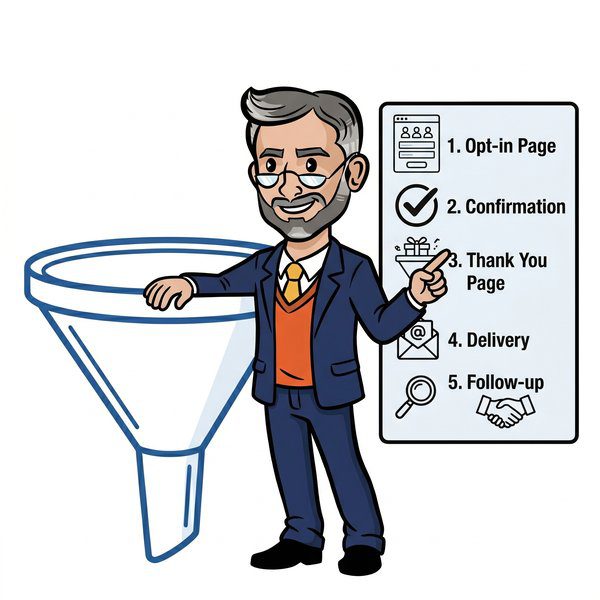
Ensure immediate confirmation: thank-you page plus instant email with the asset link. Don’t make prospects wait or hunt for their download, because most lead magnet landing pages perform better when access is instant and the user does not have to wait.
Design the Follow-Up Sequence
The money is in the follow-up, because the sequence encourages leads to take the next step. Your lead magnet is the door-opener, not the end point. Attracting customers is just the first step—converting them requires nurture.
Simple 3-5 email sequence:
| Day | Focus | Example Content |
|---|---|---|
| 0 | Delivery | Asset link + quick win tip |
| 2 | Case study | Related client success story |
| 5 | Invitation | Low-friction call or audit offer |
| 9 | Value add | Additional resource on same subject |
| 14 | Close | Direct CTA with urgency |
Sales Funnel Professor helps clients architect these sequences so every lead magnet ties to measurable revenue outcomes, not just more leads sitting in a database and helps generate leads consistently from each asset over time.
Optimizing and Testing Your Lead Magnets
Once a lead magnet is live, treat it as an experiment, not a finished product. Testing and optimizing your lead magnet is essential; A/B testing different elements can help identify what resonates best with your audience and improve conversion rates.
Key metrics to watch:
| Landing page conversion rate | Aim for 20-50% depending on traffic source |
| Download-to-opportunity rate | 5-15% is healthy for B2B |
| Revenue per lead | The ultimate measure of lead magnet quality |
Run simple A/B tests on headline, lead magnet title, CTA button text, or form length—one change at a time for clear results.
Segment by traffic source (paid search, LinkedIn, organic search, referrals) to see which channels drive quality leads. LinkedIn often yields 2x the lead quality compared to generic search traffic for B2B offers.
Track Conversion Rates and Lead Quality
Calculate your basic funnel math:
- Visitors to opt-ins (landing page conversion)
- Opt-ins to qualified calls (higher conversions from intent-matched magnets)
- Calls to closed-won deals
Example cascade: 1,000 visitors → 300 downloads (30%) → 30 qualified calls (10%) → 6 clients. Attribute revenue back to specific lead magnets and prove ROI. Emphasize quality over quantity—track ICP fit and deal size, not just download counts.
Analyze Behavior and Feedback
Use basic analytics (scroll depth, click maps, email open/click rates) to see where potential leads drop off. Analyzing demographic and behavioral data of leads can provide insights into their quality, helping to refine lead generation strategies and improve future lead magnets.
Add a short question on the thank-you page: “What’s the biggest problem you’re trying to solve?” This reveals whether your messaging matches prospect expectations.
Interview a few leads who converted and a few who didn’t. Their perceived value insights will tell you more than any analytics dashboard.
Iterate on Offer, Format, and Positioning
Revisit underperforming lead magnets quarterly. Adjust title, promise, or format while reusing core content. Optimizing lead magnets for SEO with relevant keywords, fast load times, and strong landing page structure can significantly improve visibility and lead generation performance.
Repackaging examples:
- Turn a long guide into a 1-page cheat sheet
- Convert a webinar into an exclusive content swipe file
- Transform an audit into an interactive quiz or scorecard
Run 2-3 variations over time rather than constantly starting from scratch. Content upgrades to existing blog posts can boost opt-ins by 200% with minimal new work. Small improvements over time usually outperform constant rebuilds.
Quizzes and surveys can serve as effective lead magnets by withholding results until the user provides their email address, creating a sense of engagement and personalization. Interactive quizzes often outperform static PDFs for generating leads.
Integrating Lead Magnets Into Your Broader Go-to-Market Strategy
Lead magnets are important because they work best when promoted across multiple channels. Promoting it through email marketing, SEO, and social platforms is vital to maximize visibility and capture more leads.
Weave them into your entire go-to-market motion:
| SEO and content | Add content upgrades to blog posts. A post about conversion rate optimization should offer a related checklist. This can boost blog post opt-ins significantly without more traffic. |
| Paid social | Use LinkedIn lead gen ads and other PPC ads with contextual offers. Entice people with an exciting offer that matches the content they’re consuming. |
| ABM programs | Personalize lead magnets for target accounts. An account-specific audit preview demonstrates expertise and convinces visitors to engage. |
| Sales enablement | Arm your team with lead magnets as “gifts” in cold outreach or leave-behinds after discovery calls. Sometimes a free resource opens doors better than a hard pitch. |
| Calendar moments | Align lead magnets with fiscal year planning, funding rounds, industry conferences, or regulatory changes in 2024-2025. A “Q1 Pipeline Planning Template” in December attracts more attention than the same asset in July. |
This cross-channel integration is a core part of how we approach funnel strategy work at Sales Funnel Professor. Not everyone needs every tactic—but connecting your lead magnet to multiple touchpoints generates more traffic and paying customers.
When to Get Expert Help With Your Lead Magnet Strategy
Building effective lead magnets isn’t rocket science, but many founders and marketing leaders find themselves stuck. Traffic comes in, but pipeline doesn’t follow. The lead magnet funnel stalls somewhere between download and revenue.
Signs it’s time to bring in outside help:
- Your conversion rate from visitor to lead sits below 2% despite decent traffic
- List growth has stalled and new leads have dried up
- Sales and marketing disagree on what constitutes a “qualified” lead
- You have lead magnet ideas but no clear path from download to loyal customers
- Leads download your content but never book calls or respond to follow-up
- You’re attracting potential buyers but can’t convert them to sales leads
Most lead magnets fail when they don’t solve a specific pain point or attract the right audience.
A revenue-focused consultancy like Sales Funnel Professor approaches this systematically. We start with a funnel audit to diagnose where prospects drop off, then develop lead magnet strategy aligned to your specific offers. From there, we help with copy and offer design, plus performance coaching so your team can maintain and optimize the system.
The goal isn’t just a test drive of tactics—it’s building a repeatable engine that turns anonymous traffic into qualified pipeline and ultimately more customers.
Ready to fix your leaky funnel? Book a free strategy session with our team to diagnose your current funnel and brainstorm one high-impact lead magnet that could transform your pipeline, with expert help to improve your ability to generate sales leads. Or request a consultation if you’re ready to discuss a more comprehensive engagement. Let’s turn your traffic into revenue.
B2B Lead Magnet FAQ
What is a B2B lead magnet?
A B2B lead magnet is a free resource offered in exchange for a prospect’s contact information to help generate qualified business leads.
What makes a high-converting lead magnet?
High-converting lead magnets solve a specific problem quickly, provide immediate value, and align closely with buyer intent.
What types of lead magnets work best for B2B?
Popular B2B lead magnets include checklists, calculators, audits, templates, webinars, strategy sessions, and industry reports.
How long should a lead magnet be?
Most effective lead magnets are concise and actionable, often ranging from one page to a short guide or video that can be consumed quickly.
Why are lead magnets important for sales funnels?
Lead magnets help businesses capture qualified leads, nurture prospects through the funnel, and improve conversion rates without increasing traffic costs.