Table of Contents
What Is a Sales Funnel? (And Why Your Steps Must Match How B2B Buyers Actually Buy)
The 6 Core Sales Funnel Steps in B2B
Sales Funnel Step 1: Awareness
Sales Funnel Step 2: Interest
Sales Funnel Step 3: Consideration
Sales Funnel Step 4: Intent
Sales Funnel Step 5: Decision
Sales Funnel Step 6: Retention and Expansion
Mapping Sales Funnel Steps to Your CRM and GTM Motion
Key Metrics and Benchmarks for Each Funnel Step
Common Breakdowns in Sales Funnel Steps (And How to Fix Them)
Designing Your Sales Funnel Steps for Different Deal Sizes and Cycles
Optimizing Stage-to-Stage Conversion with Automation and Enablement
Putting It All Together: A Sample 6-Step B2B Funnel in Practice
Next Steps: Audit Your Sales Funnel Steps and Build Predictable Pipeline
Unpredictable revenue usually points to poorly defined sales funnel steps, inconsistent qualification criteria, or weak stage-to-stage conversion processes. You might have strong demand generation, capable sales reps, and a product that customers love—yet your forecast misses targets and your pipeline feels like guesswork. This inconsistency is usually a structural problem tied to how funnel stages are defined, measured, and managed.
At Sales Funnel Professor, our Atlanta-based consultancy founded by Eddie Davis, we’ve seen this pattern repeatedly. Companies between $500K and $50M ARR typically leak 20–40% of potential revenue due to fuzzy stages, weak handoffs between sales and marketing teams, and undefined exit criteria at each step. A well-structured B2B sales funnel helps convert prospects into customers while improving retention, forecasting accuracy, and revenue growth.
This guide delivers concrete sales funnel steps, stage definitions, benchmarks, and optimization tactics your B2B team can implement within 30 days. We focus on a 6-stage model—Awareness, Interest, Consideration, Intent, Decision, and Retention/Expansion—because it maps best to how modern B2B buyers actually buy. This is a B2B-focused, data-driven framework built from real SaaS and services funnels, not generic marketing theory.
What Is a Sales Funnel? (And Why Your Steps Must Match How B2B Buyers Actually Buy)
A sales funnel is a step-by-step model of the buyer’s journey from first touch to expansion, with each step tied to observable behaviors and conversion metrics. Most sales funnel models follow the AIDA framework (Awareness, Interest, Desire, Action) or a more expanded version that includes post-purchase stages. The funnel represents the buyer’s journey, visualizing how potential customers enter and leave the buying process, while the sales pipeline represents the sales team’s process, defining and tracking how deals progress.
The jump from a whiteboard funnel map to a production-ready system with tracking, automation, and SLAs is where most internal projects stall—and where professional funnel builders earn their keep.
If mapping these six steps reveals skill gaps your team cannot fill quickly, outsourcing the build to a provider who already owns the playbook can protect your launch timeline.
The key difference between a sales funnel and a sales pipeline is perspective: the funnel focuses on the buyer’s journey and conversion rates, whereas the pipeline focuses on the seller’s activities and deal progression. Sales funnels and sales pipelines are often used interchangeably, but they serve different purposes—the funnel emphasizes volume and conversion optimization, while the pipeline emphasizes deal velocity and revenue forecasting. Both are essential, but this guide addresses the funnel: how your prospective customers move through their buying process.
Visualize the funnel as a narrowing path. Many anonymous visitors enter at the top. A smaller pool becomes marketing qualified leads. An even smaller set converts to sales qualified leads and qualified opportunities. Finally, you have customers and expansion deals. Consider this sales funnel example: a B2B SaaS company might see 10,000 monthly website traffic visitors become 1,000 leads, which yield 200 qualified meetings, resulting in 40 proposals, 20 closed-won deals, and 5 expansion deals in year one.
In B2B sales, buyers loop and revisit steps. They rarely move linearly through the customer journey. Your target audience might engage at the awareness stage, disappear for weeks, then reappear at consideration. Your sales funnel stages must be flexible but explicitly defined with clear entry and exit criteria to accommodate this reality.
The 6 Core Sales Funnel Steps in B2B
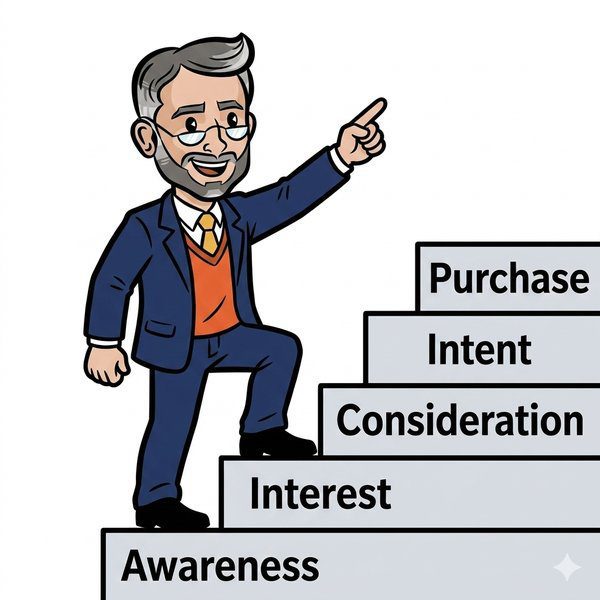
The sales funnel typically consists of six stages: Awareness, Interest, Evaluation, Engagement, Action, and Retention. We use a parallel structure optimized for B2B sales funnel execution: Awareness, Interest, Consideration, Intent, Decision, and Retention/Expansion. The sales funnel typically consists of five key stages—Awareness, Interest, Consideration/Desire, Intent/Evaluation, and Action—refining leads by addressing needs and reducing purchasing friction, but we add Retention because recurring revenue demands it.
These are buyer-centric stages you can map directly to your CRM and go-to-market motion. At each step, the buyer does something observable, and your revenue team has a primary objective:
| Funnel Stage | Buyer Behavior | Revenue Team Objective |
|---|---|---|
| Awareness | Recognizes a problem, begins searching | Be part of their initial solution set |
| Interest | Takes hand-raising action (download, subscribe) | Segment and qualify for fit |
| Consideration | Evaluates options, compares solutions | Confirm fit, disqualify gracefully |
| Intent | Collects info for internal justification | De-risk decision, build consensus |
| Decision | Chooses vendor, routes contracts | Accelerate close, reduce friction |
| Retention | Uses product, evaluates ongoing value | Drive adoption, expand, generate advocacy |
You can adapt these stages to your existing CRM labels as long as the buyer behaviors and qualification criteria remain consistent. The sections below detail benchmarks and tactics for each funnel stage.
Sales Funnel Step 1: Awareness
In the awareness stage, potential customers become aware of a product or service through marketing efforts such as social media, content marketing, and advertising. At this step, prospects are experiencing symptoms of a problem and just beginning to search for language and possible solutions. They may not yet recognize their challenge as a distinct business problem—they’re in discovery mode.
What does Awareness look like in B2B? Search queries like “how to reduce churn in B2B SaaS,” engagement with LinkedIn social media posts, podcast downloads, webinar registrations, and initial website visits without form submission. Your target customers aren’t evaluating vendors yet; they’re trying to understand their situation.
Typical channels that work for B2B Awareness in 2024–2026 include LinkedIn organic posts, targeted paid advertising on social platforms, SEO for problem-based queries, industry newsletters, podcasts, and conference talks. Digital marketing strategies at this step focus on visibility and credibility, not conversion. Your marketing team should aim to appear when buyers first search, establishing your company’s offerings as part of their mental solution set.
Realistic benchmarks: strong Awareness pages achieve 2–4% website visit-to-lead capture, and well-targeted LinkedIn awareness ads see 0.8–1.5% CTR. If your paid social CTR sits below 0.5%, you likely have targeting or messaging mismatch with actual buyer intent.
Consider this example: a cybersecurity firm increased organic Awareness traffic by 65% in six months by creating 12 in-depth guides on “how to comply with X regulation.” This problem-focused content attracted prospective buyers actively seeking answers—not product pitches. The lesson: Awareness marketing efforts should address pain points, not push features.
Sales Funnel Step 2: Interest
Interest begins when an anonymous visitor takes a hand-raising action signaling curiosity beyond casual browsing. During the interest stage, prospects engage with educational content to learn more about the product’s features, benefits, and unique selling points, evaluating its suitability as a potential solution. Common Interest behaviors include subscribing to a GTM newsletter, downloading a KPI benchmark report, registering for live training, or spending significant time on solution pages.
Using targeted email campaigns, social media engagement, and personalized content can effectively guide prospects through the interest stage of the sales funnel, addressing their specific needs and demonstrating the value of offerings. Utilizing targeted email campaigns and social media marketing can effectively nurture leads through the interest stage of the sales funnel, addressing specific needs and demonstrating value.
Not every form-fill should move into sales outreach. Distinguish between raw leads and marketing qualified leads. For companies with limited AE capacity, lead scoring becomes critical. Define MQL criteria explicitly—form download plus two or more email opens plus LinkedIn profile match to ICP—rather than treating all form fills equally. This prevents the common sales reps complaint of “low-quality leads.”
Benchmarks for Interest: 20–35% landing page conversion for targeted offers and 25–40% email open rates on welcome sequences in well-segmented B2B lists. These rates assume decent list hygiene and relevant segmentation.
A B2B services firm doubled MQL volume in a quarter by replacing generic eBooks with persona-specific ROI calculators and scorecards. A Finance buyer has different pain points than an HR buyer, so generic assets underperform. Persona-specific content demonstrates the shift from broad lead generation to qualified lead generation.
Sales Funnel Step 3: Consideration
At the consideration stage, prospects understand the problem, are aware of several solution options, and are evaluating whether your approach belongs on their shortlist. They’ve moved past “what is this problem?” into “what are my options?” and are now prospective customers actively comparing alternatives.
Typical B2B Consideration signals include multiple website sessions, repeat engagement with educational content, reviewing pricing or “how it works” pages, attending product-focused webinars, and replying to outreach with deeper questions. These behaviors indicate genuine evaluation, not casual browsing.
Qualification frameworks like MEDDIC and BANT become essential at this step. The goal is to confirm fit and disqualify gracefully when appropriate. In modern B2B, buying committees are larger and more complex, so qualification often requires multiple stakeholders across different functions to align. Your sales process must account for this complexity.
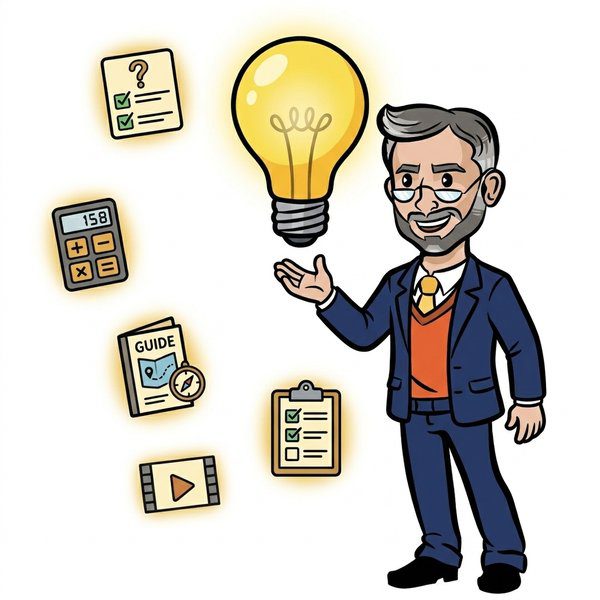
Effective content for this stage includes comparison sheets (your solution vs. alternatives), ROI calculators tailored to the prospect’s use case, short diagnostic audits, personalized Loom walk-throughs, and customer stories broken down by industry and use case. The emphasis should be on specificity and relevance.
Benchmarks: around 40–60% of discovery calls should move to deeper evaluation (POC, workshop, or proposal) if your top-of-funnel targeting is strong. If this rate consistently falls below 40%, audit your ICP definition and discovery call messaging.
A Series B SaaS vendor achieved 55% conversion from interested leads to qualified opportunities using 30-minute “diagnostic calls.” This structure aligned buyer and seller interests—the prospect gained clarity on their situation while the seller clarified fit and decision timeline.
Sales Funnel Step 4: Intent
Intent occurs when prospects signal they are seriously considering purchase and are collecting information needed for internal justification and approval. The shift from Consideration to Intent is often abrupt—a prospect moves from “exploring options” to “building a business case” for potential buyers internally.
Observable Intent behaviors include requesting pricing, asking about implementation timelines, inviting cross-functional stakeholders to calls, requesting proposals or trials, or adding you to a formal RFP process. These actions indicate serious purchase consideration, not information gathering.
Your team’s objective shifts from educating and qualifying to de-risking the decision and building internal consensus among 6–10 stakeholders typical in mid-market and enterprise B2B purchases. Many Intent-stage deals stall because the seller aligns with a champion but hasn’t secured buy-in from Finance or executive leadership. Identify the economic buyer early and engage multiple stakeholders throughout.
Effective Intent-stage assets include tailored ROI models using the prospect’s own numbers and assumptions, security and compliance documentation (often requested by IT or Security), and stakeholder-specific one-pagers addressing Finance, IT, Ops, and end-user concerns differently. A single proposal rarely satisfies all stakeholders; targeted, role-specific content accelerates consensus.
Benchmarks: 60–80% proposal delivery rate after strong multi-stakeholder discovery, and a target of 30–40% proposal-to-close rate in well-structured B2B funnels. Cycle times vary: 14–30 days for SMB, 30–90 days for mid-market, and 90–180 days for enterprise. Manage buying committees actively with clear next steps and documented action items.
Sales Funnel Step 5: Decision
At the Decision step, the buyer is choosing a vendor, aligning on terms, and routing contracts for approval and signature. Velocity and clarity become critical. The decision stage involves prospects comparing the product with alternatives, considering factors like pricing, reliability, and customer support, with the sales team providing personalized assistance.

Common Decision-stage friction points include legal redlines on contracts, security reviews, executive churn mid-deal, last-minute discount demands, and internal priority shifts. These are normal and predictable, not surprises.
Best practices for this stage include clear mutual action plans, documented procurement steps, specific deadlines with stated business impact, and aligning on go-live milestones rather than only price negotiations. Deals stall at Decision not because of unresolved objections but because next steps are unclear or stakeholders are waiting for others to move. Visual pipeline management and deal tracking become essential for sales managers.
Benchmarks: typical B2B Decision-stage sales cycle times run 14–30 days for SMB, 30–90 days for mid-market, and 90–180 days for enterprise. Target close rates from this stage should be 50–70% if deals are well-qualified earlier in the funnel.
A $10M ARR services company cut average “contract in legal” time from 45 to 18 days by standardizing MSAs and creating pre-approved fallback clauses. This example demonstrates that Decision-stage velocity is often constrained by process, not substance. Removing predictable friction points recovered 27 days per deal—substantial improvement in both cash flow and quota attainment.
Sales Funnel Step 6: Retention and Expansion
For most B2B companies with recurring revenue, 60–80% of customer lifetime value is realized after the final purchase. In the retention stage, businesses focus on customer satisfaction and loyalty through excellent customer service, ongoing engagement, and upselling or cross-selling opportunities. Retention and Expansion must be formal funnel steps in your sales funnel model, not afterthoughts handed to customer success without process.
Post-purchase retention aims to engage customers to become repeat customers and advocates through loyalty programs and proactive support. This stage includes onboarding, adoption milestones, QBRs (quarterly business reviews), upsell and cross-sell motions, advocacy programs, and referral generation. Your account managers and customer success teams own these motions.
Key metrics include net revenue retention (NRR), gross revenue retention (GRR), expansion revenue percentage, logo churn, and time-to-first-value. For B2B SaaS companies targeting predictable growth, NRR above 100% is increasingly table stakes. Aim for core value demonstration within 30–45 days for most SaaS tools.
Personalized follow-up communications, regular check-ins, and proactive problem-solving can significantly improve customer retention by ensuring ongoing satisfaction and loyalty. Encouraging satisfied customers to refer new business can accelerate the movement of prospects through the sales funnel, as referred leads are often more trusting and have higher conversion rates.
A B2B productivity tool improved NRR from 96% to 115% in 12 months by implementing health scores and automated “risk alerts” for accounts with dropping usage. By identifying at-risk accounts and expansion opportunities automatically, they shifted from reactive customer success to proactive, data-driven engagement. Happy customers and loyal customers feed back into Awareness as advocates and case studies, creating a virtuous cycle.
Mapping Sales Funnel Steps to Your CRM and GTM Motion
A sales funnel works only if operationalized. Each step must map cleanly to CRM stages, lead statuses, and owner responsibilities across marketing, sales, and customer success. Optimizing a sales funnel involves mapping the full customer experience, which includes understanding the various touchpoints and interactions that customers have with a business throughout their journey.
Translate your six stages into CRM objects and fields:
| Stage | CRM Object | Entry Criteria | Exit Criteria | Owner |
|---|---|---|---|---|
| Awareness | Web Visitor | Site visit | Form submission | Marketing |
| Interest | Lead/MQL | Score ≥ 60 | SDR qualification | Marketing/SDR |
| Consideration | SQL | Discovery complete | Proposal requested | SDR/AE |
| Intent | Opportunity | Proposal sent | Terms agreed | AE |
| Decision | Opportunity (Late) | Contract in review | Signature | AE |
| Retention | Customer | Closed-won | Expansion/Renewal | CSM |
Define SLAs for each transition. Speed-to-lead targets for Awareness-stage inbound should be 5 minutes. Intent-stage proposals should go out within 24 hours. Decision-stage contract redlines should be returned within 48 hours. These SLAs correlate directly with win rates and cycle time.
For a $5M ARR SaaS company, this might mean one growth marketing person owns Awareness, two SDRs manage Interest-to-Consideration handoff, three AEs split by region own Consideration through Decision, and two CSMs own Retention. This structure enables sales leaders to inspect and coach against concrete, measurable outcomes at each stage.
Key Metrics and Benchmarks for Each Funnel Step
If you’re not tracking conversion rates between steps, you’re guessing where revenue leaks. This section serves as your numeric reality check against sales funnel metrics that matter.
Core metrics per step:
| Funnel Stage | Key Metrics to Track |
|---|---|
| Awareness | website traffic, CTR on ads, visit-to-lead conversion |
| Interest | lead-to-MQL rate, email engagement, content download rates |
| Consideration | MQL-to-opportunity rate, meeting set rate, discovery completion |
| Intent | proposal rate, multi-stakeholder engagement, timeline commitment |
| Decision | close rate, time-in-stage, average contract value |
| Retention | NRR/GRR, logo churn, expansion revenue, TTFV |
Realistic benchmark ranges for B2B companies at $1–20M ARR: 10–25% lead-to-opportunity conversion, 20–35% opportunity-to-close for well-defined ICPs, and 90–95% gross logo retention. These are directional—calculate your current rates and track quarter-over-quarter improvement rather than chasing external benchmarks immediately.
Identify your “leak points.” Calculate conversion rates between each step and find the stage with the lowest conversion. That’s your immediate improvement opportunity. A 20–30% improvement at a single leak point often produces material ARR impact. Data driven insights and dashboards beat vanity metrics like raw lead volume every time.
Common Breakdowns in Sales Funnel Steps (And How to Fix Them)
Every effective sales funnel eventually encounters breakdowns. Here are the most frequent failure modes and their remedies.
| Funnel Breakdown | Symptoms, Root Causes, and Remedies |
|---|---|
| Too much unqualified Awareness traffic | Symptom: high website traffic but low MQL conversion; sales complains about lead quality. Root cause: Awareness campaigns are too broad. Remedy: tighten ICP definition, shift from generic content to vertical-specific content, implement audience exclusions. Businesses can increase sales by creating targeted content for awareness, nurturing leads, offering social proof, and simplifying the checkout process. |
| Weak lead scoring at Interest | Symptom: most MQLs don’t meet quality standards when sales outreach begins. Root cause: lead scoring isn’t tied to funnel behaviors. Remedy: implement behavioral scoring tied to observable Intent signals—form type, email engagement, page visits—and route MQLs only when thresholds are met. |
| No clear qualification criteria at Consideration | Symptom: discovery calls are inconsistent; forecast accuracy is poor. Remedy: introduce a discovery scorecard aligned to MEDDIC or BANT. Score every call; recycle low-scoring deals into nurture rather than forcing them forward. |
| Stalled deals at Intent | Symptom: deals linger in “Proposal Sent” for weeks. Remedy: schedule defined follow-ups at proposal delivery, create mutual action plans, document which stakeholders have reviewed materials, and follow up with specific questions. To increase conversions, businesses must reduce friction and deliver the right message at each specific stage of the sales funnel. |
| Ad-hoc customer success at Retention | Symptom: unpredictable churn, sporadic expansion. Remedy: develop playbooks with milestones, implement usage alerts, establish QBR cadences. Customer feedback becomes essential input for retention motions. |
One B2B team changed a single step definition—“SQL requires economic buyer identified”—and improved forecast accuracy from 62% to 84% within one quarter. Small definition changes yield measurable outcomes.
Designing Your Sales Funnel Steps for Different Deal Sizes and Cycles
Not all funnels are created equal. A $5K ACV self-serve tool needs different step granularity than a $250K enterprise contract. Your successful sales funnel design must match your deal dynamics.
For sub-$10K ACV deals, compress steps. Interest and Consideration may blur into a single “Free Trial” stage. Intent might not exist separately—prospects move from trial directly to purchase. The typical flow: Awareness → Free Trial → Purchase. Sales cycle runs weeks, not months. Sales team involvement is minimal; the funnel is largely self-serve with low-touch email support.
For $20–80K ACV mid-market SaaS, all six stages are present but compressed. Awareness and Interest might take 2–3 weeks total. Consideration runs 2–4 weeks. Intent takes 4–6 weeks. Decision runs 2–4 weeks. Total sales cycle: 8–14 weeks. Buying committees typically include 4–6 people.
For $250K+ enterprise contracts or large implementation projects, expand your stages. Intent might split into “RFP Response,” “Security Audit,” and “Technical Workshop.” Decision might include “Executive Steering Committee Review,” “Legal Negotiation,” and “Go-Live Planning.” Total cycle can stretch 6–12 months with 8–15 stakeholders across functions.
The principle: longer cycle time justifies more granular stage definition because more discrete decision points occur. Choose a structure that reflects your buyer’s actual buying process, not a template copied from a different business.
Optimizing Stage-to-Stage Conversion with Automation and Enablement
Intelligent automation improves conversion rates without burying sales reps in admin. Organizations that utilize data-driven insights and advanced analytics to optimize their sales funnels can enhance lead nurturing, target high-value prospects, and personalize customer experiences, ultimately driving revenue growth.
Where automation works best by step:
| Funnel Stage | Automation and Tooling Priorities |
|---|---|
| Awareness | bid management on paid search, SEO monitoring alerts, content distribution scheduling |
| Interest | lead routing to available SDRs, continuous lead scoring, triggered welcome sequences |
| Consideration | automated follow-up reminders, proposal generation from templates, engagement tracking |
| Intent/Decision | deal health scoring, mutual action plan templates, stalled deal alerts |
| Retention | health scoring algorithms, renewal alerts, expansion opportunity triggers via marketing automation |
Consider this exercise: list every manual task per stage, estimate time spent, and prioritize automation where it saves 3–5 hours per week without harming relationship building or personalization. The goal is freeing reps to focus on conversations that close deals.
Tool categories that support each step include CRM (HubSpot, Salesforce), marketing automation platforms, conversation intelligence tools, and sales engagement platforms. The specific tools matter less than the principle: each funnel stage should have clear automation opportunities that eliminate admin while preserving human connection where it matters.
Putting It All Together: A Sample 6-Step B2B Funnel in Practice
Consider this scenario: a $3M ARR HR tech platform selling workforce planning software to mid-market companies. Their baseline funnel showed 12,000 monthly visitors, 400 leads, 200 MQLs (fuzzy criteria), 30 discovery meetings, 12 proposals, and 3 closed-won deals per month at $35K ACV.
After implementing the 6-step framework:
At Awareness, they refined targeting to “mid-market HR leaders evaluating workforce planning tools,” increasing landing page conversion from 1.8% to 3.2%. At Interest, they introduced persona-specific lead scoring and set a 60-point MQL threshold, reducing raw MQL volume from 200 to 130 but increasing quality dramatically. At Consideration, they implemented a MEDDIC-aligned discovery scorecard, recycling low-scoring prospects into nurture. At Intent, they created stakeholder-specific content—Finance, IT, and HR executive one-pagers—plus mutual action plans for every proposal. At Decision, they standardized their MSA with pre-approved fallbacks, cutting contract time from 35 to 18 days. At Retention, they implemented health scoring based on login frequency and module adoption.
Results after 90 days: traffic held at 12,500, leads dropped slightly to 375, but quality MQLs hit 130. Discovery meetings increased from 30 to 45. Proposals rose from 12 to 22. Closed-won doubled from 3 to 6. New quarterly ARR jumped from $1.26M to $2.1M—a 67% increase without adding headcount.
This demonstrates how refined steps, consistent criteria, and aligned teams produce predictable pipeline. The same sales resources delivered dramatically better business outcomes through funnel clarity alone.
Next Steps: Audit Your Sales Funnel Steps and Build Predictable Pipeline
Pick one funnel step this week to audit. Examine Awareness quality, Interest qualification criteria, Consideration discovery rigor, Intent follow-up cadence, Decision velocity, or Retention health scoring. Identify where your conversion rates fall below the benchmarks in this guide.
A healthy 6-step B2B sales funnel has explicit entry and exit criteria at each stage, clear ownership and SLAs, consistent qualification frameworks, and metrics tracked between every transition. This clarity is non-negotiable for accurate forecasting and scalable growth. It’s how sales funnel strategies translate into revenue.
Operationalizing a six-step framework across CRM, automation, and reporting is where most teams hit friction, and it is exactly the kind of work a funnel consultant is built to accelerate.
Your three-step action plan: First, map your current stages and document actual criteria (not aspirational definitions). Second, define entry/exit criteria with your team for each stage and instrument tracking in your CRM. Third, calculate conversion rates between each step and identify your top leak point for immediate focus.
If you want expert guidance, book a free strategy session with Sales Funnel Professor. We’ll spend 45–60 minutes reviewing your current funnel, identifying 2–3 specific leak points, and proposing an improvement roadmap tailored to your deal size and sales cycle. We specialize in designing and optimizing B2B sales funnels for companies between $500K and $50M ARR, with a focus on predictable pipeline and measurable revenue lift. Your funnel steps determine your revenue ceiling—let’s raise it.
B2B Sales Funnel Steps FAQ
What are the main stages of a B2B sales funnel?
Most B2B sales funnels include Awareness, Interest, Consideration, Intent, Decision, and Retention/Expansion stages.
Why are sales funnel steps important?
Clear sales funnel steps help businesses improve lead qualification, forecast revenue more accurately, and identify conversion bottlenecks.
What is the difference between a sales funnel and a sales pipeline?
A sales funnel focuses on the buyer’s journey and conversion rates, while a sales pipeline focuses on the sales team’s deal progression and activities.
How do you optimize a B2B sales funnel?
Businesses optimize B2B sales funnels by improving qualification criteria, strengthening nurture sequences, reducing sales friction, and tracking stage-to-stage conversion metrics.
What metrics should businesses track in a sales funnel?
Important sales funnel metrics include conversion rates, MQL-to-SQL progression, close rates, pipeline velocity, CAC, retention, and expansion revenue.