
Table of Contents
The Sales Funnel: Understanding the Customer’s Journey
The Sales Pipeline: Navigating the Internal Sales Process
Sales Funnel vs. Sales Pipeline: Key Distinctions Analyzed
Why This Distinction is Crucial for Sales & Marketing Leaders
Practical Applications and Integration in Practice
Conclusion: Mastering Both for Growth
Further Reading
As marketing and sales leaders, we operate within complex systems designed to attract, engage, and convert potential customers. Two concepts are foundational to understanding these systems: the sales funnel and the sales pipeline. While frequently used interchangeably, this lack of precise distinction can lead to misaligned strategies, inaccurate reporting, and missed opportunities for growth. This article aims to cut through that confusion, offering a clear, analytical breakdown of each concept, its purpose, and why understanding their differences is not merely academic, but critical for effective sales management and strategy in today’s landscape.
A clear understanding of core concepts is paramount for leaders. It ensures that the metrics teams track are meaningful, that conversations between departments are productive, and that data-driven decisions are based on accurate interpretations of reality. Let’s establish the precise definitions necessary to navigate the nuances of revenue generation.
The Sales Funnel: Understanding the Customer’s Journey
The sales funnel, fundamentally, is a representation of the customer’s journey from initial awareness of a problem or your brand to the point of purchase. Its structure, wide at the top and narrow at the bottom, visually depicts the decreasing number of potential customers as they move through the stages of consideration and decision-making.
When we discuss the sales funnel vis pipeline, the funnel offers a bird’s-eye view. It focuses on the aggregate flow of potential customers, analyzing volume and conversion rates at different points along the path to becoming a buyer. It’s a conceptual framework primarily used to understand market dynamics, analyze overall lead generation effectiveness, and identify where potential customers might be dropping off before engaging directly with the sales team. It represents the demand generation and nurturing process in a broad sense.
The sales funnel’s focus is inherently customer-centric. It tracks the potential buyer’s progression through various states of mind and engagement levels with your company and its offerings.
Typical Stages of the Sales Funnel
While specific terminology can vary, the standard model of the sales funnel includes stages that mirror the buyer’s journey:
- Awareness: At the top of the funnel, potential customers become aware of their problem or need, and potentially, aware that solutions like yours exist. They are often consuming educational content, searching for information, or encountering marketing messages. Metrics here focus on reach, impressions, website visits, and initial lead generation (e.g., form fills, downloads).
- Interest / Consideration: Prospects move into this stage when they begin actively researching potential solutions and vendors. They are evaluating options, comparing features, reading reviews, and engaging more deeply with your content (e.g., webinars, detailed guides, case studies). This stage involves demonstrating how your offering addresses their specific needs. Key metrics include engagement rates, content downloads, demo requests, and the generation of Marketing Qualified Leads (MQLs).
- Decision: In this phase, the potential customer has narrowed down their options and is evaluating the finalists. They might be requesting specific pricing, comparing proposals, asking detailed questions about implementation, or seeking social proof. This is often where the baton is explicitly passed from marketing to sales, resulting in the creation of Sales Qualified Leads (SQLs) or early-stage opportunities.
- Action (Purchase): The final stage where the prospect makes a decision and becomes a paying customer. The focus shifts to closing the deal and onboarding the new client. Success here is measured by conversion rates from the decision stage and the volume of new customers acquired.
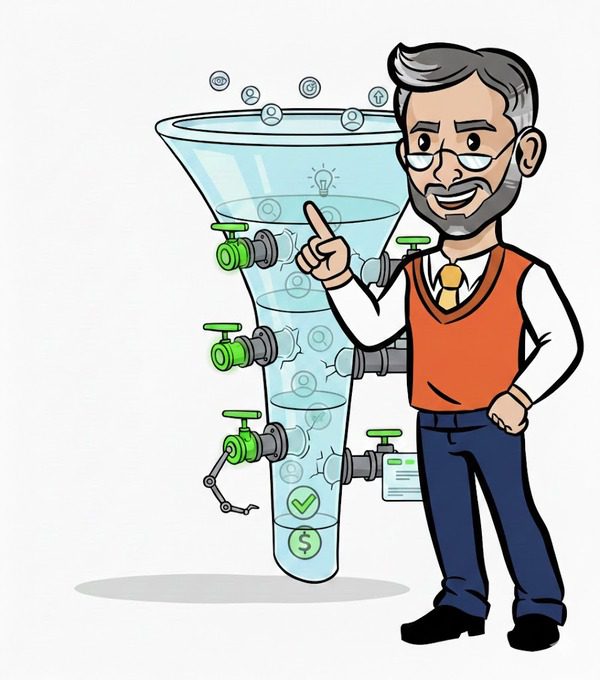
The sales funnel, particularly the upper and middle stages, is primarily associated with marketing activities aimed at attracting and nurturing leads. Marketing teams use funnel analysis to optimize campaigns, improve lead quality, and increase the volume of potential customers entering the sales process. Analyzing conversion rates between each stage is crucial for identifying bottlenecks in the customer journey – perhaps leads are entering the funnel but not converting to interest, indicating a content or messaging issue.
The key metrics derived from the sales funnel are typically volume-based and focused on efficiency: total leads generated, conversion rates between stages (e.g., Awareness to Interest, Interest to Decision, MQL to SQL), cost per lead (CPL), and overall customer acquisition cost (CAC). These metrics provide insights into the health and effectiveness of your demand generation engine.
The Sales Pipeline: Navigating the Internal Sales Process
In contrast to the customer-centric view of the funnel, the sales pipeline provides an internal, sales-centric perspective. It represents the series of steps or sales pipeline stages that a sales team follows to move a *qualified opportunity* from initial contact to a closed deal (won or lost).
Think of the sales pipeline as the sales team’s workflow. It is a dynamic system where individual deals, represented as opportunities, progress through a defined sequence of activities and milestones managed by the sales representatives. The focus here is on managing specific potential transactions, assessing their likelihood of closing, and executing the sales activities necessary to advance them.
The sales pipeline is inherently about opportunity management. It provides visibility into the status of each potential deal, the actions required next, the potential revenue it represents, and its estimated closing date.
Standard Sales Pipeline Stages
The stages within a sales pipeline reflect the actions and progress of the sales team working an opportunity. Common stages include:
- Lead Qualification: This initial stage is critical. The sales team evaluates whether a lead (often an SQL passed from marketing) fits the ideal customer profile and has a genuine need, budget, authority, and timeline (often assessed using frameworks like BANT: Budget, Authority, Need, Timeline) or other methodologies like MEDDIC (Metrics, Economic Buyer, Decision Criteria, Decision Process, Identify Pain, Champion). Only qualified leads enter the formal sales pipeline as opportunities.
- Prospecting/Initial Contact: The sales representative makes initial contact with the qualified prospect. This could involve calls, emails, or social outreach to introduce themselves, verify qualification, and schedule a discovery meeting.
- Needs Analysis/Discovery: A crucial stage where the sales rep delves deep into the prospect’s specific challenges, goals, and requirements. The objective is to fully understand their pain points and how your solution can address them. This stage often involves detailed conversations, diagnostic questions, and building rapport.
- Proposal/Presentation: Based on the discovery, the sales team crafts and delivers a tailored proposal or presentation outlining the recommended solution, its benefits, pricing, and terms. This demonstrates how your offering directly addresses the prospect’s identified needs.
- Negotiation: Once the prospect is interested in the proposal, discussions may involve price, terms, scope adjustments, or contractual details. This stage requires strong communication and negotiation skills to reach a mutually agreeable outcome.
- Closing/Commitment: The final stage where the deal is either won (the contract is signed, payment is made) or lost. This involves securing the final commitment and completing necessary paperwork or processes.
The sales pipeline is primarily associated with the sales team’s day-to-day operations and management. Sales managers use the pipeline to monitor individual sales reps’ progress, track the health of the overall sales pipeline (e.g., total value in play), forecast future revenue, and identify deals that may be stuck or require intervention.
Key metrics for the sales pipeline focus on the opportunities themselves: the total value of the pipeline (sum of potential revenue from all open opportunities), sales velocity (the speed at which deals move through the pipeline), win rate (percentage of qualified opportunities that are won), average deal size, and the duration of time opportunities spend in each stage. These metrics provide insights into the efficiency and effectiveness of the sales execution process.
Sales Funnel vs. Sales Pipeline: Key Distinctions Analyzed
Understanding the fundamental differences between the sales funnel and the sales pipeline is paramount for sales and marketing leaders. While they represent sequential phases in bringing a customer onboard, their perspectives, scope, and purpose are distinctly different. Confusing them leads to miscommunication, inaccurate analysis, and flawed strategic planning.
Fundamental Differences in Perspective and Focus
The most critical distinction lies in the viewpoint they represent:
- Perspective: The Sales Funnel is focused on the *customer’s journey*. It tracks potential customers as they move through their stages of awareness, interest, and decision-making. It’s an external view, focusing on the market and how prospects engage with the company’s efforts to attract them. The Sales Pipeline, conversely, is focused on the *internal sales process*. It tracks the steps the sales team takes to manage and close specific deals. It’s an internal view, focusing on the sales team’s activities and progression with qualified opportunities.
- Scope: The Sales Funnel provides an *aggregate view* of potential customers. It’s concerned with volume – how many leads are entering, how many are moving from one broad stage to the next. It considers the collective pool of prospects. The Sales Pipeline focuses on *individual deals or opportunities*. Each entry in the pipeline is a specific potential transaction with a defined value and likely closing date. It’s about managing a portfolio of distinct opportunities.
- Purpose: The primary purpose of analyzing the Sales Funnel is *optimizing lead conversion and volume*. It’s about understanding where and why potential customers are engaging or disengaging from the broad journey before they even become a sales-qualified opportunity. The purpose of managing the Sales Pipeline is *managing deal progression and closing*. It’s about ensuring qualified opportunities move efficiently through the sales process and ultimately convert into paying customers.
Consider a hypothetical scenario: A marketing leader reviews a report showing a significant drop-off between the “Interest” and “Decision” stages of the *funnel*. This suggests potential customers are engaging with content but not requesting demos or contacting sales. This is a *funnel* problem, likely related to messaging, calls to action, or lead nurturing. A sales leader reviews a report showing deals stalling in the “Negotiation” stage of the *pipeline*. This suggests qualified opportunities are entering the latter part of the sales process but aren’t closing. This is a *pipeline* problem, possibly related to sales skills, pricing issues, or competitive challenges. The analysis and required actions are fundamentally different based on whether the issue lies in the funnel or the pipeline.
Contrasting Stages and Flow
The stages within each concept also differ significantly:
- Funnel stages reflect the buyer’s mindset: Awareness, Interest, Decision. These are states of being or understanding for the potential customer.
- Pipeline stages reflect sales activities: Qualification, Prospecting, Needs Analysis, Proposal, Negotiation, Closing. These are actions and milestones performed by the sales team.
While the funnel flow is typically depicted as linear (though prospects can sometimes skip or jump stages), the pipeline flow of an individual opportunity is more dynamic. While the ideal is linear progression, opportunities can sometimes move backward (e.g., from Proposal back to Needs Analysis if new information arises) or might not follow every single standard stage depending on the deal complexity. The pipeline is a structured process, but the movement within it is tied to the specific interactions and progress of individual deals, not just a general decrease in volume.
Different Metrics and Measurement Goals
The metrics used to evaluate the health and performance of each concept are tailored to their distinct purposes:
- Funnel Metrics: Focus on overall flow and efficiency. Key metrics include:
- Conversion rates between stages (e.g., Website Visitor to Lead, MQL to SQL)
- Lead volume trends (total leads generated over time)
- Conversion volume at each stage
- Cost per lead (CPL)
- Traffic sources and their conversion performance
- Overall Funnel conversion rate (e.g., initial touch to customer)
- Pipeline Metrics: Focus on opportunity progression, value, and closure. Key metrics include:
- Total pipeline value (sum of potential revenue from open opportunities)
- Pipeline value by stage (distribution of value across the sales process)
- Sales velocity (average time it takes for a deal to close from opportunity creation)
- Win rate (percentage of qualified opportunities won)
- Average deal size
- Stage-to-stage conversion *of opportunities* (percentage of opportunities moving from one pipeline stage to the next)
- Stage duration (average time opportunities spend in each pipeline stage)
- Analysis of lost deals (reasons for loss, stage where deals were lost)

Comparing, say, “Conversion Rate” from the funnel (percentage of leads moving to the next *awareness/interest* stage) with “Win Rate” from the pipeline (percentage of *qualified opportunities* closed) highlights the different levels of analysis. The funnel looks at the mass, the pipeline looks at the specific.
While not strictly a written element, it’s worth noting that visualizing these differences through diagrams (a funnel shape vs. a horizontal series of boxes representing pipeline stages) is immensely helpful in clarifying the concepts for teams. It underscores the customer journey perspective of the funnel versus the process-oriented view of the pipeline.
Why This Distinction is Crucial for Sales & Marketing Leaders
For marketing and sales leaders aiming for predictable revenue growth, the clarity between the sales funnel and the sales pipeline is not just a matter of terminology; it’s a strategic imperative. Misunderstanding or conflating these concepts can lead to fundamental breakdowns in strategy, reporting, and team alignment.
Aligning Sales and Marketing Efforts
Perhaps the most significant benefit of a clear distinction is improved alignment between sales and marketing teams. These two functions are intrinsically linked in the revenue generation process, yet they often operate with different goals and metrics.
- Understanding the Funnel vs. Pipeline ensures both teams recognize their distinct, yet sequential, roles. Marketing is primarily responsible for filling the *funnel* and moving prospects through the early stages of the customer journey, delivering qualified leads (MQLs, then SQLs) to the ‘top’ of the *pipeline*. Sales is then responsible for working those *qualified opportunities* through the *pipeline* to closure.
- This clarity improves handover efficiency. When marketing understands the criteria for a qualified lead that sales can successfully work in their *pipeline*, and sales trusts the quality of leads passed from the *funnel*, friction is reduced. This is where the funnel vs pipeline definition translates into tangible process improvements.
- Establishing unified goals based on a clear understanding of both concepts becomes possible. Instead of marketing focusing solely on lead volume (top of funnel) and sales solely on closed deals (bottom of pipeline), they can set shared objectives around MQL to SQL conversion rates (the link between funnel and pipeline), pipeline velocity (impacted by both lead quality from marketing and sales execution), and overall revenue generated.
A marketing leader focusing only on the total number of leads generated (Funnel metric) might fail to see that these leads aren’t progressing through the pipeline because they are poorly qualified. A sales leader focusing only on win rates (Pipeline metric) might miss the fact that the volume of qualified opportunities entering the pipeline is insufficient to meet revenue targets. A shared understanding, derived from a clear distinction, allows leaders to diagnose root causes accurately and collaborate on solutions.
Enhancing Reporting and Forecasting Accuracy
The distinction is absolutely vital for accurate reporting and reliable sales forecasting. Using the correct metrics derived from the appropriate concept (Funnel or Pipeline) prevents skewed analysis and misleading projections.
- Leaders must know which sales reporting metrics apply to which stage. Is the report showing lead conversion rates (Funnel metric) or opportunity conversion rates between sales stages (Pipeline metric)? Are we looking at the total number of raw inquiries (Funnel) or the value of qualified opportunities in play (Pipeline)? Using pipeline metrics to evaluate top-of-funnel marketing campaigns, or vice versa, leads to incorrect conclusions.
- Identifying bottlenecks is far more effective with clear definitions. As illustrated before, a drop-off in the funnel (e.g., low website visitor to lead conversion) indicates a marketing or early engagement issue. A slow-down or high loss rate in the pipeline (e.g., deals getting stuck in negotiation or losing late stage) indicates a sales process, skill, or competitive issue. The diagnosis points to different parts of the organization and different types of interventions.
- Improving sales forecasting reliability relies heavily on accurate pipeline management. Forecasting based on unqualified leads in the broad funnel is highly speculative. Reliable forecasting focuses on the value and stage of *qualified opportunities* in the pipeline, often applying weighted probabilities based on historical win rates for each stage. Leaders need to analyze pipeline coverage (pipeline value vs. revenue target), stage progression, and sales velocity to build confident forecasts. Without distinguishing between early-stage leads and late-stage opportunities, accurate forecasting is nearly impossible.
*Hypothetical Scenario Example:* Imagine a company is seeing decreased revenue.
- *Funnel Analysis:* Reports show lead volume is high, but the conversion rate from “Interest” (MQL) to “Decision” (SQL) is down 30%. *Diagnosis:* This is a Funnel problem. Marketing might be attracting leads that aren’t a good fit, or nurturing isn’t effectively preparing leads for sales engagement.
- *Pipeline Analysis:* Reports show SQL volume is stable, but the win rate from “Proposal” to “Closed-Won” is down 20%, and stage duration in “Negotiation” has increased. *Diagnosis:* This is a Pipeline problem. Sales might be struggling with competition, pricing, or negotiation skills in the final stages of deals that *did* qualify. These two diagnoses lead to very different strategic responses – one focused on marketing efforts and lead quality, the other focused on sales training, pricing strategy, or competitive positioning. Without the distinction, leaders might apply the wrong solution to the problem.
Furthermore, this conceptual clarity aids in making informed decisions on resource allocation, process improvements, and technology investments (e.g., selecting and configuring CRM systems to accurately track both lead status and opportunity stages).
Practical Applications and Integration in Practice
Understanding the theoretical differences between the sales funnel and the sales pipeline is the first step. The next is effectively implementing this understanding in daily operations, particularly through technology and defined sales reporting metrics. Modern sales organizations leverage CRM systems and structured reporting to manage both views effectively.
Leveraging CRM Systems
Customer Relationship Management (CRM) systems are the primary tools for managing both the sales funnel and the sales pipeline in practice. Effective CRM configuration is essential to track the distinct concepts accurately.
- Setting up and tracking distinct Funnel stages (often linked to lead status) and Pipeline stages (linked to opportunity status) within the CRM. Leads typically flow through statuses like ‘New’, ‘Contacted’, ‘Engaged’, ‘MQL’, ‘SQL’. Once qualified, they are converted into Opportunities, which then move through distinct Pipeline stages like ‘Qualification’, ‘Needs Analysis’, ‘Proposal’, ‘Negotiation’, ‘Closed-Won/Lost’. The transition from SQL (Funnel) to Opportunity (Pipeline) is a critical point explicitly tracked in most CRMs.
- Generating reports based on both Funnel and Pipeline data. CRM platforms allow users to pull reports on lead conversion rates (Funnel) and separate reports on pipeline value, velocity, and win rates (Pipeline). Advanced systems can even provide dashboards that show the flow *from* the Funnel *into* the Pipeline.
- Enabling effective opportunity management. The pipeline view within a CRM allows sales reps and managers to see every active deal, its stage, value, next steps, and history. This level of detail is specific to the pipeline’s function and enables reps to manage their workload and managers to coach and forecast.
Using a CRM correctly ensures that the data collected reflects the reality of both the broad market engagement (funnel) and the specific deal progress (pipeline). This is fundamental to generating accurate sales reporting metrics.
Implementing Effective Sales Reporting Metrics
Leaders should implement a suite of sales reporting metrics that provide visibility into the health of both their funnel and their pipeline. This offers a holistic view of the revenue generation process.
- Reporting on Funnel Health: Metrics should track the flow and conversion of potential customers from initial engagement to becoming sales-ready. Examples include:
- Lead generation sources and their contribution
- Website traffic to lead conversion rate
- MQL to SQL conversion rate (the bridge metric)
- Lead quality metrics (e.g., lead score distribution)
- Cost per lead and MQL
- Overall Funnel conversion rate (e.g., from total website visitors to closed customer)
- Reporting on Pipeline Performance: Metrics should track the progress, value, and outcomes of qualified opportunities. Examples include:
- Total pipeline value (current and projected)
- Pipeline value segmented by stage, sales rep, product line, etc.
- Sales velocity (average days from Opportunity creation to Close)
- Win rate (overall and by stage, source, or rep)
- Average deal size
- Stage duration (average time opportunities spend in each stage)
- Stage-to-stage conversion rates *for opportunities*
- Analysis of lost opportunities (reasons, stages lost, competitors)
- Combining Insights: The most powerful insights come from analyzing both sets of data together. Is pipeline value low because not enough qualified leads are coming *from* the funnel? Or is the funnel producing leads, but they are getting stuck or lost *within* the pipeline stages? Are marketing efforts attracting leads that turn into high-velocity, high-win-rate deals in the pipeline? Are there specific pipeline stages where deals from certain funnel sources consistently fail to progress? This integrated analysis provides a comprehensive understanding of what’s working and what needs improvement across the entire customer acquisition lifecycle.
Connecting these concepts to standard sales methodologies and qualification frameworks (like BANT, MEDDIC, or others) reinforces the process orientation of the pipeline. These methodologies are tools sales teams use *within* the pipeline stages (particularly Qualification and Needs Analysis) to move specific deals forward effectively. Their success or failure is reflected in pipeline metrics like stage duration, win rates, and sales velocity.

Conclusion: Mastering Both for Growth
The seemingly simple distinction between the sales funnel and the sales pipeline carries profound implications for sales and marketing leadership. The sales funnel provides a macro, customer-centric view of the journey from awareness to becoming a sales-ready lead, focusing on volume and conversion rates of prospects. The sales pipeline offers a micro, internal view of managing individual qualified opportunities through the sales process to a closed deal, focusing on deal value, velocity, and win rates.
While often confused, understanding that the sales funnel represents stages of customer awareness and interest, while the sales pipeline represents the sales team’s process with specific deals, is a critical piece of knowledge for effective sales management and forecasting.
For marketing and sales leaders, this clarity is not merely about using the right jargon. It’s about accurately diagnosing challenges, aligning interdependent teams, building reliable forecasts, and ultimately, driving predictable revenue growth. Mastering both the concepts and the practical application of tracking them through appropriate systems and metrics is essential for navigating the complexities of modern revenue generation. Without this fundamental understanding, strategic decisions risk being based on flawed assumptions.
Further Reading
- What’s the Difference Between a Marketing Funnel vs Sales Funnel? Aligning for a Seamless Customer Journey
- Need a Sales Funnel Icon?
- Sales Quotas: Setting & Achieving Targets for Growth
- Pushing the Envelope: Driving Success Through Innovation
- What is RevOps? A Guide for Sales & Marketing Leaders
- Measuring Marketing ROI in 2026