
Table of Contents
The Leaky B2B Funnel: Why Strategic Optimization is Your Biggest Growth Lever
Deconstructing “Value Proposition”: What It Truly Means for Your Business
Identifying Your Funnel’s Weakest Links: Pinpointing Conversion Bottlenecks
Unlocking-High-Conversion:-Overarching-Strategic-Levers-for-B2B-Funnel-Optimization
Optimizing Critical B2B Funnel Handoffs: Strategies for Peak Conversion
Supercharging Lead Nurturing: Accelerating Prospects Through the Funnel
Measuring Impact and Maximizing ROI: Tying Funnel Optimization to Revenue Growth
Building a High Performance Funnel Engine: Implementation & Continuous Improvement
Proof in the Pipeline: Real World B2B Funnel Optimization Success Stories
Is your B2B marketing funnel feeling less like a powerful revenue engine and more like a colander, leaking potential customers at every stage? You’re not alone. Many C-suite leaders grappling with ambitious growth targets and the pressure to maximize marketing ROI recognize that a significant amount of potential revenue is lost not at the very top of the funnel, but at critical handoff points throughout the journey. Wasted marketing spend and unpredictable revenue generation are often direct consequences of an inefficient, “leaky” funnel.
But what if those small percentage gains in conversion rates at just a few key stages could yield exponential increases in qualified leads, opportunities, and ultimately, closed deals? That’s not hypothetical – it’s the reality of a strategically optimized B2B funnel. This article isn’t about minor tactical tweaks; it’s a strategic playbook designed specifically for C-suite leaders to identify, diagnose, and fundamentally fix the high-impact conversion bottlenecks within their B2B funnel, unlocking predictable and exponential revenue growth.
The Leaky B2B Funnel: Why Strategic Optimization is Your Biggest Growth Lever
The B2B buying journey is complex and often lengthy, involving multiple stakeholders and touchpoints. As prospects move from initial awareness through consideration and ultimately to decision, they navigate various stages, handed off between different teams and processes. It’s at these intersections, these handoff points, where the potential for loss is highest. A prospect who was a perfectly good fit at the top might stall, disengage, or fall through the cracks simply because the transition to the next stage wasn’t seamless or strategically managed.

For the C-suite, this translates directly into tangible business challenges: high customer acquisition costs (CAC) because valuable leads fail to convert, unpredictable revenue forecasts due to inconsistent pipeline velocity, and the gnawing sense that significant marketing investment isn’t translating into the desired sales outcomes. An inefficient B2B lead nurturing process, poorly defined handoffs between marketing and sales, or a lack of clarity around lead qualification criteria can all contribute to this “leak.”
The core concept we must embrace is the multiplicative effect of conversion rate improvements. Even a modest percentage increase at one critical stage – say, converting Marketing Qualified Leads (MQLs) to Sales Qualified Leads (SQLs) – doesn’t just add a few leads to the next stage; it increases the base for all subsequent stages. These small, targeted improvements, compounded across several key handoffs, can lead to disproportionately large increases in closed deals and overall revenue. This is why strategic funnel optimization is not just a marketing or sales tactic; it’s a fundamental growth lever for the entire business, directly impacting your bottom line and maximizing your marketing ROI. Our focus here is providing you with a framework to identify and fix these high-impact bottlenecks at a strategic level.
Deconstructing Your B2B Funnel: A Strategic Blueprint
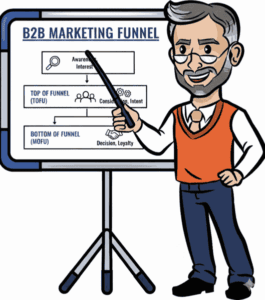
To optimize your B2B marketing funnel for growth, you must first understand its current state from a strategic perspective. For the C-suite, this means viewing the funnel not just as a diagram, but as the operational blueprint of how your company turns potential interest into paying customers. While specific stage names might vary, a common strategic view includes:
Awareness: Prospects identify a problem or need and become aware of potential solutions, including yours.
Engagement: Prospects interact with your content and brand, demonstrating initial interest.
Marketing Qualified Lead (MQL): A prospect identified by marketing as having met specific criteria indicating a higher propensity to become a customer (e.g., downloaded key content, attended a webinar).
Sales Accepted Lead (SAL): An MQL reviewed and accepted by Sales as worthy of direct follow-up.
Sales Qualified Lead (SQL): A prospect who has been qualified by Sales and meets criteria indicating a genuine fit and interest for a sales conversation.
Opportunity: A qualified prospect who is actively engaged in a sales process with a defined potential deal value and timeline.
Customer: A closed, paying customer.
From a strategic optimization standpoint, the most critical handoff points demanding your attention are typically:
MQL to SQL: The transition from a marketing-identified lead to one deemed truly sales-ready.
SQL to Opportunity: Converting a qualified lead into an active sales engagement with a potential deal.
Opportunity to Close: Guiding a potential deal through the sales cycle to a successful win.
Why these stages? Because these represent the points where significant investment (both marketing and sales) has been made, and where friction or misalignment can cause the largest number of qualified prospects to drop out before reaching revenue. Defining clear, strategically aligned criteria for moving prospects between these stages is paramount. This isn’t just about a checkbox; it’s about establishing shared understanding and accountability between Marketing and Sales based on criteria that genuinely predict future customer value.
Understanding typical B2B conversion rate benchmarks is also crucial, not necessarily to mirror them exactly, but to provide context. What constitutes a healthy funnel varies significantly by industry, deal size, and sales cycle complexity. For example, MQL-to-SQL rates can range from under 10% to over 30%, while Opportunity-to-Close rates might vary from 10% to 50%+. Knowing typical ranges allows you to contextualize your own performance and identify stages that are significantly underperforming relative to industry norms or internal targets, pinpointing areas for strategic focus.
Identifying Your Funnel’s Weakest Links: Pinpointing Conversion Bottlenecks
You can’t fix what you don’t measure. The imperative for a data-driven approach to funnel analysis is non-negotiable for any C-suite focused on growth and efficiency. Relying on intuition alone is a recipe for continued leakage and wasted resources. Strategic funnel evaluation requires looking beyond vanity metrics and focusing on indicators that reveal the health and efficiency of your conversion process.
Key metrics for strategic funnel evaluation include:
Stage-by-Stage Conversion Rates: The percentage of prospects that successfully move from one stage to the next (e.g., Awareness to Engagement, MQL to SQL, SQL to Opportunity, Opportunity to Close). This is the most direct measure of conversion efficiency at each handoff.
Pipeline Velocity: How quickly prospects move through the funnel, either overall or within specific stages (Time in Stage). Slow velocity can indicate bottlenecks, stalled leads, or inefficient processes. A strong pipeline velocity improves revenue predictability. (/link-to-article-on-pipeline-management)
Lead to Opportunity Rate: The overall percentage of initial leads (raw inquiries) that eventually become qualified opportunities.
Opportunity to Close Rate: The percentage of opportunities that successfully close as won deals.
Customer Acquisition Cost (CAC) related to stage drop-offs: Analyzing how drop-offs at specific stages inflate the cost of acquiring a paying customer. For example, if your MQL-to-SQL rate is low, you’re essentially paying to generate MQLs that never turn into sales opportunities, increasing your effective CAC.
Methods for visualizing funnel flow, such as creating simple funnel charts or using advanced analytics dashboards, are essential for quickly identifying major drop-off points. These visualizations make it immediately clear which stages are hemorrhaging prospects. Analyzing this data allows you to isolate specific stages with low B2B lead conversion rates, pinpointing the “weakest links” that offer the highest potential ROI for optimization efforts.
However, data alone only tells you where the problem is, not why. Gathering qualitative insights is equally critical. Implementing strategic feedback loops with your Sales team, Customer Success teams, and even recent prospects (both wins and losses) can uncover the underlying reasons for drop-offs. Sales might report that MQLs aren’t truly qualified, customer success might reveal issues with initial onboarding that stem from how deals were closed, and lost prospects can provide invaluable feedback on your sales process or value proposition. Combining quantitative data with qualitative feedback provides a complete picture of your funnel’s health and identifies the root causes of inefficiency.
Unlocking High Conversion: Overarching Strategic Levers for B2B Funnel Optimization
Optimizing your funnel for high conversion requires more than just tactical tweaks; it demands strategic alignment and cultural shifts across the organization. For the C-suite, pulling these overarching strategic levers sets the foundation for sustainable growth.
Firstly, cultivating a data-centric decision-making culture across marketing and sales is paramount. This means establishing shared metrics, providing access to relevant data, and empowering teams to use insights to inform their actions. Decisions about resource allocation, process changes, or content strategy should be driven by funnel performance data, not just gut feelings.

Secondly, ensuring strategic Sales and Marketing alignment (often formalized through a Service Level Agreement or SLA) is non-negotiable for seamless handoffs. Marketing must deliver leads that Sales agrees are qualified, and Sales must commit to timely and appropriate follow-up. This requires joint definition of ideal customer profiles (ICPs), lead scoring criteria, and stage progression definitions. Focusing on the Ideal Customer Profile (ICP) ensures that the right type of lead enters the funnel from the outset, reducing wasted effort on prospects who are unlikely to ever become valuable customers.
Applying strategic Conversion Rate Optimization (CRO) principles extends beyond just optimizing website landing pages. It means looking at every step in the prospect’s journey through the funnel – from the initial interaction to the final contract signature – and asking: How can we make it easier, more compelling, and more efficient for the prospect to move to the next stage? This could involve optimizing the lead qualification process, streamlining the demo booking experience, or refining the proposal delivery method.
Strategic considerations for investing in data infrastructure and analytics capabilities are also critical. You need the right systems (CRM, marketing automation, analytics platforms) not just to collect data, but to connect it across the entire prospect journey and provide actionable insights. This isn’t just an IT expense; it’s an investment in your ability to understand and optimize your revenue engine.
Ultimately, all funnel optimization efforts must connect directly to reducing CAC and increasing customer lifetime value (LTV). By reducing the number of wasted leads and accelerating the sales cycle for qualified prospects, you lower the cost of acquiring each customer. By ensuring a smoother, more relevant buyer journey, you contribute to better customer satisfaction and retention, increasing LTV. A high converting B2B funnel strategy at a strategic level is one that demonstrably impacts these core financial metrics.
Optimizing Critical B2B Funnel Handoffs: Strategies for Peak Conversion
Focusing strategic effort on the most impactful handoff points is key to unlocking significant revenue gains. Let’s delve into strategies for optimizing the critical transitions identified earlier.
Optimizing MQL to SQL Conversion
This is often one of the leakiest parts of the B2B funnel. A significant number of leads generated by marketing never receive meaningful follow-up from sales, or when they do, they are quickly dismissed as unqualified.
Establishing a joint Marketing and Sales definition of what constitutes a qualified MQL is the foundational step. This definition must be agreed upon by both teams and based on criteria that demonstrably correlate with future customer success. It’s a strategic alignment point, not a tactical exercise.
Strategic refinement of lead scoring models should be based on behavioral and demographic data relevant to high-value prospects. The model needs to be dynamic, updated based on feedback from Sales on which leads actually convert to opportunities and customers. This goes beyond simple point allocation; it’s about predictive modeling. (/link-to-article-on-lead-scoring-strategies)
Discussing strategic lead enrichment processes ensures that Sales receives not just a name and contact info, but necessary context. What content did they engage with? What company do they work for? What industry trends are relevant? This context helps Sales prioritize and personalize their outreach, increasing the likelihood of conversion.
Optimizing the speed and strategy of Sales follow-up on MQLs is critical. Research consistently shows that the faster a qualified lead is contacted, the higher the chance of engagement. This requires strategic processes and accountability on the Sales side, often supported by technology. The strategy of the follow-up – tailored messaging based on lead context – is as important as speed.
Creating a formal feedback loop for Sales to inform Marketing on MQL quality and conversion challenges is vital for continuous improvement. Marketing needs to know why leads aren’t converting – is it poor fit, lack of interest, timing? This feedback allows Marketing to refine targeting, messaging, and lead scoring.
Addressing the root causes of inefficient B2B lead nurturing that results in low MQL->SQL rates means examining the relevance, timing, and personalization of your nurturing campaigns leading up to the MQL stage and beyond. Is the content guiding prospects toward sales readiness? Are you nurturing them effectively after they become an MQL but aren’t immediately engaged by Sales?
Optimizing SQL to Opportunity Conversion
Once Sales has accepted a lead, the next critical step is converting them into a genuine sales opportunity. This stage requires precision in qualification and process.
Defining clear, mutually agreed-upon criteria for Sales Accepted Leads (SQLs) and Opportunity creation is crucial. What specific information must Sales gather to classify a prospect as an Opportunity? This prevents premature opportunity creation (cluttering the pipeline) and ensures focus on leads with genuine potential.
Implementing or refining strategic sales qualification frameworks (e.g., BANT, MEDDIC, etc.) ensures that Sales systematically gathers the necessary information to assess fit, need, budget, and decision-making process. This aligns qualification criteria with overall business goals and resource allocation strategy.
Streamlining the strategic handover process between Marketing and Sales post-MQL acceptance minimizes friction. How is the lead information transferred? Is the context provided? Is there a clear process for Sales acknowledging receipt and initiating contact? A clunky handover can kill momentum.
Ensuring Sales teams are strategically enabled with the right information and insights from Marketing means providing readily accessible competitive intelligence, relevant case studies, pricing details, and insights into the prospect’s prior engagement history. Sales shouldn’t have to hunt for information; it should be delivered strategically.
Identifying and removing strategic process bottlenecks that prevent qualified leads from becoming opportunities requires analyzing the sales process itself. Are there unnecessary steps? Delays in scheduling? Internal approval hurdles? Removing these strategic roadblocks accelerates the conversion from SQL to Opportunity.
Optimizing Opportunity to Close Conversion
This is the final stage where significant value is realized (or lost). Optimizing here directly impacts revenue.
Standardizing and optimizing the strategic sales process stages and criteria ensures consistency and allows for meaningful analysis. What are the key milestones in your sales cycle, and what specific actions and prospect commitments are required to move from one stage to the next? Defining this strategically helps identify where deals are stalling.
Improving strategic forecasting accuracy is directly linked to refined deal stage progression criteria. If stages are clearly defined by prospect actions/commitments, forecasting becomes more reliable. This is critical for resource planning and revenue prediction at the C-suite level.
Strategic initiatives to accelerate pipeline velocity can include implementing deal review processes, using sales automation tools, or providing resources to help prospects navigate internal buying processes. Reducing the time spent in the Opportunity stage speeds up cash flow and increases sales capacity. (/link-to-article-on-pipeline-management)
Identifying and addressing common, high-impact sales objections at a strategic level involves analyzing win/loss data and sales feedback to understand why deals are lost. Then, developing strategic responses, content, or product/service adjustments to proactively address these objections early in the sales process.
Implementing a robust win/loss analysis process isn’t just about reviewing individual deals; it’s about aggregating insights to identify systemic issues. Are you losing deals to competitors consistently? Are there common reasons for “no decision”? This analysis provides strategic intelligence for refining sales strategy, messaging, and even product development.
Considering strategic approaches to negotiation and deal structuring can impact close rates and average deal size. This involves training Sales on effective negotiation tactics and providing frameworks for structuring deals that meet both the customer’s needs and your business objectives.
Supercharging Lead Nurturing: Accelerating Prospects Through the Funnel
Lead nurturing isn’t just a top-of-funnel activity; it’s a strategic imperative that accelerates prospects through the entire B2B funnel, keeping them engaged and moving towards conversion.
The strategic role of lead nurturing extends from initial awareness all the way through to becoming a customer and potentially advocating for your brand. Nurturing should support prospects at every stage, providing relevant value and guiding them towards the next step in their journey.
Implementing advanced segmentation strategies is key to effective nurturing. Segmenting based on buyer stage (e.g., MQL, SQL, Opportunity), behavior (e.g., website visits, content downloads, email clicks), and intent signals allows you to deliver highly relevant messages.
Strategic approaches to personalization go beyond simply using a prospect’s name. It involves tailoring content and messaging based on their industry, company size, role, challenges they’ve indicated, and past interactions. Personalization at scale requires sophisticated technology and a strategic content architecture.
Aligning content strategy directly with the strategic needs and questions of buyers at each funnel stage is fundamental. Are you providing educational content for the Awareness stage? Solution-focused content for the Engagement and MQL stages? Case studies, demos, and pricing information for the SQL and Opportunity stages? Content should proactively address buyer questions and build confidence at every step.
Designing strategic automated nurturing paths triggered by specific prospect actions or milestones ensures timely and relevant communication. Downloading a specific whitepaper might trigger a sequence offering related resources or an invitation for a consultation. Reaching a certain lead score could trigger an alert to Sales. These automated paths are designed to keep momentum and guide prospects efficiently.
Measuring the effectiveness of nurturing campaigns must go beyond open and click rates. The strategic measure is their impact on progression to the next funnel stage and ultimately, conversion rates and pipeline velocity. Are nurtured leads converting to SQLs at a higher rate? Are nurtured Opportunities closing faster?
Addressing “inefficient B2B lead nurturing” directly involves examining relevance, timing, and strategic goal alignment. Is the nurturing content actually relevant to the prospect’s current stage and interests? Is the timing right? Is the entire nurturing program strategically designed to move prospects efficiently towards becoming qualified leads and opportunities, rather than just sending out generic communications?
Measuring Impact and Maximizing ROI: Tying Funnel Optimization to Revenue Growth
For the C-suite, the ultimate goal of funnel optimization is not just better metrics in isolation, but demonstrable impact on revenue and ROI. This requires a rigorous approach to measurement and reporting.
Continuously tracking key conversion metrics at every stage is essential, not just to see performance at a point in time, but to identify trends and the impact of implemented changes. Are conversion rates improving quarter over quarter after implementing new strategies?
Developing a framework for calculating the ROI of specific funnel optimization initiatives is crucial for prioritizing future investments. If investing X in refining your lead scoring model led to a Y% increase in MQL-to-SQL conversion, and that translated into Z additional closed deals worth $A, you can quantify the return on that specific optimization effort. This is the essence of a Stage-by-Stage ROI Analysis.
Quantifying the impact of improved pipeline velocity on revenue predictability is also vital. Faster-moving deals mean revenue is realized sooner and forecasts become more reliable. You can model how a reduction in average sales cycle length translates into faster revenue recognition and improved cash flow.
Analyzing the effect of funnel optimization on CAC and ultimately LTV demonstrates the long-term financial health benefits. Lower CAC and higher LTV are direct outcomes of a more efficient, higher-converting funnel that attracts, converts, and retains valuable customers.
Forecasting potential revenue gains based on anticipated conversion rate improvements allows you to model the upside potential of your optimization efforts and justify investment. If you project a 5% increase in MQL-to-SQL and a 3% increase in Opportunity-to-Close, what does that realistically mean for your annual revenue projection?
Creating strategic reports for the C-suite should focus on revenue impact, not just activity metrics. While number of leads or website traffic might be indicators, the key is reporting on conversion rates at critical stages, pipeline value, velocity, CAC, and projected revenue impact.
Utilizing external and internal benchmarks provides context for your performance. How do your conversion rates compare to industry averages? How do different segments of your business or different product lines perform against each other? This strategic comparison helps pinpoint areas for further investigation and optimization.
Building a High-Performance Funnel Engine: Implementation & Continuous Improvement
Achieving a high converting B2B funnel is not a one-time project; it’s an ongoing operational philosophy. Building a high-performance funnel engine requires embedding optimization into the DNA of your organization.
Fostering a culture of continuous optimization and strategic experimentation is key. Encourage teams to hypothesize about potential improvements, test them rigorously, and learn from the results – whether successful or not. This requires psychological safety and executive buy-in.
Implementing a strategic testing framework means applying principles of A/B testing or multivariate testing not just to small website changes, but to entire processes, messaging sequences, or qualification criteria at key stages. For example, testing different Sales follow-up strategies for MQLs or different sequences for nurturing Opportunities.
Ensuring strong cross-functional collaboration (Marketing, Sales, Customer Success, Product) is embedded in the process. Funnel optimization is a team sport. Regular meetings, shared goals, and joint analysis of data are crucial for identifying interdependencies and implementing cohesive solutions.
Strategic considerations for leveraging technology (CRM, marketing automation, analytics platforms) are about viewing these tools as enablers of strategy, not just repositories of data or execution platforms. How can technology automate manual steps, provide deeper insights, improve communication, and streamline handoffs? Technology should support your optimized process, not dictate it.
Establishing an iterative process for ongoing optimization – Analyze, Strategize, Implement, Measure, Refine – creates a perpetual cycle of improvement. Based on data analysis, develop strategic hypotheses, implement changes, measure their impact, and refine your approach based on the results.
Developing strategies for scaling successful optimization initiatives across the organization ensures that improvements in one area benefit the whole. If a specific nurturing sequence proves highly effective for one product line, how can it be adapted and implemented for others?
This iterative process and focus on cross-functional strategic optimization is what truly constitutes a high converting B2B funnel strategy.
Proof in the Pipeline: Real-World B2B Funnel Optimization Success Stories
The strategic optimization frameworks and tactical improvements discussed here are not just theoretical. Their application yields tangible, measurable results that resonate with C-suite objectives: significant revenue uplift and improved ROI.
While specific client names and exact figures require confidentiality, aggregated data and benchmarks consistently showcase the potential revenue impact. For example, analysis across various B2B companies often reveals that increasing the MQL-to-SQL conversion rate by just 5-10 percentage points can translate to a 15-30% increase in the total number of opportunities generated from marketing leads. Similarly, optimizing the SQL-to-Opportunity or Opportunity-to-Close stages can dramatically impact pipeline value and sales velocity.
Illustrative case studies demonstrate how optimizing specific funnel stages drives overall growth. Consider a hypothetical B2B SaaS company that identified a significant drop-off between their SQL stage and Opportunity creation. Through strategic refinement of their sales qualification framework, improved sales enablement resources, and a streamlined handover process from Marketing, they were able to increase their SQL-to-Opportunity conversion rate by 12 percentage points within two quarters. This single improvement, compounding through the rest of their pipeline, led to a projected 18% increase in closed deals and a significant reduction in their customer acquisition cost for leads originating from this channel.
Another hypothetical example involves addressing inefficient B2B lead nurturing for leads in the middle of the funnel who weren’t yet SQLs. By segmenting these leads more effectively, personalizing content based on their specific interests and industry challenges, and implementing automated nurturing paths triggered by engagement, a company could observe a 20% increase in the number of these nurtured leads reaching the MQL stage, subsequently feeding more potential into the Sales pipeline.
These examples, grounded in the principles discussed – data-driven analysis, strategic handoff optimization, effective nurturing, and cross-functional alignment – quantify the results with specific metrics and business outcomes that directly impact revenue and profitability. They connect the strategic frameworks to tangible, measurable success, proving that investing in funnel optimization is investing in predictable and accelerated revenue growth.
Optimizing your B2B marketing funnel isn’t just about fixing leaks; it’s about building a highly efficient, predictable revenue engine. By focusing strategically on the critical handoff points, leveraging data to identify bottlenecks, implementing cross-functional improvements, and fostering a culture of continuous optimization, you can turn a leaky funnel into your biggest growth lever, maximizing marketing ROI and delivering exponential revenue gains.