
Table of Contents
The Evolving Landscape of Marketing for Banks
Building the Foundation: Trust, Compliance, and Customer Experience
Digital Transformation and Digital Marketing for Banks
Strategic Approaches to Bank Customer Acquisition
Leveraging Data, Personalization, and Loyalty
Measuring Marketing Success and The Future of Bank Marketing Strategy
Further Reading
The banking sector has long relied on established practices and traditional marketing channels. Yet, look around today. The competitive landscape is shifting dramatically, fueled by FinTech innovation, evolving customer expectations, and a rapid digital transformation. Did you know, for instance, that projections suggest a significant percentage of consumers now prioritize a seamless digital experience over physical branch interactions when choosing a bank? For sales and marketing leaders in financial services, this isn’t just a minor adjustment; it’s a fundamental reshaping of how we must approach marketing for banks.
Our mandate is clear: drive growth, build relationships, and enhance brand perception. However, doing so in the banking sector presents a unique duality. We must embrace the power and efficiency of digital marketing for banks, leveraging data and personalization to engage customers where they are – online, on mobile, and through new platforms. Simultaneously, we operate within a heavily regulated environment where trust isn’t just a marketing message; it’s the bedrock of our entire business model. This article delves into the modern financial services marketing strategy, exploring how leaders can navigate this complex terrain, balancing traditional values with digital innovation, all while ensuring regulatory compliance and fostering the deep trust that defines success in banking.
The Evolving Landscape of Marketing for Banks
Marketing for banks today is a far cry from the campaigns of even a decade ago. The challenges facing modern bank marketing are manifold and interconnected. We grapple with intense competition not only from incumbent financial institutions but also from agile FinTech startups offering specialized services and challenger banks built entirely on digital platforms. This increased competition puts pressure on traditional revenue streams and customer relationships.
Adding to this complexity are the rapidly changing customer expectations. Digital natives and even older demographics now expect banking services to be as convenient, intuitive, and personalized as their favorite e-commerce platforms or social media feeds. They demand 24/7 access, self-service options, and proactive communication. This shift has exposed a trust deficit for many large institutions, exacerbated by past financial crises and data privacy concerns. Customers are more discerning about who they trust with their financial lives.
Despite these challenges, digital transformation and the wealth of data now available present unprecedented opportunities. We have the tools to understand customer behavior at a granular level, personalize interactions like never before, and deliver services through channels customers prefer. Digital marketing for banks allows for more precise targeting, measurable results, and cost-effective reach compared to traditional methods.
This sets the stage for why traditional approaches alone are no longer sufficient. Relying solely on branch promotions, direct mail, or mass advertising campaigns risks alienating a significant portion of the market and failing to capture the attention of digitally-savvy consumers. While traditional touchpoints remain important for certain segments and types of interactions, they must be integrated into a broader, more sophisticated strategy.
Understanding the target audience – sales and marketing leaders in the banking sector – means recognizing that you operate at the intersection of ambitious growth targets and stringent oversight. Your teams need strategies that are not only innovative and effective at bank customer acquisition but also robust and compliant.
The core balancing act, therefore, is integrating digital innovation while maintaining the traditional values of security, reliability, and personal connection that customers still associate with their financial institution. It’s about leveraging technology to enhance the human element of banking, not replace it entirely, ensuring every digital interaction reinforces the bank’s trustworthiness and authority.
Building the Foundation: Trust, Compliance, and Customer Experience
In financial services marketing, the bedrock upon which all strategies must be built is trust. Without it, even the most innovative digital marketing for banks will fall flat. Furthermore, operating within a highly regulated industry means that compliance is not an optional add-on but a fundamental requirement that shapes every marketing activity. Overlaying these pillars is the critical need for an exceptional customer experience, which has emerged as a primary differentiator in a crowded market.
Trust as the Currency of Financial Services Marketing
The importance of trust in banking relationships cannot be overstated. Customers entrust banks with their most sensitive financial information and their future financial security. This relationship is inherently built on faith – faith that their money is safe, that their data is protected, and that the institution acts in their best interest. Marketing communications must consistently reinforce this faith, positioning the bank not just as a provider of products but as a reliable partner.
Strategies for building and reinforcing trust through marketing communications include emphasizing security measures prominently, being transparent about fees and product terms, showcasing reliable customer service, and highlighting community involvement. Every message, from a website banner to a mobile app notification, contributes to the overall perception of trustworthiness. Tone of voice should be professional, empathetic, and reassuring.
Transparency in financial products and services is paramount. Marketing materials must clearly articulate the benefits, risks, terms, and conditions of products like loans, mortgages, and investment accounts. Misleading language or hidden fees can severely erode trust and lead to regulatory penalties. Clear, simple language should be prioritized over complex jargon.
Navigating Regulatory Compliance in Marketing
Key regulations impacting bank marketing are numerous and vary by jurisdiction, but universally include requirements around truth in advertising, fair lending practices, data privacy, and consumer protection. In the US, this includes acts enforced by the Consumer Financial Protection Bureau (CFPB), while in Europe, GDPR sets a high standard for data handling. Other regulations might govern specific products, like mortgage advertising (e.g., RESPA, TILA) or investment marketing (e.g., SEC rules). Sales and marketing leaders must have a deep understanding of the regulatory landscape.
Ensuring marketing practices are compliant and ethical requires rigorous internal processes. This involves legal review of all marketing materials before public dissemination, clear record-keeping of approvals and campaign details, and ongoing training for marketing teams on relevant regulations. Ethical considerations extend beyond legal minimums, encompassing responsible targeting, avoiding predatory practices, and ensuring communications are not confusing or misleading, particularly for vulnerable populations.
Data privacy and security considerations in marketing activities are intrinsically linked to compliance and trust. With the increasing reliance on customer data for personalization and targeting, banks must adhere strictly to data protection regulations (like GDPR, CCPA, etc.). This involves obtaining proper consent for data usage, ensuring data is stored and processed securely, and being transparent with customers about how their data is used. Any perceived lapse in data security can be catastrophic for reputation and trust.
Communicating security measures to customers is a vital part of trust-building marketing. Proactively informing customers about the security technologies protecting their accounts, tips for staying safe online, and the bank’s protocols for detecting and preventing fraud reassures them and demonstrates a commitment to their safety. This communication should be clear, actionable, and delivered through trusted channels.
Customer Experience (CX) as a Key Differentiator
Defining exceptional CX in the banking sector goes beyond friendly tellers or easy-to-use apps. It encompasses the entire journey a customer takes with the bank, from initial awareness and bank customer acquisition through daily transactions, problem resolution, and potentially long-term relationship management for services like wealth management or business banking. Exceptional CX is seamless, intuitive, personalized, and consistently positive across all interactions.
Mapping the customer journey across touchpoints (physical and digital) is crucial for understanding CX. This involves visualizing the steps a customer takes when, for example, applying for a loan online, depositing a check via mobile app, visiting a branch to discuss retirement options, or contacting customer service via chat. Each touchpoint offers an opportunity to delight or frustrate the customer.
Identifying pain points and opportunities for improvement within this journey is a core task for marketing and CX teams. Is the online application process too long? Is mobile deposit glitchy? Are call center wait times excessive? Are branch staff equipped to handle complex inquiries? Data analytics, customer feedback surveys, and journey mapping workshops are essential tools for uncovering these areas. Each pain point represents a risk to customer loyalty and a potential driver of churn.
The link between positive CX and customer loyalty is direct and powerful. Customers who have consistently positive experiences are more likely to remain with the bank, deepen their relationship by using additional products (increasing customer lifetime value), and recommend the bank to others. Conversely, poor CX is a primary driver of customer defection. Marketing plays a vital role not just in promoting products, but in shaping the customer experience itself, from website design and app usability to the tone of customer service communications and the relevance of personalized offers. CX is, in effect, marketing in action.
Digital Transformation and Digital Marketing for Banks
The seismic shift towards digital channels isn’t just changing how banks operate; it’s revolutionizing marketing for banks. Embracing digital transformation is no longer optional; it’s essential for reaching customers effectively, delivering personalized experiences, and staying competitive. Digital marketing for banks encompasses a wide array of strategies and tactics designed to engage customers online and through digital devices.
Developing an Omnichannel Marketing Strategy
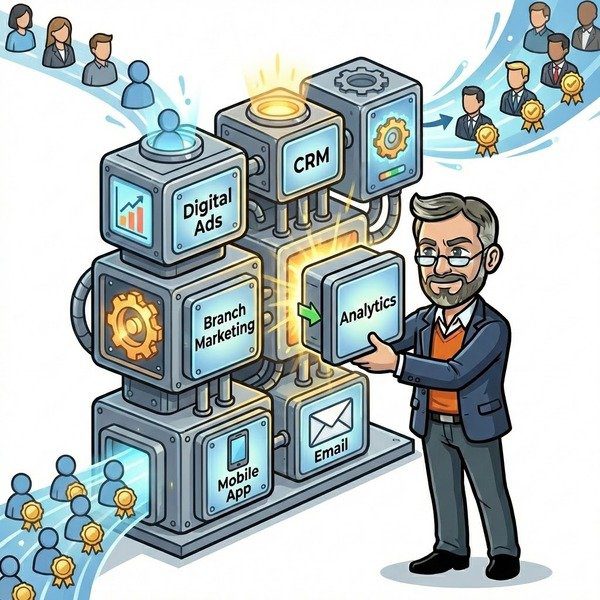
A truly effective digital marketing for banks strategy requires moving beyond siloed channels to develop an omnichannel approach. This means integrating online and offline channels seamlessly so that a customer’s experience is consistent and connected, regardless of how they interact with the bank. Think of a customer starting a loan application online, getting a personalized notification on their mobile app, receiving a follow-up email, and then visiting a branch to complete the process – all feeling like part of a single, cohesive journey.
Ensuring consistent messaging and branding across all platforms is fundamental to omnichannel success. The bank’s voice, visual identity, and value proposition should be uniform whether the customer is on the website, using the mobile app, receiving an email, seeing a social media ad, or talking to a representative in a branch. This consistency reinforces brand identity and trust.
The goal is creating a unified customer experience where the transition between channels is smooth and information is shared appropriately (with necessary compliance safeguards). *Consider a hypothetical scenario:* A customer logs into their online banking portal and sees a personalized offer for a credit card based on their spending patterns. Later that day, they receive a push notification on their mobile app reinforcing the offer with slightly different messaging. The next week, they visit a branch, and the teller, noting their online activity (with appropriate data privacy permissions), can subtly reference the credit card offer in a natural conversation. This level of integration requires sophisticated data management and coordination across marketing, sales, and service teams.
Leveraging Mobile Banking Marketing
Given that customers spend significant time on their smartphones, the importance of mobile-first strategies in digital marketing for banks is paramount. The mobile banking app is often the most frequent touchpoint a customer has with their bank. Marketing must leverage this channel effectively.
This includes in-app marketing and notifications. Banks can use personalized push notifications (with opt-in consent) to inform customers about account activity, offer relevant products based on their profile (e.g., a travel card offer before a planned trip), or provide financial literacy tips. In-app banners or messages can promote new features, services, or special offers discreetly within the user interface.
Mobile-specific content and offers can further enhance engagement. This might include short, digestible financial tips tailored for mobile consumption, exclusive mobile-only offers (like a slightly better interest rate for opening an account via the app), or features that leverage mobile capabilities, such as location-based services (e.g., finding nearby ATMs or branches).
Content Marketing and SEO for Financial Institutions
In the information age, creating valuable, educational content is a powerful form of financial services marketing strategy. Banks have a unique opportunity to position themselves as trusted advisors by providing helpful content that addresses common financial questions and needs. This can take many forms: blog posts explaining mortgage options, guides to saving for retirement, webinars on small business financing, or calculators for budgeting.
Addressing common financial questions and needs through content builds authority and trust. When a potential customer searches online for “how to improve credit score,” a bank that provides a comprehensive, easy-to-understand guide is more likely to earn that person’s trust and potentially their business than one that only serves ads.
Optimizing website and content for search engines (SEO for banks) is critical to ensure this valuable content is discoverable. This involves researching relevant keywords customers use when searching for financial information or services, optimizing website technical elements, building high-quality backlinks, and creating content that directly answers user queries. Good SEO helps a bank appear higher in search results, driving organic traffic and positioning the bank as a go-to resource.
Ultimately, content marketing and SEO contribute significantly to building authority and expertise online. A bank that consistently publishes helpful, accurate, and well-optimized content establishes itself as a knowledgeable leader in the financial space, enhancing its reputation and supporting both bank customer acquisition and retention efforts.
Social Media Strategy for Banks
Social media for banks presents both opportunities and significant challenges, primarily due to the need for strict regulatory compliance and careful reputation management. Choosing appropriate platforms for engaging the target audience requires understanding where different customer segments spend their time online. LinkedIn might be suitable for targeting business owners or wealth management clients, while Facebook or Instagram could be used for broader brand building or reaching younger demographics.
Building community and fostering interaction on social media must be carefully managed. While engagement is the goal, banks must have clear guidelines on what can be discussed publicly, particularly regarding individual account issues or specific financial advice. Interactive content like polls, Q\&A sessions (on general topics), or educational videos can foster engagement while remaining compliant.
Handling customer service and reputation management on social media requires dedicated resources and clear protocols. Customers may turn to social channels to ask questions or express frustrations. Banks must respond promptly, professionally, and know when to take the conversation offline to protect customer privacy. Monitoring social media for brand mentions and public sentiment is essential for managing reputation proactively.
Regulatory considerations for social media communication are complex. Rules around endorsements, testimonials, disclosure of affiliations, and accurate product representation apply just as they do in other marketing channels. Banks must implement robust review processes for social media posts and ensure employees are trained on compliance requirements when representing the bank online.
Paid Digital Advertising Considerations
Paid digital advertising offers powerful tools for targeting specific customer segments and driving bank customer acquisition. Platform options include search engine marketing (SEM) on Google and Bing, social media advertising on platforms like Facebook, Instagram, LinkedIn, and display advertising across vast networks of websites.
Targeting strategies for specific financial products/services can be highly sophisticated using digital advertising platforms. Banks can target individuals based on demographics, interests (e.g., interest in buying a home), search history (e.g., searching for “best savings accounts”), or even life events (e.g., recent marriage). This precision allows for highly relevant ad delivery.
Compliance in ad messaging and landing pages is non-negotiable. Ads must be truthful, not misleading, clearly disclose rates and terms where required, and link to landing pages that reiterate compliant information. Platforms also have their own advertising policies for financial services, which must be strictly adhered to. Legal and compliance review is mandatory for all paid digital ad copy and creative.
Measuring effectiveness (ROI) of paid campaigns is one of the key advantages of digital marketing for banks. Platforms provide detailed analytics on impressions, clicks, conversions (e.g., account applications started or completed), and cost per acquisition. Tracking these metrics allows marketing teams to optimize campaigns, allocate budgets effectively, and demonstrate the value of their efforts to stakeholders.
The Role of FinTech and Open Banking in Marketing
FinTech companies are revolutionizing financial services, and banks can explore partnerships with these agile innovators. Collaborating with FinTechs can enable banks to offer cutting-edge services like advanced budgeting tools, personalized financial advice via AI, faster payment options, or integrated investment platforms without building everything in-house.
Leveraging Open Banking capabilities, where regulations permit, can unlock significant opportunities for enhanced services and data insights (with customer consent). Open Banking allows secure sharing of customer financial data with third-party providers. For marketing, this could mean gaining a more holistic view of a customer’s financial life (across different institutions), enabling hyper-personalized product recommendations or services tailored to their complete financial picture.
Marketing innovative FinTech integrations to customers is essential to ensure adoption and highlight the bank’s commitment to innovation. This involves clearly communicating the benefits of new integrated services, explaining how they make the customer’s financial life easier or better, and reassuring them about the security of using these connected platforms. Highlighting these partnerships can also attract tech-savvy segments.
Strategic Approaches to Bank Customer Acquisition
Effective bank customer acquisition strategies in the modern era must be highly targeted, data-driven, and focused on building long-term relationships, not just opening accounts. The cost of acquiring a new customer can be significant, making it essential to focus acquisition efforts on prospects most likely to become valuable, long-term clients.
Defining Target Segments and Ideal Customer Profiles
Moving beyond basic demographics is crucial for defining target segments and ideal customer profiles. While age, income, and location are still relevant, understanding psychographics (attitudes, interests, lifestyles) and behavior (online activity, spending habits, financial goals) provides a much richer picture. For instance, targeting individuals interested in sustainable investing requires understanding their values, not just their income bracket.
Identifying high-value customer segments is key to optimizing financial services marketing strategy. These segments might include individuals with significant investable assets (wealth management), small business owners, or young professionals with high earning potential. Marketing efforts can then be tailored to the specific needs and aspirations of these groups.
Tailoring messaging to specific needs is essential for effective acquisition. A mortgage campaign targeting first-time homebuyers will use different language and highlight different benefits than one targeting individuals looking to refinance. Marketing for wealth management services requires a sophisticated approach that speaks to long-term financial goals and trust, distinct from messaging for a simple checking account.
Designing Effective Acquisition Funnels
Designing effective acquisition funnels involves mapping the customer acquisition journey from initial awareness through interest, consideration, and ultimately, conversion (opening an account, taking out a loan, etc.). This journey is rarely linear in the digital age, with customers moving between channels and engaging with multiple pieces of content before making a decision.
Strategies for lead generation (online and offline) must feed this funnel. Online tactics include search engine marketing, social media lead generation forms, content downloads (e.g., a guide to choosing a bank), and online contests. Offline tactics might still include referrals, community events, or targeted direct mail that drives recipients to online landing pages.
Optimizing digital application processes is a critical part of the acquisition funnel for digital marketing for banks. If the online application is cumbersome, confusing, or requires too many steps, potential customers will abandon it. Streamlining forms, allowing users to save progress, providing clear instructions, and offering easily accessible support (like chatbot or click-to-call) can significantly improve conversion rates.
Lead Generation Tactics for Banks
Beyond general strategies, specific lead generation tactics prove effective for banks. Landing page optimization is paramount – ensuring dedicated pages for specific products or offers are clear, persuasive, mobile-friendly, and have a prominent call to action.
Webinars and educational events, delivered online or in person, can generate high-quality leads by attracting individuals interested in specific financial topics (e.g., retirement planning, small business financing). These events position the bank as an expert and provide opportunities to collect contact information.
Partnerships and referrals remain valuable lead sources. Partnering with real estate agents for mortgage leads or accountants for small business leads can be effective. Encouraging referrals from existing satisfied customers through a well-designed program is also a powerful tactic.
Leveraging digital channels for lead capture involves using forms on websites, social media lead ads, email sign-up forms for newsletters, and interactive tools like financial calculators that require contact information. These tactics must always be accompanied by clear privacy policies and consent mechanisms in compliance with regulations.
Enhancing the Customer Onboarding Experience
The critical role of onboarding in reducing churn cannot be stressed enough. The period immediately after a new customer opens an account is crucial for solidifying the relationship and ensuring they become an active, loyal customer. A poor onboarding experience – difficulty setting up online access, confusion about features, lack of guidance – can lead to early churn, negating the effort and cost of bank customer acquisition.
Streamlining digital and in-branch onboarding processes is essential. This might involve sending clear, concise welcome emails outlining next steps, providing tutorials on using online and mobile banking features, scheduling a brief welcome call, or ensuring branch staff provide a warm, helpful introduction during in-person account opening.
Using communication to guide new customers involves a planned series of interactions designed to help them get the most out of their new account and the bank’s services. This could include emails explaining how to set up direct deposit, push notifications about useful mobile features, or invitations to educational webinars. The goal is to proactively address potential questions and demonstrate the value of the relationship from the outset.
Focusing on Customer Lifetime Value (CLTV)
A sophisticated financial services marketing strategy focuses not just on the initial acquisition but on understanding the long-term value of acquired customers. Customer Lifetime Value (CLTV) is a metric that estimates the total revenue a customer is likely to generate over their entire relationship with the bank. Focusing on acquiring customers with high CLTV potential justifies higher acquisition costs and shifts marketing focus towards relationship building and retention.
Strategies for acquiring customers with high CLTV potential involve targeting segments known to have complex financial needs, higher balances, or a propensity to use multiple bank products over time (e.g., young professionals, families planning for the future, small business owners). Acquisition campaigns for these segments should highlight the bank’s ability to meet their evolving needs throughout their financial journey.
Marketing for retention and relationship building becomes just as important as acquisition. Once a customer is acquired, marketing efforts should focus on deepening the relationship, encouraging the use of additional products (cross-selling), and fostering loyalty through exceptional service, personalized communications, and loyalty programs. This reduces churn and increases CLTV.
Leveraging Data, Personalization, and Loyalty
In the age of digital marketing for banks, data is a powerful asset. Ethical and compliant use of customer data allows banks to move beyond mass marketing to deliver highly personalized experiences that build deeper relationships and drive bank customer acquisition and retention.
Data Analytics and Insights for Marketing
Collecting and analyzing customer data ethically and compliantly is the foundation. This involves gathering data from various touchpoints – online banking activity, mobile app usage, branch interactions, call center logs, website visits, campaign responses – and integrating it into a unified view (while strictly adhering to privacy regulations like GDPR, CCPA, etc., ensuring transparency and obtaining necessary consent).
Using data to understand customer behavior and preferences provides invaluable insights for marketing. Analytics can reveal which products customers are interested in, which channels they prefer, their financial goals, life events they might be experiencing, and their propensity to churn or purchase additional products.
Identifying trends and opportunities through data analysis allows marketing teams to be proactive. For example, data might show an increase in young adults searching for information on student loan consolidation, signaling an opportunity for a targeted campaign. Or, analysis might reveal a drop in mobile app usage among a certain segment, indicating a need for focused engagement efforts.
Implementing Customer Segmentation Strategies
Creating dynamic customer segments based on behavior, needs, and value is a key application of data analytics in financial services marketing strategy. Moving beyond static demographic segments, banks can create dynamic segments based on actions (e.g., customers who have recently searched for mortgage information), needs (e.g., small businesses looking for financing), or value (e.g., high-net-worth individuals).
Moving beyond basic segmentation to micro-segmentation allows for even more granular targeting. This involves identifying very specific groups with shared characteristics or behaviors, enabling highly tailored messaging and offers that resonate deeply with individual needs. *Consider a hypothetical scenario:* Instead of just targeting “small business owners,” a bank might micro-segment based on the type of business (e.g., restaurant owners looking for POS solutions vs. tech startups needing venture debt) or their stage of growth.
Personalization at Scale
Implementing personalization at scale is the goal enabled by robust data and segmentation. This means delivering personalized marketing messages and offers through the customer’s preferred channels at the right time. Personalized emails might recommend relevant products based on recent account activity, or website content might dynamically adjust based on the user’s profile or browsing history.
Using data to recommend relevant products and services moves beyond generic cross-selling. Instead of promoting a credit card to everyone, data allows the bank to recommend the *most appropriate* credit card for that individual’s spending habits or credit profile. This relevance increases the likelihood of conversion and enhances the customer experience.
Personalizing the digital banking experience extends personalization beyond marketing communications into the platforms themselves. This could involve customizing the mobile app dashboard based on user preferences, providing personalized financial insights or tips within online banking, or offering quick access to frequently used features.
Building and Marketing Customer Loyalty Programs
Building and marketing customer loyalty programs is a direct strategy for increasing CLTV and retaining customers. Loyalty programs in banking can offer rewards for using certain products, reaching relationship milestones, or referring new customers. Designing programs that provide real value, whether through fee waivers, interest rate bonuses, or exclusive perks, is essential for encouraging participation.
Communicating loyalty benefits effectively is crucial for program success. Customers need to understand how the program works, the value they receive, and how to redeem rewards. Marketing should highlight the benefits clearly and consistently across relevant channels.
Using loyalty data to inform marketing strategies provides a feedback loop. Data on program participation, reward redemption, and correlated product usage can help refine loyalty program design and inform broader marketing efforts aimed at encouraging desired customer behaviors.
Utilizing CRM Systems Effectively for Marketing
Utilizing CRM systems effectively is central to managing customer relationships and interactions at scale. A robust CRM platform serves as a central hub for customer data, interaction history, and communication preferences, providing a 360-degree view of each customer.
Automating marketing campaigns based on customer data allows for timely, relevant communication. CRM systems can trigger automated emails or notifications based on specific customer actions (e.g., depositing a large check, approaching a loan anniversary) or segments (e.g., sending a retirement planning guide to customers nearing retirement age).
Tracking customer journey and engagement within the CRM system provides visibility into how customers interact with marketing efforts and progress through the funnel. This data helps optimize campaigns, personalize interactions, and identify potential issues before they lead to churn.
Measuring Marketing Success and The Future of Bank Marketing Strategy
Demonstrating the value of financial services marketing strategy requires rigorous measurement. In a data-rich environment, marketing leaders must define clear objectives and track Key Performance Indicators (KPIs) that align marketing activities with business outcomes. Looking ahead, emerging technologies promise to further transform how banks engage with customers.
Defining Key Performance Indicators (KPIs) for Bank Marketing
Defining relevant Key Performance Indicators (KPIs) for bank marketing involves tracking metrics across various aspects of the customer lifecycle and marketing funnel. Acquisition metrics are essential for evaluating bank customer acquisition efforts, including cost per acquisition (CPA), conversion rates (e.g., website visitor to application started, application started to account opened), and lead quality.
Engagement metrics assess how customers interact with marketing content and digital platforms. These might include website traffic, time on site, content consumption (e.g., video views, whitepaper downloads), email open and click-through rates, and mobile app usage frequency.
Retention and loyalty metrics are critical for measuring the long-term impact of marketing and CX efforts. These include churn rate, customer lifetime value (CLTV), product penetration (average number of products per customer), and participation in loyalty programs.
Brand health metrics provide a broader view of the bank’s reputation and perception. These can include brand awareness, brand sentiment (often tracked via social listening), and trust levels (measured through surveys or reputation scores).
Calculating Marketing ROI
Accurately calculating Marketing ROI requires attributing marketing efforts to specific business outcomes, such as new accounts opened, loan volume generated, or increases in deposits. This can be challenging in complex customer journeys but is essential for justifying marketing spend to stakeholders and optimizing budget allocation. Attribution models help determine which marketing touchpoints contributed most to a conversion.
Justifying marketing spend to stakeholders – often senior executives or board members – requires presenting clear data that demonstrates the impact of marketing on revenue, profitability, and customer growth. KPIs should be linked directly to strategic business objectives.
Emerging Technologies and Trends
The future of marketing for banks will be significantly shaped by emerging technologies. The potential of AI and Machine Learning in bank marketing is vast, enabling capabilities like chatbots for instant customer service, predictive analytics to identify customers likely to churn or be interested in a specific product, and hyper-personalization of content and offers based on sophisticated behavioral analysis.
Leveraging voice search and smart assistants presents a growing opportunity as more consumers use devices like smart speakers to manage aspects of their lives. Banks can optimize their online content to be easily discoverable via voice search and potentially develop skills or actions for smart assistants that allow customers to check balances or make simple inquiries verbally.
Hyper-personalization versus privacy concerns will remain a critical tension point. While technology enables increasingly granular personalization, banks must navigate this carefully, prioritizing customer consent, transparency, and data security above all else. Trust remains paramount, and violating customer privacy expectations can quickly undo years of marketing efforts. Marketers must stay informed about evolving privacy regulations and ethical guidelines.
Financial Services Marketing Strategy in Action: Case Studies
While specific case studies are not provided, we can conceptualize examples of banks successfully navigating digital transformation. *Consider a hypothetical case:* A regional bank traditionally reliant on branches might launch a comprehensive digital marketing for banks initiative, redesigning their website and mobile app, implementing targeted paid search campaigns for key products, and developing educational content. Tracking KPIs might show a significant increase in online account openings and mobile app engagement among younger demographics, demonstrating the success of their digital pivot.
Another hypothetical might highlight effective bank customer acquisition strategies: A bank targeting small businesses could launch an integrated campaign combining LinkedIn advertising, webinars on small business finance, and a streamlined online application process for business loans. Tracking metrics like cost per acquired business customer and the average profitability of those customers could illustrate the success of this targeted approach.
Finally, examples of building trust and loyalty through marketing might involve a bank that proactively communicates its cybersecurity measures through blog posts, social media, and emails, coupled with a highly responsive and empathetic customer service presence across all channels. Tracking brand sentiment scores and customer retention rates could demonstrate the positive impact on trust and loyalty.
The journey of marketing for banks is one of continuous adaptation. By focusing on building trust, ensuring compliance, prioritizing customer experience, embracing digital innovation, leveraging data wisely, and measuring rigorously, sales and marketing leaders can navigate the complexities and seize the opportunities of this dynamic landscape.
Successful financial services marketing strategy requires a forward-looking perspective, balancing the tried-and-true principles of trust and service with the powerful capabilities of modern digital tools. It’s about meeting customers where they are today and anticipating where they will be tomorrow, all while upholding the highest standards of security and responsibility.
To accelerate your bank’s digital marketing capabilities and effectively acquire and retain valuable customers in this evolving landscape, explore solutions designed to enhance your digital presence, streamline customer journeys, and leverage data for personalized engagement.
Further Reading
- Decoding the Meaning of On-Target Earnings (OTE)
- NPS Meaning: What is Net Promoter Score and How To Measure It
- Marketing Vocabulary: Your Guide to Strategic Communication
- Essential Marketing Terms Leadership Must Know
- The Core Components of a Winning Marketing Strategy
- Scalable Local Marketing Frameworks
- Frameworks for Effective Lead Generation
- How to Effectively Set, Monitor, and Act on Your KPIs