
Table of Contents
Why a High-Impact Sales Strategy is Your Blueprint for Predictable Growth
Laying the Groundwork: Market Analysis, ICP, and Setting Achievable Targets
Developing Your Core Sales Strategy Framework
Building and Optimizing Your Sales Process for Peak Performance
Executing the Plan: Building and Empowering Your Sales Team
Measuring Success: KPIs, Analytics, and Achieving Your Sales Goals
Aligning Sales and Marketing: Fueling the Funnel Together
Continuous Optimization: Evolving Your Strategy for Sustained Growth
Your Action Plan: Steps to Develop and Implement Your Sales Strategy
Further Reading
For sales and marketing leaders alike, the pursuit of consistent, scalable revenue growth can often feel like navigating a dense fog. You’re moving, you’re busy, but are you truly headed in the right direction? Are your efforts compounding, or are you simply reacting to the immediate demands of the market? The fundamental difference lies not just in the activities you undertake, but in the strategic foundation upon which they are built.
Trying to drive significant funnel performance and achieve ambitious revenue targets without a robust sales strategy is like attempting to construct a skyscraper without blueprints. You might manage the first few floors through sheer effort and tactical adjustments, but scaling effectively, managing resources, and ensuring structural integrity become impossible challenges. This article is designed to serve as your comprehensive guide – your architectural plan – to developing, implementing, and continuously optimizing a sales strategy that not only clarifies your path but also provides the framework for predictable, scalable growth. We’ll move beyond the daily hustle to focus on the strategic clarity that empowers both sales execution and crucial marketing alignment.
Why a High-Impact Sales Strategy is Your Blueprint for Predictable Growth
In today’s hyper-competitive landscape, relying solely on the charisma or individual heroics of your sales team is a recipe for unpredictable outcomes and stunted growth. While individual talent remains critical, it’s the underlying structure – the sales strategy – that translates individual effort into collective momentum. A strategy provides the necessary context, direction, and prioritization to move beyond scattered, tactical sales activities.
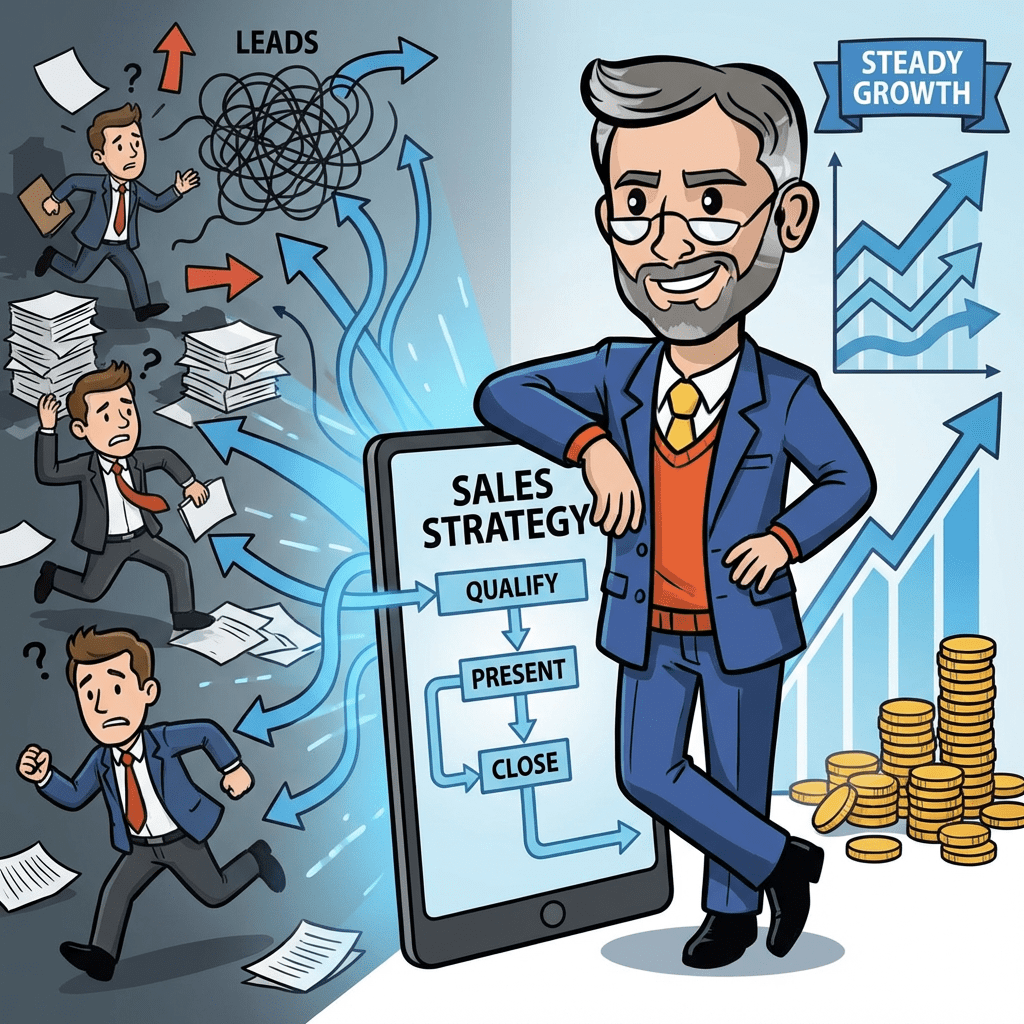
Without a clear strategy, efforts can become fragmented. Sales reps might chase unqualified leads, marketing might generate leads that don’t fit the ideal customer profile, and resources are allocated inefficiently. This leads to wasted time, missed opportunities, and, critically, a lack of predictability in revenue generation. A well-defined sales strategy serves as the indispensable link between your overarching business objectives, your ambitious revenue targets, and the day-to-day actions of your sales force. It outlines precisely *how* you will go to market, *who* you will target, *what* message you will deliver, and *how* you will measure success. This strategic clarity is the essential prerequisite for achieving truly predictable, scalable growth that satisfies both sales and marketing leadership.
Laying the Groundwork: Market Analysis, ICP, and Setting Achievable Targets
Before you can define *how* you will sell, you must first establish a deep understanding of *who* you are selling to and *where* they exist. This foundational work is non-negotiable for building a high-impact sales strategy.
Understanding Your Market and Ideal Customer Profile (ICP)
A successful sales strategy begins with an intimate knowledge of your playing field. Comprehensive market research goes beyond simply identifying your total addressable market (TAM). It involves understanding market trends, economic factors, regulatory environments, and the broader landscape in which your potential customers operate.
Equally critical is a deep dive into defining your Ideal Customer Profile (ICP). This is not just a list of company demographics (industry, size, location) but a nuanced understanding of their psychographics – their core challenges, pain points, strategic goals, daily frustrations, and underlying motivations. What triggers them to seek a solution like yours? How do they prefer to buy? Who is involved in their decision-making process? Building a rich, multi-dimensional ICP allows you to focus your efforts on the prospects most likely to buy and succeed with your offering. You can achieve this depth through interviews with existing customers who exemplify success, lost deal analysis, and collaborative workshops involving sales, marketing, and product teams.
Techniques for effective market research include analyzing industry reports, conducting surveys, monitoring news and social media trends, and, importantly, gathering intelligence directly from your front-line sales and customer success teams.
Simultaneously, analyzing the competitive landscape is vital. Who are your direct and indirect competitors? What are their strengths and weaknesses? How do they position their offerings and pricing? Understanding this allows you to articulate a clear, differentiated value proposition that resonates specifically with your target market.
Setting Clear and Measurable Sales Targets
Once you understand your market and ICP, you can establish meaningful sales targets. These must be more than arbitrary numbers; they must be strategically aligned with your overall business revenue objectives and grounded in market reality and your team’s capacity.
Setting ambitious yet achievable targets requires balancing top-down revenue goals with a bottom-up assessment of your market opportunity and the potential of your territories and sales force. Consider historical performance data, market growth rates, competitive intensity, and the effectiveness of your sales process and enablement programs.
Targets should cascade logically from the organizational level down to teams and individuals. This might involve setting goals for overall revenue, specific product lines, customer acquisition (new logos), expansion within existing accounts, or selling into particular industries or geographic territories.
Critically, your targets shouldn’t *only* focus on lagging indicators like closed revenue volume. Define initial key metrics for success that include leading indicators, such as the number of qualified opportunities created, pipeline value by stage, or key activity metrics (e.g., calls, meetings) that are proven predictors of future revenue. These early metrics are crucial for tracking progress and identifying potential issues long before they impact the final numbers, contributing directly to achieving sales targets.
Developing Your Core Sales Strategy Framework
With the foundational knowledge of your market, ICP, and targets in place, you can now build the core structure of your sales strategy framework. This involves defining your overarching strategic approach and your Go-to-Market (GTM) model.
Your strategic approach might focus on market penetration (selling more to your existing market), market expansion (entering new geographies or segments), product development (selling new offerings to existing customers), or diversification. The chosen approach will heavily influence subsequent decisions about team structure, territory design, and resource allocation.
Choosing and articulating your Go-to-Market (GTM) model is about defining *how* you will reach and engage your target customers. Will you rely primarily on direct sales, or leverage partners, channels, or a hybrid model? Your GTM model should align with your ICP, product complexity, sales cycle length, and available resources. A high-volume, low-Average Deal Size (ADS) offering might lean towards inside sales and channel partners, while a complex enterprise solution likely requires a dedicated direct sales force. Clearly defining your GTM is essential for aligning marketing efforts, channel strategies, and sales execution.
Selecting and Integrating Sales Methodologies
Within your chosen GTM model, your sales strategy framework must also incorporate a defined approach to how your sales team will interact with prospects – your sales methodology. A sales methodology provides a repeatable framework for navigating the sales conversation and guiding the buyer through their decision process. It’s the “how” of the sales interaction, building upon the “who” (ICP) and the “what” (value proposition).
Prominent sales methodologies include:
- SPIN Selling: Focuses on asking Situation, Problem, Implication, and Need-Payoff questions to uncover buyer needs in complex B2B sales.
- Challenger Sale: Positions the salesperson as an expert who challenges the customer’s thinking and teaches them something new about their business and the market.
- Sandler Selling System: Emphasizes mutual agreement between buyer and seller, focusing on qualifying early to avoid wasting time on unlikely deals.
- Solution Selling / Consultative Selling: Centers on understanding the customer’s unique business problem and tailoring a solution that addresses it directly.
Evaluating methodologies requires considering your specific ICP’s buying behavior, the complexity of your product/service, the length and typical stages of your sales cycle, and the skills and experience of your current sales force. A methodology should be chosen because it *fits* your business context, not just because it’s popular.
Effectively training and implementing a chosen methodology within your sales force is critical for adoption and consistency. This involves not just classroom training but ongoing coaching, reinforcement through role-playing, integrating methodology principles into your CRM workflow, and measuring adherence and effectiveness.
Finally, within this framework, you must craft core messaging and value propositions. These must be tailored to resonate with your different ICP segments, articulate how your solution addresses their specific challenges, and clearly differentiate you from competitors. This messaging should be consistent across sales and marketing efforts for a unified customer experience.

Building and Optimizing Your Sales Process for Peak Performance
The sales strategy defines *what* you will do and *how* you will approach it; the sales process defines the step-by-step journey a prospect takes from initial contact to becoming a customer. An optimized sales process is the operational engine that executes your strategy, directly impacting funnel velocity and conversion rates.
Mapping the Buyer’s Journey to a Defined Sales Process
A truly effective sales process is inextricably linked to the buyer’s journey. Rather than imposing an internal process onto prospects, you should map your stages to align with the typical steps your ICP takes when evaluating and deciding on a solution like yours.
Typical sales stages might include:
- Prospecting/Lead Generation: Identifying potential leads that fit the ICP.
- Qualification: Determining if a lead has the need, budget, authority, and timeline (e.g., using frameworks like BANT, MEDDIC) to become a viable opportunity.
- Discovery: Deeply understanding the prospect’s challenges, goals, and requirements.
- Demonstration/Presentation: Showcasing how your solution addresses their specific needs.
- Proposal/Negotiation: Presenting a tailored offer and reaching agreement.
- Closing: Securing the commitment and signing the contract.
- Onboarding/Account Management (Post-Sale): Ensuring successful adoption and fostering long-term relationships (often linked to customer success, but the handoff is part of the sales process).
At each stage, clearly define the key activities the salesperson must perform, the criteria that must be met to advance to the next stage (e.g., “Budget confirmed,” “Decision makers identified,” “Signed off on trial scope”), and the required exit criteria.
Crucially, this process must ensure seamless alignment with the marketing funnel. Define clear handoff points (e.g., Marketing Qualified Lead (MQL) to Sales Accepted Lead (SAL) to Sales Qualified Lead (SQL)) and the criteria for each, ensuring a smooth transition and shared understanding between the teams.
Strategies for Sales Process Optimization
Once your process is mapped, the work of sales process optimization begins. This is an ongoing effort to make each stage as efficient and effective as possible, maximizing conversion rates and reducing sales cycle length.
Start by identifying bottlenecks and inefficiencies. Where do deals consistently stall? Where is the highest drop-off rate? Analyzing CRM data is essential here, but also gather qualitative feedback from your sales team. They are on the front lines and can often pinpoint practical hurdles.
Leveraging technology is paramount for streamlining workflow. Your CRM system is the backbone, enabling consistent process execution and data tracking. Sales enablement platforms provide reps with easy access to relevant content and tools. Automation tools can handle repetitive tasks like initial email outreach or scheduling.
Implement best practices for specific process stages:
- Prospecting: Define best sources for leads, use sequencing tools effectively.
- Qualification: Standardize qualification criteria and enforce their use before creating opportunities.
- Discovery: Train reps on asking insightful questions and active listening.
- Demo/Presentation: Focus on tailoring demos to the prospect’s specific needs identified during discovery.
- Negotiation: Provide training and resources on negotiation strategies.
Developing and utilizing sales playbooks is a powerful tool for process optimization. Playbooks provide guidance for common scenarios (e.g., handling specific objections, selling into different industries, navigating competitive situations) and ensure consistency in messaging and approach across the team, directly supporting achieving sales targets.
Executing the Plan: Building and Empowering Your Sales Team
A brilliant sales strategy and an optimized process are only effective if you have the right team in place and empower them to execute. This involves structuring your sales organization, recruiting and developing talent, and providing the tools and leadership they need.
Structuring the sales organization should align with your GTM model and ICP. Common structures include segmenting by market size (SMB, Mid-Market, Enterprise), geography, industry, or by role specialization (e.g., Sales Development Reps (SDRs) for prospecting, Account Executives (AEs) for closing new business, Account Managers (AMs) or Customer Success Managers (CSMs) for expansion and retention). Specialization can drive efficiency and expertise at each stage of the customer journey.
Recruiting, hiring, and onboarding top sales talent is a continuous process. Define clear profiles based on the demands of the role and your sales methodology. Implement a structured interview process that assesses not just experience but also aptitude, coachability, and cultural fit. A robust onboarding program ensures new hires quickly learn your products, process, methodology, and culture, accelerating their time to productivity.
Effective sales territory planning and management ensure that market opportunity is distributed equitably and managed efficiently. This involves defining territories based on factors like geographic potential, industry focus, company size, or a combination. Regularly review and adjust territories based on performance and market changes.
Implementing and maximizing the value of your CRM system is non-negotiable. The CRM should be the central hub for all sales activity and data. Ensure reps understand *why* accurate data entry is important and train them on efficient usage. A well-utilized CRM provides the visibility needed for forecasting, performance analysis, and process improvement.
Ultimately, effective sales leadership is the linchpin of execution. Leaders must motivate, coach, and develop their sales force. This involves regular 1:1 coaching sessions focused on skills development and pipeline progression, providing constructive feedback, fostering a positive team culture, and ensuring compensation plans are clearly aligned with the strategic objectives and motivate the desired behaviors that lead to achieving sales targets.
Measuring Success: KPIs, Analytics, and Achieving Your Sales Goals
Execution is about action, but strategic execution requires measurement. Tracking the right metrics is essential for understanding performance, diagnosing issues, and confirming whether your sales strategy is delivering the desired results and leading to achieving sales targets.
Defining and Tracking Key Performance Indicators (KPIs)
Key Performance Indicators (KPIs) are the vital signs of your sales operation. It’s critical to distinguish between leading and lagging indicators:
- Lagging Indicators: Measure outcomes that have already occurred (e.g., total revenue, number of closed deals, customer acquisition cost).
- Leading Indicators: Measure activities and progress that predict future outcomes (e.g., number of new opportunities created, pipeline value, conversion rates between stages, sales activities like calls or meetings, demo completion rates).
While lagging indicators tell you *what happened*, leading indicators tell you *what is happening* and *what is likely to happen*. Focusing on leading indicators allows you to identify potential problems or opportunities early enough to take corrective action.
Essential sales KPIs to define and track include:
- Pipeline Metrics: Number of opportunities, pipeline value, pipeline coverage (pipeline value vs. target).
- Velocity Metrics: Sales cycle length, time spent in each stage.
- Conversion Metrics: Conversion rates from stage to stage (e.g., MQL to SQL, SQL to Close-Won, Demo to Proposal), overall win rate.
- Deal Metrics: Average deal size, average contract value (ACV).
- Activity Metrics: Number of calls, emails, meetings, social selling interactions (tailored to your process and methodology).
- Customer Metrics: Customer acquisition cost (CAC), customer lifetime value (LTV) \- often collaborative with marketing/finance.
Setting targets for these key process KPIs provides clear objectives for the sales team and helps you pinpoint exactly which part of the funnel needs optimization. For example, if your demo-to-proposal conversion rate is low, it signals a problem with your demo effectiveness or qualification criteria.
Establishing robust reporting and analytics frameworks is necessary to make sense of these KPIs. Sales dashboards should provide real-time visibility into performance at the individual, team, and organizational levels. Regular analysis of this data allows you to diagnose performance issues (e.g., high activity but low conversion \= qualification problem?), identify opportunities for improvement (e.g., a specific rep has a high conversion rate in one stage – what are they doing differently?), and make data-driven decisions.
Implementing effective sales forecasting methods, grounded in pipeline data and historical win rates, is a critical outcome of strong measurement. Accurate forecasts inform business planning, resource allocation, and financial projections. Connecting individual and team performance management to achieving overall sales targets using these KPIs creates accountability and focuses efforts on the activities that drive strategic outcomes.
Aligning Sales and Marketing: Fueling the Funnel Together
A successful sales strategy doesn’t operate in a vacuum. For sales leaders needing frameworks and marketing leaders needing to understand it for alignment, bridging the gap between these two critical functions is paramount for fueling the funnel effectively. Misalignment leads to friction, wasted leads, and missed revenue opportunities.
Establishing a shared understanding of the customer journey and funnel stages is the starting point. Both teams must agree on the definitions of each stage and the criteria for moving a prospect through the pipeline, from initial awareness (marketing’s domain) through closed won (sales’ domain) and beyond.
Defining qualified leads collaboratively is non-negotiable. What constitutes an MQL (Marketing Qualified Lead)? What actions or characteristics signal readiness to be handed over to sales as an SQL (Sales Qualified Lead)? Documenting these definitions and ensuring both teams adhere to them prevents marketing from sending unqualified leads and sales from rejecting valid ones.
Optimizing the lead handoff process is crucial. This involves defining clear communication protocols, setting Service Level Agreements (SLAs) for follow-up (e.g., sales must contact an SQL within X hours), and using your CRM to automate notifications and track handoff success rates.
Creating cohesive messaging and content strategies across both functions ensures a consistent and relevant experience for the prospect. Marketing creates content that attracts and nurtures leads; sales uses enablement materials that resonate with that messaging and help close deals. This requires regular communication and joint planning.
Building feedback loops between sales and marketing is essential for continuous improvement. Sales needs to provide feedback on the quality of leads received, common objections encountered, and what messaging resonates or falls flat. Marketing needs to share insights from campaigns, content performance, and market trends. This mutual exchange allows marketing to refine their targeting and messaging and sales to better understand the context of incoming leads. Marketing also plays a key role in supporting sales enablement efforts by providing up-to-date, relevant content, tools, and information.
Continuous Optimization: Evolving Your Strategy for Sustained Growth
The business environment is dynamic. Markets shift, competitors innovate, technology evolves, and customer expectations change. A static sales strategy will quickly become obsolete. Therefore, establishing a process for continuous optimization and adaptation is crucial for sustained, long-term growth.
The dynamic nature of sales strategy means that ongoing review and adaptation are not just good practice – they are essential for survival and growth. What worked last year (or even last quarter) may not be effective today.
Establish a regular cadence for evaluating strategy performance against objectives. This might be quarterly for tactical adjustments and annually for a more comprehensive review of the core sales strategy framework and GTM model. Use your KPIs and analytics framework as the basis for these evaluations.
Gather insights and feedback systematically. This includes analyzing performance data, conducting post-mortem reviews of won and lost deals, soliciting feedback directly from the sales team (they have invaluable insights from the field), and gathering input from customers through surveys or interviews.
Actively analyze market shifts, competitor actions, and technological advancements. Is a new competitor emerging? Is there a fundamental change in how your customers prefer to buy? Is new sales technology available that could significantly improve efficiency?
Implement a process for testing and piloting new strategic approaches or process changes before rolling them out company-wide. This could involve testing a new prospecting technique with a small group of reps, piloting a revised qualification framework, or experimenting with a different messaging approach in a specific territory.
Finally, actively incorporate lessons learned from both successes and failures into your evolving strategy. This includes integrating best practices identified through performance analysis and applying insights gained from market feedback. Tips from successful sales leaders or consultants often highlight the importance of agility, data-driven decision-making, investing in talent development, and fostering strong sales-marketing alignment – all principles that should inform your ongoing strategic adjustments. This commitment to continuous learning and adaptation ensures your sales strategy remains a living document, constantly refined to maximize effectiveness.
Your Action Plan: Steps to Develop and Implement Your Sales Strategy
Developing and implementing a comprehensive sales strategy can seem like a daunting task, but it’s achievable by breaking it down into manageable steps. Here is a practical action plan to get you started:
- Assess Your Current State: Begin by honestly evaluating your existing sales performance, processes, team capabilities, and technological infrastructure. Where are your strengths and weaknesses? What are your biggest bottlenecks?
- Deepen Your Market and ICP Understanding: Conduct thorough market research and refine your ICP definition. Use data and qualitative insights. Ensure this understanding is shared across sales and marketing.
- Define Your Overarching Strategy and GTM: Based on your market analysis and business objectives, clarify your strategic approach (e.g., penetration, expansion) and articulate your Go-to-Market model.
- Build Your Sales Strategy Framework: Select the most appropriate sales methodology for your business and ICP. Craft core messaging and value propositions that align with your chosen approach.
- Map and Refine Your Sales Process: Document your current sales process and map it to the buyer’s journey. Identify areas for optimization based on data and feedback.
- Define KPIs and Analytics: Determine the key leading and lagging indicators you will track. Set up the necessary reporting and analytics dashboards in your CRM or business intelligence tools.
- Develop Playbooks and Enablement Materials: Create resources that support your sales process and methodology, providing guidance for common scenarios and messaging.
- Structure and Equip Your Team: Ensure your sales organization structure aligns with your strategy and GTM. Invest in the right technology (especially CRM) and ensure your team is trained and proficient in using it.
- Establish Review Cadences: Schedule regular meetings (e.g., weekly pipeline reviews, monthly performance analysis, quarterly strategy reviews) to monitor progress, diagnose issues, and make adjustments.
- Build Buy-In and Collaboration: Foster strong communication and collaboration between sales and marketing. Ensure leadership champions the strategy and communicates its importance across the organization.
- Prioritize and Iterate: You don’t have to fix everything at once. Prioritize the most impactful areas for improvement (e.g., fixing a major bottleneck in the process) and aim for quick wins. Continuously test and refine your approach.
Establishing a culture of strategic execution means embedding this framework-driven approach into the DNA of your sales organization. It requires leadership commitment, ongoing training, and a willingness to use data to inform decisions. This isn’t a one-time project but a commitment to continuous improvement, ensuring your sales strategy remains a powerful engine for achieving your revenue goals.
A well-defined and executed sales strategy is the blueprint for predictable revenue growth; it requires clear objectives, understanding your market, optimizing processes, and continuous measurement. By following a structured approach, sales and marketing leaders can build the engine needed to consistently fuel the funnel and achieve ambitious sales targets.