
Table of Contents
Understanding Geofencing: Precision Targeting for Modern Marketing
How Geofencing Technology Works (A Strategic Overview)
Strategic Advantages of Implementing Geofencing
Diverse Geofencing Use Cases: Real-World Applications for Marketing Leaders
Developing a Comprehensive Geofencing Marketing Strategy
Implementing and Managing Geofencing Campaigns
Addressing Challenges and Critical Considerations
Measuring Geofencing Campaign Performance and ROI
Why Geofencing is Becoming Essential for Hyper-Local Engagement
Further Reading
In today’s hyper-connected, mobile-first world, relevance isn’t just a nice-to-have – it’s the price of admission. Yet, many marketing campaigns still miss the mark, serving generic messages to broad audiences. Did you know that a significant percentage of mobile ad spend may be inefficiently allocated due to a lack of true location precision? As marketing leaders, you face the dual challenge of cutting through the digital noise and delivering genuinely timely, valuable interactions to your audience, all while navigating increasingly complex technological landscapes and privacy regulations.
For years, marketers have leveraged location data to some extent, but often through broad, less precise methods. The real competitive advantage lies in moving beyond simple geographic tagging to sophisticated, behavioral triggers based on a user’s proximity to specific, defined areas. This is where geofencing comes into play.
As a Data-driven Marketing Technology Analyst, my goal is to demystify geofencing marketing strategy for you, explaining its strategic power, practical applications, and the critical considerations for implementation. This article will provide an analytical, use-case-focused perspective designed to equip you with the knowledge to harness this powerful tool for enhanced campaign relevance and performance. The key takeaway is clear: Geofencing offers precise, location-based targeting capabilities that can significantly enhance campaign relevance and performance for marketing leaders.
Understanding Geofencing: Precision Targeting for Modern Marketing
At its core, marketing success hinges on delivering the right message to the right person at the right time. In our mobile-driven society, “the right time” is increasingly tied to “the right place.” Traditional approaches to location-based marketing have often relied on broad strokes, useful for general segmentation but lacking the granularity needed for truly impactful engagement.

Defining Geofencing: What it is and how it differs from traditional location targeting.
Let’s start with a clear definition. Geofencing is a location-based service that uses GPS, Wi-Fi, or cellular data to trigger a pre-programmed action when a mobile device enters or exits a virtual geographic boundary, known as a geofence. Think of it as drawing an invisible fence around a specific physical location – a store, an event venue, a competitor’s business, or even a park. When a user with a location-enabled app on their device crosses this virtual boundary, it triggers a notification or action.
This is fundamentally different from traditional location targeting, which typically relies on static data points like IP addresses, zip codes, cities, or designated market areas (DMAs). While useful for segmenting large campaigns by general location, this approach lacks the real-time precision and dynamic triggering capabilities offered by geofencing. Traditional methods can tell you someone lives in a zip code, but geofencing can tell you they are currently standing near your storefront.
The strategic imperative of location-based marketing in today’s digital landscape.
The strategic imperative for sophisticated location-based marketing, especially geofencing, stems directly from evolving consumer behavior. Customers are mobile, connected, and increasingly expect personalized, contextual experiences. Generic ads served regardless of location feel irrelevant and can even be annoying. Location data, when used strategically and responsibly, provides invaluable context about a user’s potential needs and intent in that moment.
Consider a user searching for “coffee shop near me.” A traditional campaign might serve them an ad for a coffee chain regardless of their current location within the city. A geofencing strategy, however, could trigger an ad or push notification specifically for your coffee shop when that user enters a geofence around your block or even a competing coffee shop across the street. This shift from broad geographic signals to precise, real-time proximity enables marketers to intercept customers at critical points in their journey, influencing decisions when location is a primary factor.
Addressing the marketing leader’s challenge: Moving beyond simple location tags to precise behavioral triggers.
For marketing leaders, the challenge often lies in moving beyond the perceived complexity of advanced location technology. Many teams are comfortable with basic geotargeting (which we’ll discuss next), but the step to geofencing feels daunting. It requires a different mindset – one focused on understanding user behavior in physical space and translating that into digital interactions.
This shift involves moving from thinking about where someone is generally to what someone is doing or about to do because of where they are precisely. Geofencing allows you to define triggers not just by location, but by the event of entering or exiting that location, and even the duration of their stay (dwell time). This unlocks powerful behavioral signals that simple location tags cannot provide, enabling campaigns that are not only location-aware but truly location-relevant.
Geofencing vs. Geotargeting: A Critical Distinction
While often used interchangeably, particularly in casual conversation, geofencing vs geotargeting represents a crucial technical and strategic difference for marketers aiming for precision. Understanding this distinction is fundamental to developing an effective geofencing marketing strategy.
Defining Geotargeting: Targeting based on broader geographic areas (city, zip code, etc.).
Geotargeting is the practice of delivering content or advertisements to users based on their general geographic location. This location is typically determined by less precise data points such as a user’s IP address, device settings, or registration information. Campaigns using geotargeting can specify regions ranging from entire countries down to states, provinces, cities, zip codes, or even designated market areas (DMAs).
This method is widely used for campaigns where broad regional relevance is sufficient, such as national brands promoting state-specific sales, local businesses reaching residents within their service area, or targeting demographics in specific urban or suburban zones. It’s a powerful tool for segmenting audiences geographically but lacks the granularity needed for interactions tied to specific, smaller physical locations.
Defining Geofencing: Targeting within virtual geographic boundaries (polygons) around specific locations.
In contrast, geofencing operates within much smaller, user-defined virtual boundaries. These boundaries are typically drawn as polygons on a map, ranging in size from tens of meters (like around a single storefront or aisle) to several kilometers (like around a shopping mall or airport). Geofencing relies on more precise location data sources like GPS, Wi-Fi, and cellular triangulation, often requiring a user to have a specific mobile app installed and location services enabled.
The key differentiator is the trigger. Geofencing activates when a device crosses the defined boundary (entry or exit) or spends a certain amount of time within the boundary (dwell time). This dynamic triggering capability allows for real-time, context-specific communication tied directly to a user’s immediate physical environment and movements.
Key differences in application, precision, and marketing potential.
The practical differences boil down to precision, timeliness, and behavioral insight:
Precision: Geotargeting is city-level or zip code-level. Geofencing is address-level or even building/room-level (especially when combined with beacons).
Timeliness: Geotargeting serves ads based on a user’s likely general location over time. Geofencing serves ads or triggers actions based on a user’s current, real-time presence at a specific point of interest.
Behavioral Potential: Geotargeting enables segmentation based on where people live or generally are. Geofencing enables segmentation based on where people are going, have been, or are spending time, offering deeper behavioral insights tied to physical locations.
Why geofencing represents a more advanced approach for targeted campaigns.
For marketing leaders focused on driving tangible outcomes like foot traffic, in-store engagement, or event attendance, geofencing represents a significantly more advanced and potentially impactful approach. It allows for hyper-local, personalized messaging delivered at the moment a user is most likely to be receptive or in need of the information.
Instead of broadly targeting “people in Chicago,” a geofencing campaign could target “people currently inside the Magnificent Mile shopping district,” or even more precisely, “people currently inside Nordstrom for more than 10 minutes.” This level of precision allows for highly relevant offers (“Come to our store for a 10% discount, just two blocks away!”), timely information (“Your concert is starting in 15 minutes – gate B entrance!”), or competitive strategies (“Visit us instead! We’re just across the street and offering a special promotion.”). The ability to connect digital messaging directly to real-world physical presence and behavior unlocks a new dimension of marketing effectiveness.
How Geofencing Technology Works (A Strategic Overview)
Understanding the underlying technology of geofencing, even at a high level, is crucial for marketing leaders. It informs strategic decisions about feasibility, accuracy, scaling, and privacy. While the technical implementation can be complex, the core principles are straightforward and tied to how mobile devices understand their location.
Core technical components: GPS, Wi-Fi, cellular data, beacons.
Geofencing technology leverages various components within a user’s mobile device to determine their location:
GPS (Global Positioning System): Satellites provide the most accurate outdoor location data, typically precise within a few meters. However, GPS can be less reliable indoors or in dense urban canyons and can consume significant battery life.
Wi-Fi: Devices can estimate location by scanning nearby Wi-Fi networks and comparing them against a database of known Wi-Fi access points with associated geographic coordinates. This works well indoors and in areas with dense Wi-Fi coverage, offering good accuracy.
Cellular Data (Cell Tower Triangulation): A device’s location can be estimated based on its proximity to multiple cell towers. This is less precise than GPS or Wi-Fi but works reliably in areas with cellular coverage and is generally more battery-efficient.
Beacons: While not strictly part of the “geofence” boundary definition, Bluetooth Low Energy (BLE) beacons are often used within geofenced areas (like stores) to provide extremely granular location data (down to a few feet) and trigger highly specific actions (e.g., promoting a product on a shelf the user is standing near). They complement geofencing by providing micro-location context within a larger geofenced zone.
Geofencing platforms often use a combination of these technologies to provide the most accurate and battery-efficient location detection possible, prioritizing Wi-Fi and cellular indoors and GPS outdoors.
How virtual boundaries are defined and managed.
Defining a geofence involves using a mapping interface within a geofencing platform or marketing technology platform. Marketers draw a virtual boundary – typically a circle or a polygon – around the specific physical location they want to target. This could be a single point with a defined radius (like a store) or a complex shape outlining an entire building, park, or neighborhood.
These boundaries are then stored and managed within the platform. The platform continuously monitors the location of opted-in user devices against these defined boundaries.
Triggering actions based on user entry, exit, or dwell time within a geofenced area.
The power of geofencing lies in its ability to trigger actions based on specific events:
Entry Trigger: When a device crosses into the defined geofence boundary. This is useful for welcoming users, promoting offers upon arrival, or notifying staff.
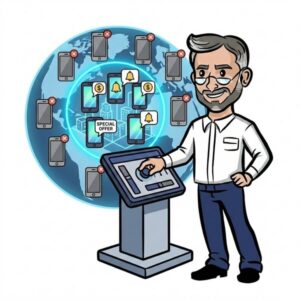
Exit Trigger: When a device crosses out of the geofence boundary. This can be used for post-visit surveys, loyalty reminders, or providing directions to another location.
Dwell Time Trigger: When a device remains within the geofence boundary for a specified duration (e.g., 5 minutes, 15 minutes). This signal is particularly powerful as it suggests higher engagement or intent. Targeting someone who has spent 20 minutes in a car dealership is much more valuable than someone who just drove past.
These triggers are sent back to the geofencing platform, which then initiates the pre-configured action, such as sending a push notification, triggering a mobile display ad, logging an event for analytics, or sending a data point to a CRM.
Role of mobile apps and background location services (simplified explanation).
For geofencing to work effectively for individual users, their mobile device needs to be actively reporting its location. This typically requires the user to have a relevant mobile app installed (your brand’s app, a partner app, or another app utilizing location services) and to have explicitly granted permission for that app to access their location, often specifically in the background.
Background location services allow the app to monitor the device’s position even when the app isn’t actively open on the screen. This is essential for triggering geofence actions without the user needing to be actively engaged with the app at the precise moment they cross a boundary. Platforms are designed to use location services efficiently to minimize battery drain, often leveraging less precise (and less power-hungry) methods until a boundary is neared.
Integrating geofencing data with marketing platforms and customer data.
The strategic value of geofencing data multiplies when integrated with other marketing technology. Geofencing platforms can send trigger data to:
Advertising Platforms: To serve highly targeted mobile ads via real-time bidding when a user enters a geofence.
CRM Systems: To log a user’s visit to a physical location, enriching their profile with offline behavior.
Analytics Platforms: To analyze foot traffic patterns, visit frequency, dwell times, and conversion rates.
Marketing Automation Platforms: To trigger email or SMS sequences based on location-based behavior.
This integration allows marketers to build more complete customer profiles, personalize messaging across channels, and measure the true impact of digital campaigns on physical world actions – a critical step for demonstrating ROI.
Strategic Advantages of Implementing Geofencing
Implementing a geofencing marketing strategy offers distinct strategic advantages for marketing leaders looking to elevate their campaigns beyond traditional methods. These benefits directly address the need for increased relevance, efficiency, and measurable results in a competitive digital landscape. Increasing campaign relevance through hyper-local and real-time messaging.
Perhaps the most significant advantage is the ability to increase campaign relevance dramatically. By targeting users based on their precise, real-time location, you can deliver messages that are contextually appropriate for their immediate surroundings.
Imagine a user walking down a specific shopping street. Instead of seeing a generic ad for your brand, they could receive a push notification or a mobile ad promoting a sale happening right now in your store just ahead. This hyper-local relevance reduces wasted impressions and increases the likelihood of engagement because the message directly relates to the user’s current physical context and potential intent.
Driving foot traffic and in-store visits for physical locations.
For businesses with physical locations – retail stores, restaurants, dealerships, banks, etc. – driving foot traffic is a primary objective. Geofencing is one of the most effective digital tools for influencing offline behavior. By setting up geofences around your own locations, you can engage users who are nearby with targeted offers designed to entice them to visit.
Furthermore, competitive geofencing allows you to draw fences around competitor locations. Users who are detected within a competitor’s geofence could be served ads highlighting your unique selling propositions, special offers, or closer proximity, effectively attempting to divert potential customers towards your business. This offers a direct strategy for winning market share in competitive physical spaces.
Enhancing customer engagement with timely, context-aware interactions.
Geofencing enables marketing interactions that feel less like interruption and more like helpful, timely information. When a user enters a location relevant to your brand or an action you want them to take, a contextual message is far more likely to resonate.
Consider a user entering a large event venue. A timely push notification from the event app reminding them of the schedule or pointing them to the nearest concession stand is highly engaging and adds value to their experience. For a retailer, notifying a loyalty program member about available points as they enter the store enhances their shopping experience. These context-aware interactions foster positive brand perception and deeper engagement throughout the customer journey.
Improving conversion rates and ROI through precise targeting.
Precision targeting inherently leads to improved campaign performance metrics, including conversion rates and ROI. By focusing your ad spend and messaging efforts on users who are physically located where they are most likely to convert (e.g., near your store, at a relevant event, near a product display), you increase the efficiency of your campaigns.
Serving an ad for a specific product to someone browsing that product in a store (via geofencing and potentially beacons) is far more likely to result in a purchase than showing the same ad to someone miles away. This targeted efficiency means lower costs per conversion and a higher overall return on investment for your marketing spend. Statistics have consistently shown that location-targeted ads perform significantly better than non-targeted mobile ads in terms of click-through and conversion rates.
Gaining a competitive advantage through sophisticated location intelligence.
Implementing advanced geofencing strategies can provide a significant competitive advantage. While competitors may still rely on broader geotargeting, your brand can engage customers at a micro-level, influencing decisions at the critical moment of proximity.
This isn’t just about serving ads; it’s about building a sophisticated understanding of location-based behavior. By analyzing patterns of entry, exit, and dwell time across various geofenced locations (your stores, competitor stores, relevant public spaces), you gain unique insights into customer movement, preferences, and the effectiveness of different physical locations or events.
Gathering actionable insights on customer behavior and location patterns.
Beyond triggering immediate actions, geofencing platforms provide rich data for analysis. By tracking aggregated, anonymized patterns within and around geofences, marketing leaders can gain valuable insights into:
Popular routes customers take to reach your store.
How long customers typically spend in different areas.
The times of day or week that see the most foot traffic.
The effectiveness of competitive geofencing in drawing users away from competitors.
The correlation between digital ad exposure via geofencing and actual physical visits (attribution).
These data analytics can inform broader business decisions, from staffing levels and store layouts to site selection for new locations and refining overall digital marketing and local marketing strategies.
Diverse Geofencing Use Cases: Real-World Applications for Marketing Leaders
The versatility of geofencing technology means it can be applied across a wide range of industries and marketing objectives. Exploring specific geofencing use cases helps marketing leaders visualize the practical application and potential ROI for their own businesses.
Retail and QSR (Quick Service Restaurants) Geofencing
Retail and QSR businesses are perhaps the most immediate beneficiaries of geofencing, given their direct reliance on physical locations and foot traffic.
Driving traffic to specific store locations: Setting geofences around individual stores allows for timely delivery of mobile coupons, promotions, or loyalty reminders to users detected nearby, directly incentivizing visits.
Promoting in-store offers or new products upon customer arrival: As a customer enters the geofence around a store, a push notification highlighting a specific aisle sale or a newly launched product can enhance their shopping experience and drive impulse purchases.
Triggering loyalty program reminders: Reminding loyalty members to scan their app or card as they enter helps ensure they earn points and reinforces their connection with the brand.
Competitive geofencing: Targeting customers near competitor locations: Drawing geofences around competitors’ stores allows you to serve ads to their potential customers, attempting to persuade them to visit your location instead, perhaps with a compelling offer or convenience message.
Measuring in-store attribution from digital campaigns: By tracking which users exposed to a geofencing ad subsequently enter a geofenced store, businesses can directly measure the impact of their digital spend on offline visits, providing critical data for ROI calculation.
Event and Entertainment Geofencing
Events, from large conferences and music festivals to local fairs and sports games, offer unique opportunities for contextual marketing via geofencing.
Targeting attendees at conferences, concerts, or festivals: Geofences around event perimeters can be used to welcome attendees, provide essential information, or direct them to registration or specific stages/areas.
Delivering real-time updates, schedules, or special offers during an event: As users move around the event space (within specific geofenced zones), timely notifications about session changes, performer timings, or flash merchandise sales enhance their experience and drive engagement.
Promoting nearby concessions or merchandise booths: Geofences around specific vendor areas can trigger messages promoting food, drinks, or merchandise when attendees are in close proximity, increasing sales opportunities.
Engaging potential attendees around event venues prior to start: Drawing larger geofences around the surrounding neighborhood in the days leading up to an event can target people who live or work nearby with last-minute ticket offers or event highlights.
Service-Based Businesses and Professional Services Geofencing
While less reliant on impulse foot traffic than retail, service-based businesses can still leverage geofencing for targeted outreach and lead generation.
Targeting relevant demographics around service areas: For businesses like real estate, healthcare providers, or home services, geofencing specific neighborhoods or districts allows for targeted advertising to potential clients within their service radius.
Promoting local branches or representatives: For companies with multiple locations (e.g., banks, insurance agencies), geofencing around each branch can promote local services or introduce the local team to nearby prospects.
Engaging potential clients visiting competitor offices or related businesses: A law firm could geofence around competitor offices or courthouses. A wealth management service could geofence around other financial institutions or business centers, targeting individuals likely to be seeking such services.
Using geofencing for B2B scenarios (e.g., around business parks): Geofencing around office buildings or business parks allows B2B service providers (IT services, consulting, corporate catering) to target employees or visitors during business hours with relevant messaging.
Other Innovative Geofencing Use Cases
The applications extend far beyond the most common examples, limited only by creativity and data availability.
Real Estate: Targeting potential buyers near properties or open houses with information about the listing, tour schedules, or neighborhood highlights. Geofencing around a specific property during an open house can trigger notifications to visitors with digital flyers or agent contact info.
Automotive: Driving service appointments or new car inquiries. Geofencing around dealerships can offer service reminders to existing customers or financing specials to potential buyers detected nearby. Geofencing around auto repair shops or competitor dealerships can also be effective.
Tourism: Engaging visitors at key landmarks or tourist attractions. Geofences can trigger historical facts, promotional offers for nearby restaurants or shops, or guided tour information.
Educational Institutions: Targeting prospective students or parents near campuses or college fairs with information about admissions, specific programs, or campus visit opportunities. Geofencing around competitor campuses can highlight your institution’s unique advantages.
These diverse examples illustrate how a thoughtful geofencing marketing strategy can be tailored to meet specific business objectives across different sectors, leveraging the power of precise location and timing.
Developing a Comprehensive Geofencing Marketing Strategy
Implementing geofencing isn’t just about setting up fences; it requires a strategic approach aligned with overall marketing and business goals. A comprehensive geofencing marketing strategy involves careful planning across objectives, targeting, technology, and messaging.
Defining Clear Objectives and Target Audiences
The first step in any successful marketing strategy is defining what you want to achieve. For geofencing, this means aligning its unique capabilities with your broader goals.
Aligning geofencing goals with overall marketing and business objectives (e.g., increasing store visits, boosting engagement): Are you trying to increase foot traffic by X%? Boost in-store conversion for a specific product? Drive attendance at an event? Enhance customer loyalty? Your geofencing strategy should have specific, measurable goals that contribute to these larger objectives.
Identifying key customer segments and behaviors to target: Who are you trying to reach with geofencing? Is it existing loyalty members? New prospects near a store? Attendees at a specific event? Furthermore, what behavior are you trying to trigger or understand? Entry into a competitor store? Dwell time at a specific location? Identifying these segments and desired behaviors will dictate where and how you set up your geofences and what messaging you use.
Mapping geofencing strategies to specific stages of the customer journey: Geofencing can influence different stages. Awareness (targeting around competitor locations), Consideration (targeting users researching nearby), Decision (targeting users near your store with an offer), Loyalty (reminding existing customers of benefits upon arrival). Understand where geofencing fits into your specific customer paths.
Selecting and Defining Geofences
Once objectives and audiences are clear, the practical step of defining the geofences begins.

Determining the appropriate size and shape of geofenced areas (store radius, competitor location, specific event zone): The size and shape of your geofences are critical. A fence too large around a store might trigger irrelevant messages. A fence too small around an event might miss attendees. Consider the typical behavior and speed of movement in the area. Circles work well for single points like stores, while polygons are necessary for irregular shapes like parks, malls, or competitor locations.
Considerations for accuracy and density of target locations: How precise does your targeting need to be? Are you targeting a single building, or a block? Do you have many locations to geofence? The number and density of geofences will impact the technical platform needed and the complexity of management. High-density areas might require smaller, more precise fences.
Strategies for dynamic vs. static geofences: Most geofences are static, drawn around fixed locations. However, some platforms allow for dynamic geofences based on mobile routes or real-time events (though this is more complex). For most marketing purposes, static geofences around points of interest are sufficient.
Choosing the Right Geofencing Technology Platform
The technology platform you choose is foundational to your geofencing capabilities.
Evaluating platform capabilities (precision, scale, analytics, integration): Does the platform offer the necessary precision using multiple location technologies? Can it handle the number of geofences required for your business scale? What kind of analytics and reporting does it provide on location data and campaign performance? Crucially, how well does it integrate with your existing marketing stack (CRM, DSPs, analytics)?
Understanding location data sources and quality: Where does the platform get its location data? Is it relying solely on background app data, or does it incorporate other sources? The quality and reliability of the underlying location data directly impact the accuracy and effectiveness of your geofencing triggers.
Considering features like dwell time tracking, frequency capping, and attribution modeling: Advanced features like measuring how long a user stays within a geofence (dwell time), limiting how often a user is targeted within a specific timeframe (frequency capping), and robust models for attributing offline visits to online exposure are essential for optimizing campaigns and measuring ROI.
Crafting Compelling Geofencing Creative and Messaging
Even with precise targeting, your message needs to be compelling and relevant to the user’s immediate context.
Developing contextually relevant calls-to-action (CTAs): Your CTA should make sense given the user’s location. “Visit our store just around the corner!” is far more effective when they are, in fact, just around the corner, compared to a generic “Shop Now.”
Leveraging personalized messaging based on location and user profile: Combine location data with what you know about the user (e.g., loyalty status, past purchases, stated preferences). A loyalty member near your coffee shop could receive an offer for a free upgrade, while a new prospect gets a first-time visitor discount.
Optimizing creative formats for mobile devices (push notifications, mobile display ads, SMS): Geofencing triggers happen on mobile devices. Your creative must be optimized for mobile screens and typical mobile interactions. Push notifications are direct and timely, mobile display ads offer visual impact within apps or mobile web, and SMS can be used for simple, direct messages (with appropriate consent).
Implementing and Managing Geofencing Campaigns
Once the strategy is defined and the technology is selected, the focus shifts to execution and ongoing management. Successful implementation requires careful setup and integration into existing workflows.
Setting up campaigns within chosen platforms: This involves defining the specific geofences, linking them to target audience segments (based on location entry/exit/dwell time triggers combined with other demographic or behavioral data), and associating the geofence triggers with specific creative assets and actions (e.g., serve Ad Set A upon entry into Geofence X for Audience Y).
Integrating with existing marketing stacks (CRM, analytics, ad platforms): Ensure seamless data flow between your geofencing platform and other essential tools. This allows location-triggered events to enrich CRM profiles, enables granular performance analysis in your analytics platform, and facilitates real-time bidding on mobile ad exchanges based on geofence triggers.
Managing audience segmentation and targeting parameters: Continuously refine your audience segments within the geofencing platform. Based on performance data, you might narrow or expand target demographics, adjust dwell time requirements, or modify the specific locations you are targeting with different messages.
Ensuring campaign delivery and monitoring performance in real-time: Active monitoring is crucial. Check that triggers are firing correctly, ads are being served to the intended audience within the geofences, and messaging is rendering properly on mobile devices. Real-time dashboards are essential for identifying issues or opportunities quickly.
Scaling geofencing efforts across multiple locations or campaigns: As you see success, plan how to scale your geofencing strategy. This might involve rolling out campaigns to more store locations, creating more granular geofences (e.g., around departments within a store), or launching simultaneous campaigns targeting different events or competitor sets. A robust platform with good management tools is key to handling complexity at scale.
Addressing Challenges and Critical Considerations
While the benefits of geofencing are significant, marketing leaders must also navigate potential challenges, particularly those related to data privacy, technical accuracy, and measurement. Proactively addressing these aspects is essential for building trust and ensuring sustainable success.
Data Privacy, Compliance, and Ethical Geofencing
Privacy is not merely a technical or legal hurdle; it’s a fundamental ethical consideration and a cornerstone of building trust with your audience. Location data is inherently sensitive, and misuse can severely damage brand reputation.
Understanding the importance of user consent and opt-in mechanisms: Geofencing targeting of individuals requires explicit consent. Users must clearly understand that their location data is being collected and how it will be used, and they must have an easy way to opt-out. This is non-negotiable. Relying solely on platform terms of service is often insufficient; your brand’s approach to consent must be clear and transparent.
Navigating regulations like GDPR, CCPA, and other regional privacy laws: Global and regional privacy regulations (such as Europe’s GDPR, California’s CCPA, and emerging laws elsewhere) place strict requirements on the collection, processing, and use of personal data, including location data. Marketing leaders must ensure their geofencing technology and practices are fully compliant with all applicable laws. This requires legal consultation and a deep understanding of the regulatory landscape in the markets you operate.
Ensuring transparency with users about location data usage: Clearly communicate why you are requesting location access and how enabling it benefits the user (e.g., “Enable location to get timely offers when you’re near our store”). Burying this information in privacy policies is not enough; proactive, user-friendly communication builds trust.
Strategies for anonymizing or aggregating location data: For analytics and reporting purposes, individual user location data can often be anonymized or aggregated. Instead of tracking “User X entered Geofence Y,” you track “Z devices entered Geofence Y between Time A and Time B.” This reduces privacy risk while still providing valuable insights into traffic patterns.
Building trust through responsible data handling practices: Your brand’s commitment to data privacy must be evident in all practices. Secure data storage, limited access, and clear internal policies on location data usage are crucial. Demonstrating respect for user privacy builds long-term trust and encourages continued opt-in.
Avoiding intrusive or irrelevant targeting: Just because you can target someone based on location doesn’t mean you always should. Avoid targeting sensitive locations (e.g., medical clinics, places of worship) and ensure your messaging is truly relevant to the user’s likely intent or needs in that location. Overly aggressive or irrelevant geofencing can feel intrusive and lead users to revoke location permissions.
Data Quality and Accuracy
The effectiveness of geofencing hinges on the quality and accuracy of the location data received from devices.
The impact of location data precision on campaign effectiveness: If location data is inaccurate, your geofences will misfire. You might target users outside the intended area or miss users who are correctly within the boundary. Imprecise data leads to wasted spend and poor user experience.
Sources of inaccuracy and how to mitigate them: Inaccuracy can arise from factors like poor GPS signal (indoors, urban canyons), limited Wi-Fi or cellular coverage, device settings, or user-side issues. Using platforms that intelligently combine multiple location technologies, allowing for configurable geofence sizes (larger fences are less susceptible to minor inaccuracies), and potentially incorporating beacon data for high-precision zones can help mitigate these issues.
Validating location data and user presence within geofences: Robust platforms include mechanisms to validate location signals and filter out unreliable data. They may also use algorithms to estimate dwell time more accurately even with fluctuating signal quality.
Technical Implementation Hurdles
Deploying and maintaining geofencing campaigns involves technical considerations.
Battery drain considerations for users: Historically, constant location monitoring could significantly drain device batteries. Modern geofencing SDKs and platforms are optimized to minimize battery impact by using less power-hungry location methods when high precision isn’t immediately needed (e.g., using cellular triangulation until a user nears a geofence boundary). However, it remains a user consideration that can impact opt-in rates.
Background location service reliability: Mobile operating systems manage background processes and location access to conserve resources. Ensuring that your app or the platform’s SDK reliably maintains background location access requires careful technical implementation and adherence to platform best practices.
Ensuring cross-device and cross-platform functionality: Campaigns need to work consistently across different device manufacturers and operating systems (iOS and Android), which have different approaches to location permissions and background processes.
Measurement and Attribution Complexity
Accurately measuring the impact of geofencing campaigns, especially on offline actions, presents a unique challenge.
Challenges in accurately attributing online actions or offline visits to geofencing campaigns: How do you definitively prove that a user visited your store because they saw a geofencing ad, rather than for another reason? Correlation is easier to establish than causation.
Developing robust measurement frameworks and KPIs: Requires defining clear KPIs upfront (e.g., Foot Traffic Lift: Increase in visits among the exposed group vs. a control group). Using control groups (audiences in the same area who weren’t targeted) is crucial for isolating the geofencing effect.
Implementing attribution models that account for location-based touchpoints: Attribution models need to capture the geofence trigger and subsequent physical visit as a touchpoint in the conversion path. This requires integrating geofencing data with sales data or in-store tracking mechanisms (like Wi-Fi triangulation or loyalty app check-ins).
Measuring Geofencing Campaign Performance and ROI
Measuring the success of your geofencing campaigns is vital for optimization, demonstrating value, and scaling your efforts. It requires defining relevant metrics and establishing robust attribution models.
Defining Key Performance Indicators (KPIs) for geofencing (e.g., foot traffic uplift, conversion rates, cost per visit).
Traditional digital marketing KPIs like clicks and impressions are useful but insufficient for geofencing, which often aims for offline outcomes. Key geofencing KPIs include:
Foot Traffic Lift: The percentage increase in physical visits to a targeted location among the audience exposed to the geofencing campaign compared to a control group. This is a primary indicator for retail and QSR.
Visit Rate/Conversion Rate: The percentage of users who received a geofence trigger (e.g., saw an ad or got a notification) and subsequently visited the physical location within a defined timeframe.
Dwell Time: The average or total time users spend within a geofenced area after a trigger. Useful for events, malls, or large stores to understand engagement levels.
Cost Per Visit (CPV): The total cost of the geofencing campaign divided by the number of attributed physical visits. A critical metric for assessing efficiency.
Sales Lift: The increase in sales among the exposed group vs. the control group, providing a more direct measure of revenue impact. Requires integrating geofencing data with sales transaction data.
Engagement Rate: For app-based triggers, this could be the open rate of push notifications or click-through rate on in-app messages triggered by geofences.
Implementing attribution models that account for location-based touchpoints.
Effective attribution is key to proving ROI. Location attribution models link exposure to a geofencing campaign (an ad impression or notification receipt) to a subsequent physical visit or in-store action. This often involves:
Exposure Tracking: Recording which specific users (anonymously, via device IDs) were shown a geofence-triggered ad or received a push notification.
Visit Tracking: Detecting when those specific users’ devices subsequently enter the geofenced physical location (often through the same app/platform used for triggering).
Look-back Windows: Defining a reasonable time period after exposure within which a visit is considered attributable to the campaign (e.g., a visit within 7 days of seeing the ad).
Control Groups: Comparing the visit rate of the exposed group to a similar control group that was not exposed to the geofencing campaign to isolate the incremental lift caused by the campaign.
Advanced platforms offer sophisticated location attribution models that can help provide confidence in these measurements.
Analyzing geofence-specific data alongside other campaign metrics.
Geofencing data should not live in isolation. Integrate its performance metrics with your broader marketing dashboard. Compare the CPV of geofencing campaigns to the cost per lead from search or social media. Analyze how geofencing influences other digital behaviors, like website visits or app usage. Understanding geofencing’s role in the cross-channel customer journey provides a more complete picture of its strategic value.
Calculating Return on Investment (ROI) for geofencing initiatives.
Calculating ROI requires quantifying the revenue generated or cost saved by the geofencing campaign relative to its cost.
ROI = ((Revenue Generated by Geofencing – Cost of Geofencing Campaign) / Cost of Geofencing Campaign) * 100%
Measuring “Revenue Generated” can be complex but often involves:
Using sales lift data from exposed vs. control groups.
Assigning an average transaction value to attributed visits.
Tracking redemptions of location-specific coupons or offers.
Accurate ROI calculation proves the business impact of your geofencing strategy and justifies continued investment.
Using data analytics to optimize geofences, messaging, and targeting over time.
Performance data should drive continuous optimization.
Analyze which specific geofences (around which locations or competitors) are performing best.
Test different messaging and creative variations triggered by the same geofence to see what resonates most.
Refine target audiences based on which segments are most responsive to location-based targeting.
Adjust bid strategies or budget allocation based on the CPV and ROI of different geofences or campaign segments.
Leveraging these data analytics allows you to refine your geofencing marketing strategy iteratively, maximizing effectiveness and improving return on investment over time.
Why Geofencing is Becoming Essential for Hyper-Local Engagement
In an era where consumers expect personalized experiences delivered in the moment, geofencing has evolved from a niche capability to an essential tool for achieving hyper-local engagement. It allows brands to connect with individuals based on their real-world context, influencing behavior precisely when and where it matters most.
For marketing leaders, embracing geofencing means unlocking the potential of location data to drive tangible business outcomes like increased foot traffic, higher conversion rates, and enhanced customer loyalty. While it presents challenges around data privacy and technical implementation, the strategic advantages of precise, real-time targeting far outweigh the hurdles when approached thoughtfully and responsibly.
Geofencing isn’t just about drawing virtual lines on a map; it’s about understanding and engaging with the customer journey in physical space. By developing a clear geofencing marketing strategy aligned with your objectives, carefully selecting technology, prioritizing user privacy and consent, and rigorously measuring performance, you can leverage geofencing to gain a significant competitive advantage and deliver truly relevant, impactful marketing experiences.
Ready to explore how precise location targeting can transform your campaigns?
Explore our solutions for location-based marketing and sales.
Further Reading
- Fitness Marketing Agency: Fueling Growth for Your Business
- Shifting Fintech Landscape: Implications for Sales and Marketing Leaders
- The Funnel Building Skills Your Team Needs
- Breaking Down Silos: Building a Unified Bank Sales & Marketing Engine for Accelerated Growth
- How Sales Leaders Can Master Gatekeeper Navigation