
Table of Contents
The Strategic Imperative: Why Lead Generation is Paramount for Sales and Marketing Leaders
Beyond Tactics: Defining Strategic, Scalable Lead Generation
Building the Engine: Core Frameworks for B2B Lead Generation
Fueling the Engine: Aligning Sales and Marketing for Seamless Lead Flow
Knowing Your Velocity: Mastering Lead Generation Metrics and Measurement
Quality Over Quantity: Strategies for Improving Lead Quality
The Feedback Loop: Continuous Optimization and Adaptation
Further Reading
As a Strategic Advisor to Sales and Marketing Leaders, I’ve seen firsthand the immense pressure you face. Your mandate is clear: drive revenue growth. And the engine powering that growth? Effective lead generation. Yet, for many B2B organizations, lead generation remains a frustratingly inconsistent, inefficient, and often siloed endeavor.
Consider this: a recent study by HubSpot found that generating traffic and leads is the top challenge reported by marketers, and only 26% of marketers say their lead generation efforts are “highly effective.” This isn’t just a marketing problem; it’s a fundamental business challenge directly impacting your sales pipeline, revenue predictability, and ultimately, your company’s bottom line.
Generating leads isn’t merely about running campaigns or acquiring lists. For leaders focused on sustainable growth, it’s a strategic imperative that demands robust frameworks, predictable processes, and deep alignment across the revenue team. This article isn’t about the latest lead generation tactic; it’s about building the strategic engine that delivers consistent, high-quality leads and empowers your teams to convert them efficiently.
The Strategic Imperative: Why Lead Generation is Paramount for Sales and Marketing Leaders
In today’s competitive landscape, a consistent and predictable flow of qualified leads isn’t a luxury – it’s the bedrock of sustained business growth. Without it, sales pipelines become erratic, revenue forecasts turn into educated guesses, and investments in sales teams yield diminishing returns.
Sales and marketing leaders are acutely aware of this, yet face persistent challenges:
Inconsistent Pipeline Fill: One month the pipeline is full, the next it’s a barren wasteland, making forecasting and resource allocation nearly impossible.
Poor ROI Visibility: Investments in lead generation activities don’t always translate into measurable, profitable customer acquisition, leading to questions about marketing’s true impact.
Lack of Alignment: Disconnects between marketing’s lead definitions and sales’ needs result in wasted effort, friction, and missed opportunities.
Difficulty Scaling: Ad-hoc campaigns don’t build the repeatable processes needed to increase lead volume and quality as the business grows.
These challenges underscore why lead generation must be elevated from a tactical activity handled solely by marketing specialists to a core strategic function overseen and optimized by leadership. It requires a holistic view of the entire lead-to-customer journey.
Beyond Tactics: Defining Strategic, Scalable Lead Generation
Many organizations get stuck in the “tactics trap” – chasing the latest social media trend, buying lists, or running one-off email blasts. While tactics have their place, they are not a strategy. Strategic lead generation, on the other hand, is about building a predictable, repeatable, and scalable system designed to attract, engage, and qualify potential customers consistently over time.
For sales and marketing leaders, this means shifting focus from individual campaign performance in isolation to the health and efficiency of the entire lead generation process. It’s about designing systems that can be optimized and scaled, ensuring that increased investment yields proportionally increased (or better quality) results.
A strategic approach recognizes that lead generation is intertwined with market positioning, sales processes, customer success, and technology infrastructure. It supports long-term business goals by creating a reliable engine for revenue predictability and growth, rather than relying on unpredictable bursts of activity. The leader’s role becomes that of an architect and engineer, building and refining robust systems, not just supervising individual tasks.
Building the Engine: Core Frameworks for B2B Lead Generation
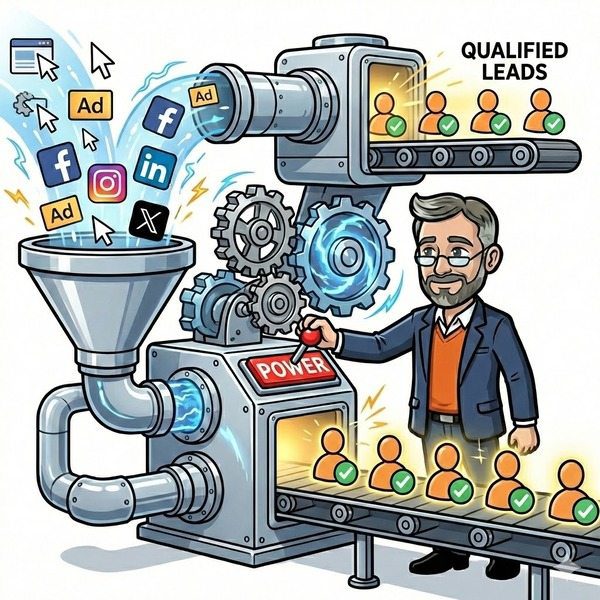
Effective B2B lead generation strategies are built upon well-defined frameworks. These aren’t rigid boxes, but rather interconnected components that work together to create a powerful lead-generating machine.
Understanding the Foundation: Ideal Customer Profile (ICP) and Buyer Personas
The most common mistake in B2B lead generation is targeting too broadly. Strategic lead generation begins with absolute clarity on who you are trying to reach.
Ideal Customer Profile (ICP): This is a profile of the type of company that receives the most value from your solution and provides the most value in return (high lifetime value, low churn). It defines firmographic characteristics (industry, company size, revenue, location) and potentially technographic or psychographic factors.
Buyer Personas: Within your ICP, these are semi-fictional representations of the specific individuals who make buying decisions or influence them. They delve into roles, responsibilities, goals, challenges, pain points, motivations, and communication preferences.
The strategic importance of clearly defined ICPs and buyer personas for B2B lead generation strategies cannot be overstated. They are the compass that guides every subsequent decision: which channels to use, what messaging will resonate, what content to create, and how to qualify leads effectively. Wasted lead generation spend is often directly traceable to a fuzzy understanding of the target audience. Leaders must ensure these profiles are not static documents but living guides, regularly reviewed and refined based on market shifts and sales feedback.
Developing and refining these profiles typically involves data analysis (CRM data on best customers), interviews with sales and customer success, market research, and conversations with actual prospects and customers.
Choosing the Right Channels and B2B Lead Generation Strategies
With your target audience defined, the next strategic step is identifying the most effective channels and B2B lead generation strategies to reach them where they consume information and make decisions. This is not a matter of trying everything, but strategically selecting the channels that offer the best potential ROI based on your ICP and buyer personas.
Key B2B channels include:
Content Marketing: Creating valuable, relevant content (blog posts, whitepapers, webinars, case studies) to attract and engage your target audience.
Search Engine Optimization (SEO): Optimizing your online presence to rank higher in search results for terms your ICP uses.
Paid Search (PPC): Running targeted advertising campaigns on search engines.
Social Media Marketing: Engaging with prospects on relevant platforms like LinkedIn, Twitter, etc.
Email Marketing: Building relationships and nurturing leads through targeted email campaigns.
Events (Online & Offline): Participating in or hosting events to connect with prospects.
Partnerships: Collaborating with complementary businesses to reach new audiences.
Outbound Sales/Prospecting: Direct outreach through calls, emails, and social selling.
A strategic framework balances inbound marketing (attracting leads through valuable content and experiences) and outbound marketing (proactively reaching out to potential leads). The optimal mix depends on your industry, ICP, resources, and sales cycle. Leaders must evaluate channel performance based on not just lead volume, but lead quality and conversion rates further down the funnel.
Crafting Compelling Offers and Content (Leveraging Lead Magnets)
Once you’ve captured a prospect’s attention through your chosen channels, you need a compelling reason for them to identify themselves. This is where valuable content and offers, often referred to as lead magnets, come into play.
Lead magnets are pieces of valuable content or resources offered in exchange for contact information. Examples include:
Ebooks and whitepapers
Webinars and workshops
Templates and checklists
Free trials or demos
Case studies and research reports
Infographics and presentations
The strategic role of lead magnets and compelling content is to attract prospects by addressing their pain points, educating them, and demonstrating your expertise at different stages of the sales funnel. Content should be mapped to the buyer’s journey – awareness, consideration, decision – providing relevant information as the prospect moves closer to a purchasing decision. Effective content not only generates leads but also begins to qualify them and build trust. Leaders need to ensure content creation aligns with persona needs and has clear calls-to-action.
Implementing the Technology Stack (CRM, Marketing Automation)
You cannot manage a strategic, scalable lead generation process manually. A robust technology stack is essential. At the core of this stack for B2B organizations are CRM (Customer Relationship Management) and Marketing Automation systems.
CRM: This is the central database for all lead and customer information. It’s strategically vital for tracking interactions, managing relationships, and providing visibility into the sales pipeline. A well-utilized CRM allows leaders to see the status of every lead and understand historical engagement.
Marketing Automation: This technology enables the automation of repetitive marketing tasks such as email sequences, social media posting, and lead nurturing. Strategically, it allows for personalized communication at scale, segmentation of leads based on behavior, and setting up automated workflows for lead qualification and handoff.
Integrating your CRM and Marketing Automation systems is crucial for a unified view of the lead journey. This integration allows marketing activities to be tracked against sales outcomes, providing the data needed for accurate lead generation metrics and performance analysis. Leaders must invest in the right technology and, critically, ensure their teams are trained and consistently using these tools to realize their strategic value.
Fueling the Engine: Aligning Sales and Marketing for Seamless Lead Flow
Even the most sophisticated B2B lead generation strategies will fail if sales and marketing are not tightly aligned. Misalignment leads to finger-pointing, dropped leads, and a disjointed buyer experience. Strategic alignment is not optional; it’s foundational to revenue success.
Leaders must champion and enforce deep collaboration between sales and marketing teams. This starts with defining shared revenue goals and agreeing on shared responsibilities throughout the funnel.
Key components of strategic alignment include:
Shared Definitions: Establishing clear, agreed-upon definitions for different lead stages, particularly MQLs (Marketing Qualified Leads) and SQLs (Sales Qualified Leads). An MQL is a lead deemed ready for sales engagement by marketing based on specific criteria (e.g., lead score, actions taken). An SQL is a lead that sales has accepted as qualified and ready for active pursuit. Lack of clarity here is a primary source of friction.
Service Level Agreements (SLAs): Formal agreements between sales and marketing that define expectations. Marketing commits to delivering a certain volume and quality of MQLs; sales commits to following up on those MQLs within a specified timeframe and reporting back on the outcome. SLAs create accountability and predictability.
Joint Planning and Review: Regular joint meetings between sales and marketing leadership and teams to review pipeline, discuss lead quality, analyze performance data, and plan future campaigns together. This fosters a shared understanding of challenges and opportunities.
Communication and Collaboration Platforms: Using shared tools and processes to facilitate communication about specific leads, campaign performance, and market insights.
Sales Enablement: Marketing plays a key role in providing sales with the content, tools, and training they need for effective lead follow-up and conversion. This sales enablement is a critical link in the lead generation chain.
By fostering a culture of collaboration and establishing clear processes and definitions, leaders ensure that the leads generated by marketing are efficiently and effectively worked by sales, maximizing conversion rates and ROI.
Knowing Your Velocity: Mastering Lead Generation Metrics and Measurement
What gets measured gets managed. For sales and marketing leaders, establishing robust lead generation metrics is non-negotiable for understanding performance, identifying bottlenecks, justifying investment, and driving continuous improvement. Moving beyond vanity metrics (like website traffic volume without context) to actionable performance indicators is a strategic necessity.
Establishing key performance indicators (KPIs) aligned with overall business objectives is the starting point. These KPIs should measure both the efficiency and effectiveness of your lead generation efforts.
Core Lead Generation Metrics
While many metrics exist, leaders should focus on those that provide insights into the health and performance of the lead generation engine and its contribution to revenue:
Volume Metrics:
Total Leads Generated (by channel, campaign)
Number of MQLs Generated
Number of SQLs Generated
Cost Metrics:
Cost Per Lead (CPL): Total cost of lead generation efforts / Total number of leads.
Cost Per MQL/SQL: More valuable metrics showing the cost of acquiring a qualified lead.
Customer Acquisition Cost (CAC): Total sales and marketing costs to acquire a customer. While broader than just lead generation, it’s the ultimate measure of efficiency.
Conversion Rates:
Lead-to-MQL Conversion Rate
MQL-to-SQL Conversion Rate
SQL-to-Opportunity Conversion Rate
Opportunity-to-Win (Close) Rate
Overall Lead-to-Customer Conversion Rate
Velocity Metrics:
Average time for a lead to move from one stage to the next (e.g., Lead to MQL, MQL to SQL). This indicates process efficiency.
ROI Calculation: Measuring the revenue generated by leads from specific campaigns or channels relative to their cost.
These metrics provide a comprehensive view of the lead funnel’s performance, highlighting where leads are dropping off or getting stuck.
Implementing Reporting and Analysis
Collecting data is only the first step. Leaders need to implement reporting structures and analysis processes that provide actionable insights.
Setting up clear dashboards that visualize key lead generation metrics allows leaders to quickly assess performance. Regular analysis involves digging deeper:
Analyzing conversion rates by channel, campaign, or lead source to identify what’s working and what’s not.
Identifying bottlenecks in the funnel (e.g., a low MQL-to-SQL conversion rate might indicate poor lead quality or a sales follow-up issue).
Using cost metrics to evaluate channel efficiency and allocate budget strategically.
Analyzing velocity to understand sales cycle length and identify areas for acceleration.
Data-driven insights allow leaders to move beyond gut feeling, justify investments in successful strategies, and make informed decisions about where to optimize the lead generation process for maximum impact.
Quality Over Quantity: Strategies for Improving Lead Quality
Generating a high volume of leads is useless if they don’t convert into paying customers. A major challenge for sales teams is spending time on low-quality leads. For leaders, the focus must be on how to improve lead quality systematically.
Improving lead quality starts with attracting the right prospects, as defined by your ICP and buyer personas. But it also involves processes for evaluating and nurturing leads before they are passed to sales.
Implementing Lead Scoring Frameworks
Lead scoring is a strategic framework used to rank prospects based on their perceived value and readiness to buy. It assigns points based on demographic/firmographic information (e.g., company size, job title) and behavioral data (e.g., website visits, content downloads, email opens).
Developing a lead scoring model requires collaboration between sales and marketing to agree on what constitutes a “sales-ready” lead. A strategically implemented scoring model allows marketing to prioritize follow-up for the hottest leads and helps sales focus their efforts on prospects most likely to convert. Regularly reviewing and refining lead scoring criteria based on actual sales outcomes and feedback is crucial for its effectiveness.
Effective Lead Nurturing Strategies
Not all leads are ready to buy immediately. Many require nurturing – building a relationship and providing value over time until they are sales-ready. Lead nurturing is a critical component of how to improve lead quality.
Strategic lead nurturing involves designing multi-channel sequences (email, social, retargeting) tailored to different segments and stages of the buyer’s journey. It uses personalized content to educate prospects, address their concerns, and keep your brand top-of-mind. Leveraging marketing automation is essential for executing lead nurturing campaigns efficiently at scale. Effective nurturing ensures that when leads do reach a certain lead score or exhibit buying signals, they are more engaged and better informed, significantly improving the chances of conversion when passed to sales.
Integrating Sales Feedback Loops
The sales team is on the front lines, interacting directly with leads. Their feedback is invaluable for understanding how to improve lead quality. Leaders must establish formal, consistent mechanisms for sales to provide feedback to marketing.
This can involve:
Regular meetings dedicated to lead quality review.
Structured forms or fields in the CRM for sales to rate lead quality and provide specific comments.
Analyzing conversion rates after leads are passed to sales.
Using this feedback, marketing can optimize campaigns, refine targeting, adjust messaging, and fine-tune the lead scoring model. This continuous loop ensures that marketing’s efforts are aligned with sales’ reality and constantly working towards delivering higher-quality leads that close.
The Feedback Loop: Continuous Optimization and Adaptation
Effective lead generation is not a set-it-and-forget-it process. It’s an iterative cycle of planning, execution, measurement, analysis, and optimization. Leaders must cultivate a culture of continuous improvement.
Implementing conversion rate optimization (CRO) principles across your lead generation touchpoints – website landing pages, forms, email calls-to-action – is essential. Strategic CRO involves using data and user feedback to improve the percentage of visitors who complete a desired action.
Strategies for continuous optimization include:
A/B Testing: Systematically testing variations of headlines, copy, images, calls-to-action, and form fields to identify what resonates best with your audience and drives higher conversion rates.
Regular Performance Reviews: Conducting recurring meetings between sales and marketing teams to review lead generation metrics, discuss challenges, celebrate successes, and identify areas for improvement.
Process Audits: Periodically reviewing the entire lead generation and handoff process to identify bottlenecks, inefficiencies, or points of friction.
Hypothetical Scenario Illustration: Imagine your lead generation metrics show a significant drop-off between MQLs and SQLs for leads originating from a specific content marketing campaign (e.g., a whitepaper download). Sales feedback indicates these leads often aren’t qualified or seem unaware of your solution’s core value proposition. A strategic review would analyze:
The whitepaper content itself: Is it attracting the right audience? Is the topic too broad?
The landing page: Is the messaging clear?
The lead scoring criteria for this source: Is the score threshold too low?
The nurturing sequence: Are leads being adequately educated after downloading the whitepaper but before sales contact? Based on analysis (e.g., A/B testing different landing page copy, refining the lead score trigger, adding a more in-depth follow-up email sequence using marketing automation), you might discover that adding a short video explaining the whitepaper’s key takeaway and value prop on the landing page significantly increases MQL-to-SQL conversion. This iterative process, driven by data and feedback, is the hallmark of a high-performing lead generation engine.
Finally, strategic leaders understand that the market is dynamic. B2B lead generation strategies must adapt to changes in customer behavior, competitive pressures, new technologies, and economic shifts. Regularly reviewing and adjusting your frameworks, channels, and messaging ensures your lead generation efforts remain relevant and effective over time.
Ultimately, effective lead generation is a strategic process requiring aligned sales & marketing efforts and continuous optimization, directly impacting bottom-line performance. It’s about building a resilient engine for growth.
Further Reading
- Decoding the Meaning of On-Target Earnings (OTE)
- NPS Meaning: What is Net Promoter Score and How To Measure It
- Marketing Vocabulary: Your Guide to Strategic Communication
- Essential Marketing Terms Leadership Must Know
- The Core Components of a Winning Marketing Strategy
- Marketing for Banks: Navigating Digital & Trust in Finance
- Scalable Local Marketing Frameworks
- How to Effectively Set, Monitor, and Act on Your KPIs